
Details
Artist
Styles
Screenprint // Homage to the Square by Josef Albers is a screen-print from 1971, part of his iconic series that explores the interaction of color within geometric forms. This piece presents a set of nested squares, each one varying in shades of yellow and gold. The precise arrangement of these squares creates a visual depth and an optical effect of movement or receding space. Albers' work is a study of how colors influence each other and how perception shifts with juxtaposition, inviting viewers to engage with the simplicity of form and the complexity of color relationships.
Homage to Square, 1971
form
Medium
Size
50.8 x 50.8 cm
- Inches
- Centimeters
Edition
Price
Details
Artist
Styles
Screenprint // Homage to the Square by Josef Albers is a screen-print from 1971, part of his iconic series that explores the interaction of color within geometric forms. This piece presents a set of nested squares, each one varying in shades of yellow and gold. The precise arrangement of these squares creates a visual depth and an optical effect of movement or receding space. Albers' work is a study of how colors influence each other and how perception shifts with juxtaposition, inviting viewers to engage with the simplicity of form and the complexity of color relationships.
- Recently Added
- Price (low-high )
- Price (high-low )
- Year (low-high )
- Year (high-low )
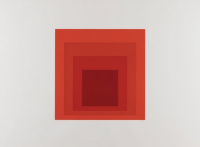
Josef Albers
JHM-I, 1973
Limited Edition Print
Screen-print
Inquire For Price
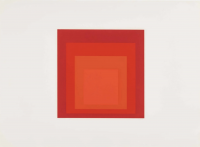
Josef Albers
JHM-II, 1973
Limited Edition Print
Screen-print
Inquire For Price
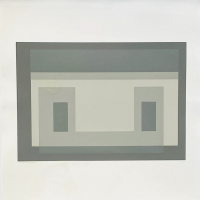
Josef Albers
Variants-III (from The Ten Variants Series), 1966
Limited Edition Print
Screen-print
Inquire For Price
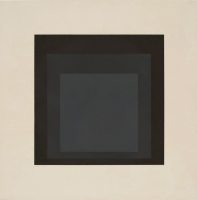
Josef Albers
Late, From Soft Edge-Hard Edge, 1965
Limited Edition Print
Screen-print
USD 10,000 - 15,000

Josef Albers
Midnight + Noon I, 1964
Limited Edition Print
Lithograph
USD 40,000 - 50,000
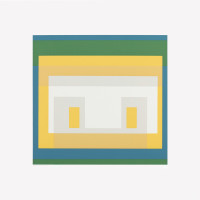
Josef Albers
Variants II, From Ten Variants, 1966
Limited Edition Print
Screen-print
USD 5,400
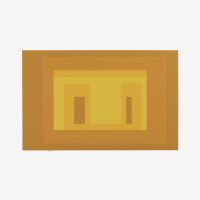
Josef Albers
Variants I, From Ten Variants, 1966
Limited Edition Print
Screen-print
USD 5,400

Josef Albers
Variants IV, From Ten Variants, 1966
Limited Edition Print
Screen-print
USD 5,400

Josef Albers
GB 2 (From Homage To The Square), 1969
Limited Edition Print
Screen-print
Currently Not Available

Josef Albers
Concord (From Dei Oberflache), 1965
Limited Edition Print
Screen-print
Currently Not Available

Josef Albers
Homage To The Square, 1970
Limited Edition Print
Screen-print
Currently Not Available
Related Artists


Related Articles

Popular, Artists, Art Movements - May 05, 2022
9 Essential Artists of the The Minimalist School
Discover 9 essential artists of the Minimalist movement, including Donald Judd and Agnes Martin. Explore their transformative impact on modern art and design. Read More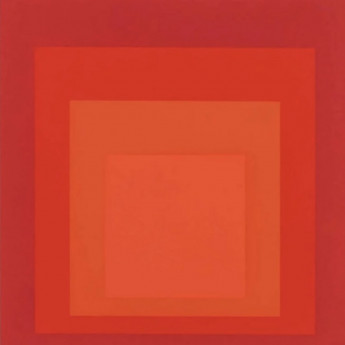

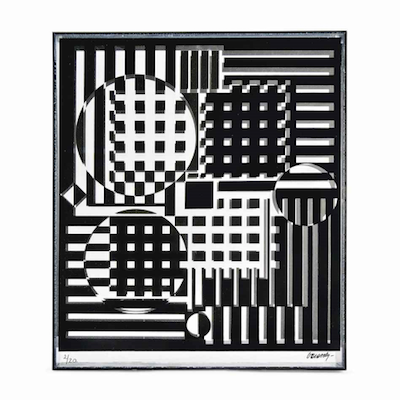
What is Op Art?
Op Art is a visual art style that uses optical illusions to create the impression of movement, vibrating patterns, flashing, or hidden images. The works are typically abstract, with many well-known pieces in black and white. The roots of Op Art can be traced back to earlier movements like Futurism, Constructivism, Dada, and Neo-Impressionism, particularly in their use of color effects and graphic design.