Details
Artist
Styles
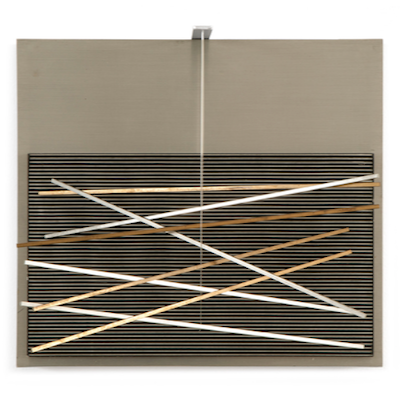
3d construction // SBST 2818 by Ludwig Wilding, created in 1986, is a 3D construction that showcases the artist’s mastery of optical and kinetic art. This piece uses precise patterns of black and white lines to create an illusion of depth and motion, drawing viewers into a mesmerizing, shifting space. The repetitive, radiating lines converge toward the center, creating a tunnel-like effect that seems to pulsate and move with the viewer’s perspective. Wilding’s work is characterized by such optical effects, engaging viewers to experience art in an interactive way, as their perception shifts with their position. This limited-edition object highlights Wilding's commitment to exploring the boundaries of visual perception.
SBST 2818, 1986
form
Medium
Size
28 x 28 X 6 cm
- Inches
- Centimeters
Edition
Price
- USD
- EUR
- GBP
Details
Artist
Styles
3d construction // SBST 2818 by Ludwig Wilding, created in 1986, is a 3D construction that showcases the artist’s mastery of optical and kinetic art. This piece uses precise patterns of black and white lines to create an illusion of depth and motion, drawing viewers into a mesmerizing, shifting space. The repetitive, radiating lines converge toward the center, creating a tunnel-like effect that seems to pulsate and move with the viewer’s perspective. Wilding’s work is characterized by such optical effects, engaging viewers to experience art in an interactive way, as their perception shifts with their position. This limited-edition object highlights Wilding's commitment to exploring the boundaries of visual perception.
- Recently Added
- Price (low-high )
- Price (high-low )
- Year (low-high )
- Year (high-low )

Ludwig Wilding
SBST 2827, 1993
Sculpture / Object
Object
EUR 1,500

Ludwig Wilding
SBST 2838, 2000
Sculpture / Object
Object
EUR 1,500

Ludwig Wilding
SBST 2823, 1993
Sculpture / Object
Object
EUR 1,500

Ludwig Wilding
SB II, 1986
Sculpture / Object
Object
EUR 1,500

Ludwig Wilding
SBST 2818, 1986
Sculpture / Object
Object
EUR 1,500

Ludwig Wilding
SBT 2835, 1998
Sculpture / Object
Object
EUR 1,500

Ludwig Wilding
SBST 2839, 2001
Limited Edition Print
Mixed Media
EUR 1,500
Related Artists


Related Articles

Popular, Collecting - July 23, 2025
Sculpture Care and Display: From Plinths to Pedestals in Your Home
Learn how to display and care for sculpture at home—from lighting tips to material care—so your art can truly shine in any space. Read More

What is kinetic art?
Kinetic art is an international movement that emerged in the 1920s and gained prominence in the 1960s, referring to art that involves both apparent and real motion. It encompasses any medium that includes movement, either relying on actual motion for its effect or being perceived as moving by the viewer. Early examples include canvas paintings designed to create optical illusions of movement. Today, kinetic art often refers to three-dimensional figures and sculptures, such as those operated by machines or those that move naturally. The movement covers a variety of styles and techniques that frequently overlap.