

signed and numbered c-print, 30 x 40 cm. /11.8 x 15.7 inches, signed, titled, dated and numbered on the back, 2010
Deutsche Stadtbaukunst by Thomas Struth is a C-print photograph capturing a quiet urban street scene, infused with a sense of nostalgia and realism. Created in 2010, this piece highlights the architectural aesthetics of a Japanese street, focusing on the intersection of traditional and modern elements in the urban environment. Struth’s monochromatic style accentuates the textures and contrasts of the street’s details, from the cluttered signage and electrical wires to the modestly scaled buildings. This image invites viewers to reflect on urban spaces and how they embody both cultural identity and the passage of time. Signed, dated, and numbered, the print’s limited edition of 30 reinforces its exclusivity.
Artwork Copyright © Thomas StruthThomas Struth (Germany, 1954) is a prominent photographer known for his large-scale images of urban scenes, family portraits, and museum interiors. A member of the Düsseldorf School, he studied under Bernd and Hilla Becher. Struth's work often explores the relationship between people and their environments, capturing the complexity of modern life.
Artwork Copyright © Thomas StruthDeutsche Stadtbaukunst, 2010
Form
Medium
Size
- Inches
- Centimeters
Edition
Price
- USD
- EUR
- GBP
- CHF
- Authenticity Guaranteed
- Insured Shipping
- Online Since 2005
●Inventory 3916
●Signed
●Comes with gallery invoice and certificate
●Sell Us a Similar Artwork. Learn more.
signed and numbered c-print, 30 x 40 cm. /11.8 x 15.7 inches, signed, titled, dated and numbered on the back, 2010
Deutsche Stadtbaukunst by Thomas Struth is a C-print photograph capturing a quiet urban street scene, infused with a sense of nostalgia and realism. Created in 2010, this piece highlights the architectural aesthetics of a Japanese street, focusing on the intersection of traditional and modern elements in the urban environment. Struth’s monochromatic style accentuates the textures and contrasts of the street’s details, from the cluttered signage and electrical wires to the modestly scaled buildings. This image invites viewers to reflect on urban spaces and how they embody both cultural identity and the passage of time. Signed, dated, and numbered, the print’s limited edition of 30 reinforces its exclusivity.
Artwork Copyright © Thomas StruthThomas Struth (Germany, 1954) is a prominent photographer known for his large-scale images of urban scenes, family portraits, and museum interiors. A member of the Düsseldorf School, he studied under Bernd and Hilla Becher. Struth's work often explores the relationship between people and their environments, capturing the complexity of modern life.
Artwork Copyright © Thomas Struth- Recently Added
- Price (Low-High)
- Price (High-Low)
- Year (Low-High)
- Year (High-Low)

Thomas Struth
Deutsche Stadtbaukunst, 2010
Photography
C-Print
EUR 2,900

Thomas Struth
Rose, Winterthur, 1991, 1996
Limited Edition Print
Lithograph
Currently Not Available
Related Artists

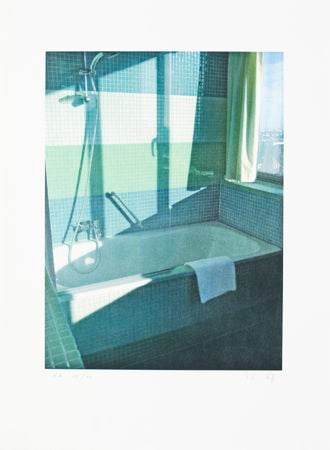



Artwork by Bernd & Hilla Becher
What is the Dusseldorf school of photography?
The Düsseldorf School of Photography refers to a group of photographers who studied under Bernd and Hilla Becher at the Kunstakademie Düsseldorf during the 1970s. This group was known for its devotion to the black-and-white industrial images characteristic of the German tradition known as New Objectivity. The photographers focused on precise, methodical documentation of industrial structures, often using a detached and objective approach.

Thomas Struth
Deutsche Stadtbaukunst, 2010
30 x 40 cm


