Etching and aquatint in colors on Somerset wove paper
-Signed in pencil, dated and numbered
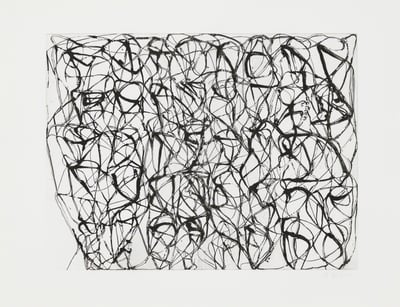
Suzhou I by Brice Marden, created in 1998, is an intricate etching and aquatint on Somerset wove paper. This limited edition print is characterized by its organic, flowing black lines that twist and intersect, forming an abstract web-like structure. The green and gray background provides subtle depth and contrast, enhancing the fluid movement of the lines. The composition evokes the natural, winding pathways of traditional Chinese gardens, alluding to the artwork's title referencing Suzhou, a city known for its classical gardens. Marden’s minimalist approach invites a contemplative viewing, balancing simplicity with a sense of complexity.
Brice Marden (USA, 1938–2023) was a celebrated painter known for his minimalist canvases and later gestural, calligraphic abstractions. His work bridged Western modernism and Eastern aesthetics, often using nuanced color palettes and meditative linework. Marden’s evolution of style made him a key figure in contemporary art for over five decades.
Etching and AquatintEtching and aquatint are printmaking techniques. In aquatint, the printing plate is etched with a pattern of tiny pits and cracks to create a wide range of tonal gradations. This technique allows artists to replicate the broad, flat tones found in watercolor paintings and ink washes.
Etching and aquatint in colors on Somerset wove paper
-Signed in pencil, dated and numbered
Suzhou I by Brice Marden, created in 1998, is an intricate etching and aquatint on Somerset wove paper. This limited edition print is characterized by its organic, flowing black lines that twist and intersect, forming an abstract web-like structure. The green and gray background provides subtle depth and contrast, enhancing the fluid movement of the lines. The composition evokes the natural, winding pathways of traditional Chinese gardens, alluding to the artwork's title referencing Suzhou, a city known for its classical gardens. Marden’s minimalist approach invites a contemplative viewing, balancing simplicity with a sense of complexity.
Brice Marden (USA, 1938–2023) was a celebrated painter known for his minimalist canvases and later gestural, calligraphic abstractions. His work bridged Western modernism and Eastern aesthetics, often using nuanced color palettes and meditative linework. Marden’s evolution of style made him a key figure in contemporary art for over five decades.
A work of art is a renewable source of energy.
- Brice Marden
Brice Marden (b. 1938 USA) is an influential American painter known for his minimalist and abstract works that explore the subtleties of color, form, and line. Marden's early work in the 1960s and 1970s was characterized by monochromatic canvases, where he applied layers of oil and beeswax to create smooth, luminous surfaces with subtle variations in tone. These minimalist compositions focused on the interaction of color and light, inviting deep contemplation. In the 1980s, Marden's style evolved to incorporate more fluid, calligraphic lines inspired by Eastern art and philosophy, resulting in his renowned "Cold Mountain" series. These works marked a shift towards more gestural abstraction, blending Western and Eastern artistic traditions. Marden's meticulous approach to composition and his ability to convey profound emotion through simplicity have established him as a key figure in contemporary art. His work has been widely exhibited and collected by major museums worldwide, solidifying his legacy as one of the leading painters of his generation.
Minimalism is a style in music and visual arts characterized by pared-down designs and simplicity. It began in Western art after World War II, gaining prominence particularly in American visual arts. Minimalism draws heavily on aspects of modernism and is often viewed as a reaction against Abstract Expressionism, as well as a precursor to post-minimal art practices. Prominent minimalist artists include Agnes Martin, Donald Judd, Robert Morris, Frank Stella, and Dan Flavin.