

Hand-signed by artist
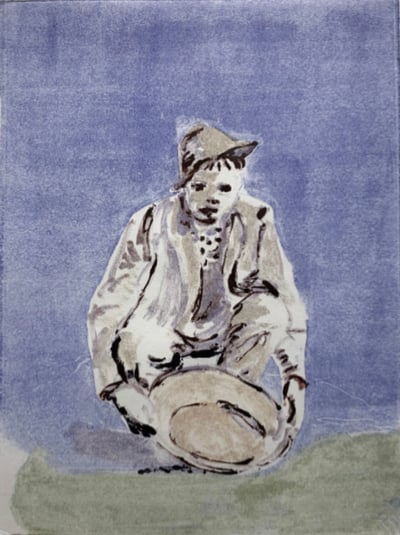
Claire Tabouret’s The Gold Miners 26 (2017) is a contemplative and atmospheric work that captures a moment of quiet determination. Rendered in acrylic on paper, the piece depicts a lone figure crouching, holding a hat in both hands, against a hazy blue background. The subject, likely referencing historical gold miners, appears in muted earth tones, their expression ambiguous—both resolute and distant.
Tabouret’s signature painterly style, marked by loose brushstrokes and a dreamlike quality, lends the image an almost ghostly presence. Her exploration of themes such as migration, labor, and historical narratives is evident here, as the figure seems suspended between past and present, evoking resilience and solitude. This unique work exemplifies her ability to transform historical references into poetic and emotionally charged imagery.
Artwork Copyright © Claire TabouretClaire Tabouret (France, 1981) is a contemporary artist based in Los Angeles, renowned for her evocative figurative paintings, drawings, and sculptures. Her work often explores themes of identity, childhood, and the passage of time, employing loose, expressive brushstrokes and a broad palette that mimics both artificial and natural hues. Tabouret's art has been exhibited internationally, including at the Yuz Museum in Shanghai and the Institute of Contemporary Art in Miami.
Artwork Copyright © Claire TabouretThe Gold Miners 26, 2017
Form
Medium
Size
- Inches
- Centimeters
Edition
Price
- Authenticity Guaranteed
- Insured Shipping
- Online Since 2005
●Inventory 15592
●Signed
●Comes with gallery invoice and certificate
●Sell Us a Similar Artwork. Learn more.
Hand-signed by artist
Claire Tabouret’s The Gold Miners 26 (2017) is a contemplative and atmospheric work that captures a moment of quiet determination. Rendered in acrylic on paper, the piece depicts a lone figure crouching, holding a hat in both hands, against a hazy blue background. The subject, likely referencing historical gold miners, appears in muted earth tones, their expression ambiguous—both resolute and distant.
Tabouret’s signature painterly style, marked by loose brushstrokes and a dreamlike quality, lends the image an almost ghostly presence. Her exploration of themes such as migration, labor, and historical narratives is evident here, as the figure seems suspended between past and present, evoking resilience and solitude. This unique work exemplifies her ability to transform historical references into poetic and emotionally charged imagery.
Artwork Copyright © Claire TabouretClaire Tabouret (France, 1981) is a contemporary artist based in Los Angeles, renowned for her evocative figurative paintings, drawings, and sculptures. Her work often explores themes of identity, childhood, and the passage of time, employing loose, expressive brushstrokes and a broad palette that mimics both artificial and natural hues. Tabouret's art has been exhibited internationally, including at the Yuz Museum in Shanghai and the Institute of Contemporary Art in Miami.
Artwork Copyright © Claire Tabouret- Recently Added
- Price (Low-High)
- Price (High-Low)
- Year (Low-High)
- Year (High-Low)
Claire Tabouret
The Gold Miners 26, 2017
Drawing / Watercolor
Acrylic on paper
Inquire For Price

Claire Tabouret
The Swimmer, 2019
Limited Edition Print
Mixed Media
Currently Not Available
Related Artists

Artwork by Alex Katz
What is figurative art?
Sometimes known as Figurativism, figurative art refers to sculptures and paintings that are clearly or specifically derived from real objects, making them representational. The term figurative art is often used in contrast to abstract art. However, since the emergence of abstract art, figurative art has come to describe any form of modern art that has strong references to the real world or actual situations.


Claire Tabouret
The Gold Miners 26, 2017
57.2 x 44.5 cm


