

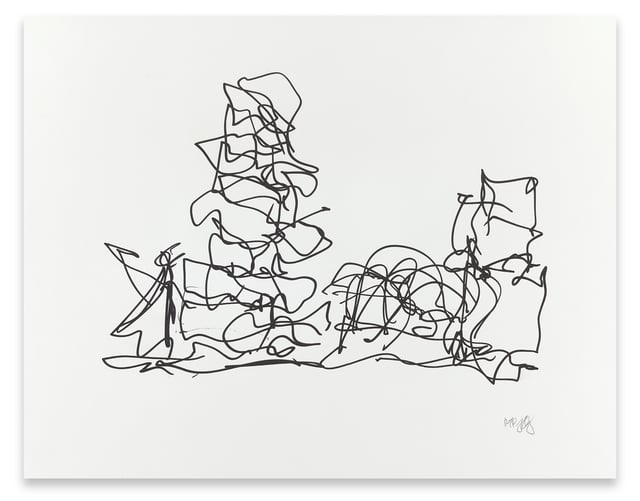
// Brooklyn Atlantic Yards Masterplan by Frank Gehry, created in 2009, is a lithograph that captures the visionary architect’s distinctive approach to design through a dynamic and abstract line drawing. This print features a series of sweeping, interlaced lines that form an impression of complex architectural forms, possibly suggesting the layered and intertwined structures of an urban landscape. Gehry’s characteristic loose, spontaneous line work conveys a sense of movement and fluidity, reflecting his innovative approach to architectural form. This piece serves as both an abstract artwork and a conceptual visualization, offering a glimpse into Gehry’s creative process in imagining large-scale urban projects. Measuring 35.6 x 45.7 cm, this limited edition lithograph exemplifies Gehry’s ability to transform simple lines into evocative compositions that resonate with his architectural philosophy.
Artwork Copyright © Frank GehryFrank Gehry (Canada/United States, 1929–2025) was a Canadian-American architect celebrated for his groundbreaking designs featuring deconstructivist aesthetics. Known for projects such as the Guggenheim Museum Bilbao and the Walt Disney Concert Hall, his work transformed urban landscapes through fluid, sculptural forms and innovative materials, redefining modern architecture.
Artwork Copyright © Frank GehryBrooklyn Atlantic Yards Masterplan, 2009
Form
Medium
Size
- Inches
- Centimeters
Price
Available works →
- Authenticity Guaranteed
- Insured Shipping
- Online Since 2005
●
●Inventory 2383
●Signed
●Comes with gallery invoice and certificate
●Sell Us a Similar Artwork. Learn more.
// Brooklyn Atlantic Yards Masterplan by Frank Gehry, created in 2009, is a lithograph that captures the visionary architect’s distinctive approach to design through a dynamic and abstract line drawing. This print features a series of sweeping, interlaced lines that form an impression of complex architectural forms, possibly suggesting the layered and intertwined structures of an urban landscape. Gehry’s characteristic loose, spontaneous line work conveys a sense of movement and fluidity, reflecting his innovative approach to architectural form. This piece serves as both an abstract artwork and a conceptual visualization, offering a glimpse into Gehry’s creative process in imagining large-scale urban projects. Measuring 35.6 x 45.7 cm, this limited edition lithograph exemplifies Gehry’s ability to transform simple lines into evocative compositions that resonate with his architectural philosophy.
Artwork Copyright © Frank GehryFrank Gehry (Canada/United States, 1929–2025) was a Canadian-American architect celebrated for his groundbreaking designs featuring deconstructivist aesthetics. Known for projects such as the Guggenheim Museum Bilbao and the Walt Disney Concert Hall, his work transformed urban landscapes through fluid, sculptural forms and innovative materials, redefining modern architecture.
Artwork Copyright © Frank Gehry- Recently Added
- Price (Low-High)
- Price (High-Low)
- Year (Low-High)
- Year (High-Low)

Frank Gehry
Brooklyn Atlantic Yards Masterplan, 2009
Limited Edition Print
Lithograph
Currently Not Available
Related Artists




Artwork by Louise Bourgeois
What is Postmodernism?
Postmodernism is an art movement that emerged as a reaction against authority and traditional boundaries, seeking to blur the lines between art and everyday life. It aimed to bridge the gap between the cultural elite and the general public by embracing eclectic mixtures of earlier conventions and styles. Postmodernist art often challenges established norms and celebrates diversity, irony, and pastiche, making it a movement that reflects the complexities of contemporary culture.

Frank Gehry
Brooklyn Atlantic Yards Masterplan, 2009
35.6 x 45.7 cm


