
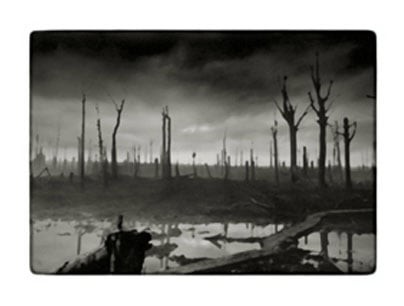
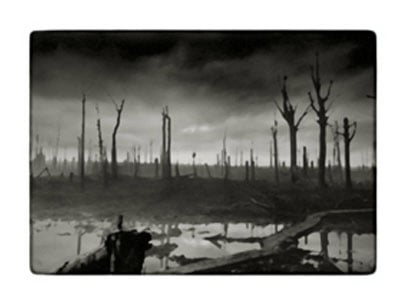
// Loss - Landscape by Hans Op de Beeck is a limited edition lithograph created in 2004, capturing a haunting, desolate scene of a devastated landscape. The monochromatic composition, with its stark contrast between the barren trees and the bleak sky, evokes a profound sense of emptiness and sorrow. Reflective pools of water on the ground mirror the skeletal remains of trees, creating an eerie symmetry that enhances the scene's somber mood. Op de Beeck’s work often explores themes of loss, memory, and transience, as seen in this piece. With an edition size of 100, this lithograph stands as a compelling meditation on the aftermath of destruction and the resilience of nature in the face of devastation.
Artwork Copyright © Hans Op de BeeckHans Op de Beeck (Belgium, 1969) is a multidisciplinary artist whose immersive installations, sculptures, and videos explore themes of time, memory, and the human condition. Known for his monochromatic works and poetic atmospheres, Op de Beeck creates contemplative spaces that invite viewers to reflect on life’s transient nature.
Artwork Copyright © Hans Op de BeeckLoss - Landscape, 2004
Form
Medium
Size
- Inches
- Centimeters
Edition
Price
Available works →
- Authenticity Guaranteed
- Insured Shipping
- Online Since 2005
●
●Inventory 1245
●Signed
●Comes with gallery invoice and certificate
●Sell Us a Similar Artwork. Learn more.
// Loss - Landscape by Hans Op de Beeck is a limited edition lithograph created in 2004, capturing a haunting, desolate scene of a devastated landscape. The monochromatic composition, with its stark contrast between the barren trees and the bleak sky, evokes a profound sense of emptiness and sorrow. Reflective pools of water on the ground mirror the skeletal remains of trees, creating an eerie symmetry that enhances the scene's somber mood. Op de Beeck’s work often explores themes of loss, memory, and transience, as seen in this piece. With an edition size of 100, this lithograph stands as a compelling meditation on the aftermath of destruction and the resilience of nature in the face of devastation.
Artwork Copyright © Hans Op de BeeckHans Op de Beeck (Belgium, 1969) is a multidisciplinary artist whose immersive installations, sculptures, and videos explore themes of time, memory, and the human condition. Known for his monochromatic works and poetic atmospheres, Op de Beeck creates contemplative spaces that invite viewers to reflect on life’s transient nature.
Artwork Copyright © Hans Op de Beeck- Recently Added
- Price (Low-High)
- Price (High-Low)
- Year (Low-High)
- Year (High-Low)
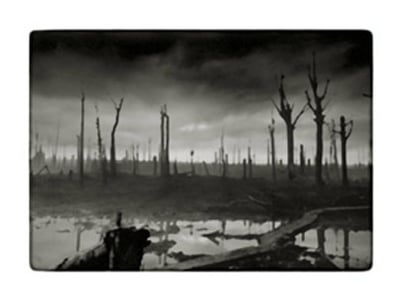
Hans Op de Beeck
Loss - Landscape, 2004
Limited Edition Print
Lithograph
Currently Not Available
Related Artists

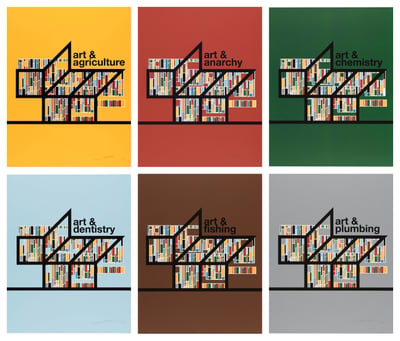

Artwork by Julian Opie
What is animation?
Animation is the process of displaying a sequence of static images in rapid succession to create the illusion of movement. Each image, or frame, is slightly altered from the previous one, particularly in the moving parts, so when shown together, they form a continuous motion. Traditionally, illustrators drew each frame by hand to produce this effect.
Hans Op de Beeck
Loss - Landscape, 2004
33 x 48 cm


