
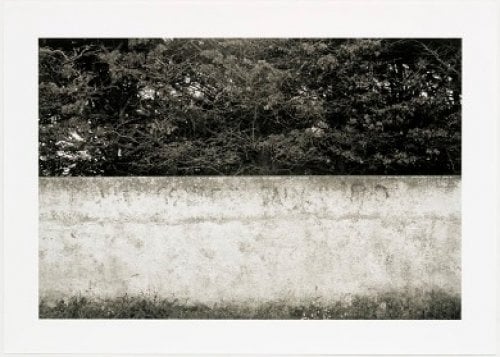
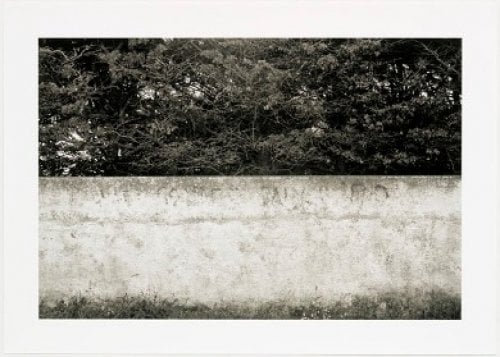
// Julião Sarmento's Mod. 4 (1993) is a black-and-white photograph that evokes a sense of quiet contemplation and minimalism. The image captures a simple yet striking composition: a horizontal concrete wall that bisects the frame, with dense foliage rising above it. The wall acts as a visual and conceptual barrier, dividing the natural and man-made elements within the photograph. The contrast between the textured, weathered surface of the wall and the organic, shadowed foliage highlights themes of separation, boundary, and the interplay between nature and urban environments. Sarmento’s work often explores the subtleties of human presence and absence, and this photograph invites viewers to reflect on the spaces that shape human experience.
Artwork Copyright © Juliao SarmentoJulião Sarmento (Portugal, 1948–2021) was a multidisciplinary artist whose work spanned painting, drawing, sculpture, photography, film, video, performance, sound, and installation. His art often delved into themes of desire, memory, and the human condition. Sarmento represented Portugal at the 1997 Venice Biennale and participated in Documenta 7 and 8. His works are featured in numerous international public and private collections.
Artwork Copyright © Juliao SarmentoMod. 4, 1993
Form
Medium
Size
- Inches
- Centimeters
Edition
Price
Available works →
- Authenticity Guaranteed
- Insured Shipping
- Online Since 2005
●
●Inventory 9741
●Signed
●Comes with gallery invoice and certificate
●Sell Us a Similar Artwork. Learn more.
// Julião Sarmento's Mod. 4 (1993) is a black-and-white photograph that evokes a sense of quiet contemplation and minimalism. The image captures a simple yet striking composition: a horizontal concrete wall that bisects the frame, with dense foliage rising above it. The wall acts as a visual and conceptual barrier, dividing the natural and man-made elements within the photograph. The contrast between the textured, weathered surface of the wall and the organic, shadowed foliage highlights themes of separation, boundary, and the interplay between nature and urban environments. Sarmento’s work often explores the subtleties of human presence and absence, and this photograph invites viewers to reflect on the spaces that shape human experience.
Artwork Copyright © Juliao SarmentoJulião Sarmento (Portugal, 1948–2021) was a multidisciplinary artist whose work spanned painting, drawing, sculpture, photography, film, video, performance, sound, and installation. His art often delved into themes of desire, memory, and the human condition. Sarmento represented Portugal at the 1997 Venice Biennale and participated in Documenta 7 and 8. His works are featured in numerous international public and private collections.
Artwork Copyright © Juliao Sarmento- Recently Added
- Price (Low-High)
- Price (High-Low)
- Year (Low-High)
- Year (High-Low)

Juliao Sarmento
Mod. 4, 1993
Photography
Photograph
Currently Not Available
Related Artists

Artwork by Louise Bourgeois
What is Postmodernism?
Postmodernism is an art movement that emerged as a reaction against authority and traditional boundaries, seeking to blur the lines between art and everyday life. It aimed to bridge the gap between the cultural elite and the general public by embracing eclectic mixtures of earlier conventions and styles. Postmodernist art often challenges established norms and celebrates diversity, irony, and pastiche, making it a movement that reflects the complexities of contemporary culture.

Juliao Sarmento
Mod. 4, 1993
40 x 60 cm


