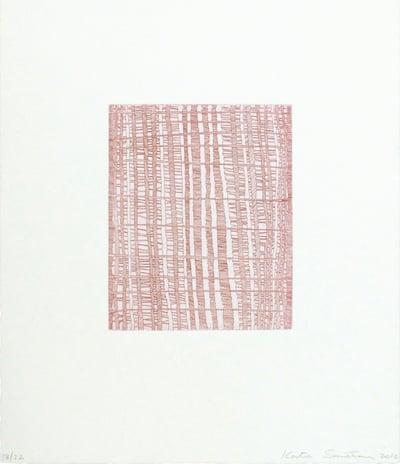
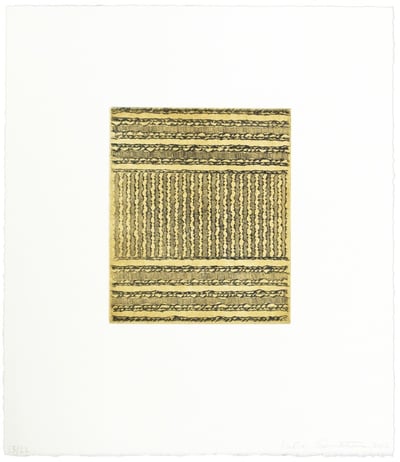
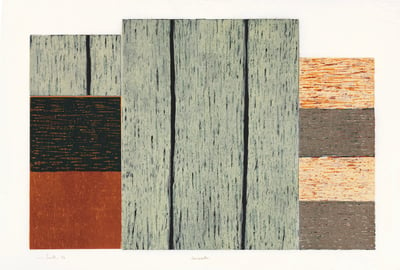
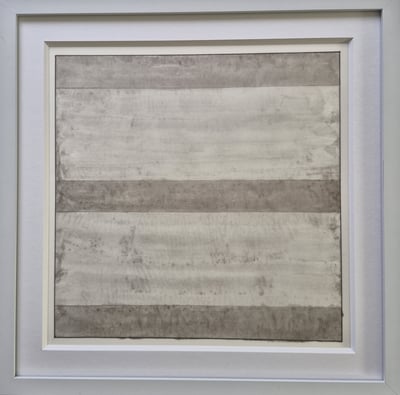
// Volver a las islas by Katia Santibañez, a 2013 etching, features an intricate, symmetrical composition of repeating lines and organic patterns, arranged in horizontal bands. The warm, earthy tones combined with textured lines evoke the feel of woven textiles or landscape topography, bringing to mind a sense of connection to natural forms and traditional craftsmanship. The title, Return to the Islands, suggests themes of journey, nostalgia, or exploration of origins, perhaps symbolizing an inward return to places of memory or cultural heritage. Santibañez’s work often draws from natural motifs and patterns, and this piece invites viewers to contemplate a harmonious blend of structure and organic flow, highlighting the meditative quality of repeated forms.
Katia Santibañez (France, 1964) is a French-American multidisciplinary abstract artist known for her intricate grid-based paintings, drawings, and prints that explore the intersection of nature and geometry. Her work is featured in collections such as the Albright-Knox Art Gallery and the Morgan Library and Museum. Santibañez has participated in residencies at Yaddo, Casa Wabi, and the Albers Foundation.
EtchingEtching is a technique where a design is created on a metal surface by using a strong acid or mordant to eat away the unprotected parts of the metal, leaving the desired pattern in relief (intaglio). In modern art and manufacturing, different chemicals may be used depending on the material being etched.
// Volver a las islas by Katia Santibañez, a 2013 etching, features an intricate, symmetrical composition of repeating lines and organic patterns, arranged in horizontal bands. The warm, earthy tones combined with textured lines evoke the feel of woven textiles or landscape topography, bringing to mind a sense of connection to natural forms and traditional craftsmanship. The title, Return to the Islands, suggests themes of journey, nostalgia, or exploration of origins, perhaps symbolizing an inward return to places of memory or cultural heritage. Santibañez’s work often draws from natural motifs and patterns, and this piece invites viewers to contemplate a harmonious blend of structure and organic flow, highlighting the meditative quality of repeated forms.
Katia Santibañez (France, 1964) is a French-American multidisciplinary abstract artist known for her intricate grid-based paintings, drawings, and prints that explore the intersection of nature and geometry. Her work is featured in collections such as the Albright-Knox Art Gallery and the Morgan Library and Museum. Santibañez has participated in residencies at Yaddo, Casa Wabi, and the Albers Foundation.
By structuring the expressiveness of nature, is the continuous theme that binds together Katia Santibanez's work. She sees the world as a prismatic scheme, which she decides to study and converse with, through the means of abstraction and introspective painting. Santibanez studied art and philosophy in Paris where she was born in 1964. She has consistently explored the visual collaboration of repetition and correspondence as it is implicitly found in natural environments and human architecture. One of her famous exhibitions, aptly titled 'The Visible and the Invisible', swiftly summarises the approach she adopts in her paintings. She sees an unspoken sense of relatedness, continuously at play between the individual mind, and the archetypes which define nature as artful constructions. She deploys her work inside the spaces where the viewer must reposition their own sense of connectedness to location. The painting can then reveal a fascinating intersection of patterns and contrasts, bound together by a unified conceptual thread: the metropolis versus nature. Santibanez connects the thematic polarities of order and chaos, balance and composition in the abstractions she creates. She reshapes reality into moulds of replications, which echo the systems of potentiality which sentient beings share with nature. The engaging intensity of her works, strengthens a sense of wonder in the viewer, who can then, willingly participate in the echoing mystery of her paintings.
Gestural art is a term that describes painting with freely sweeping brushstrokes. The primary goal of gestural art is to allow the artist to physically express emotional impulses. The varied, yet expressive paint marks are intended to convey the artist's inner thoughts and emotions, which viewers are believed to understand through the dynamic and spontaneous application of paint.