
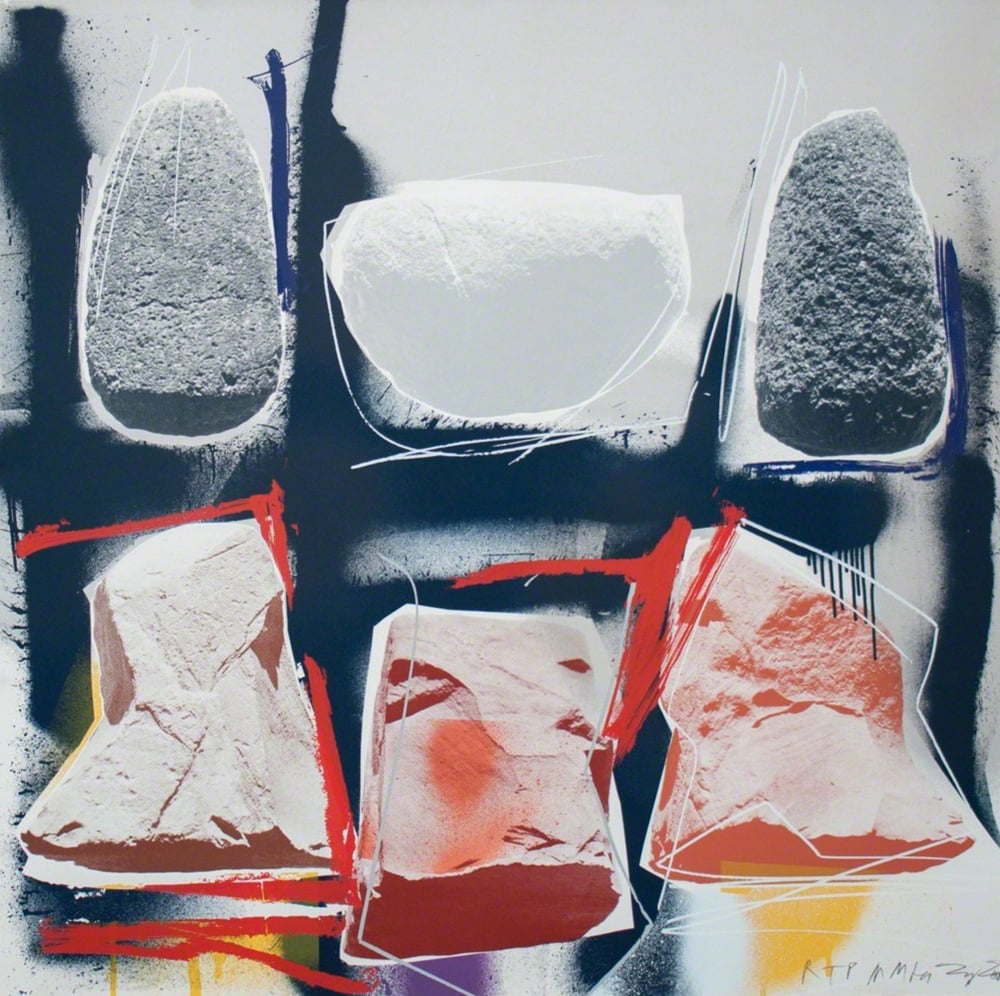
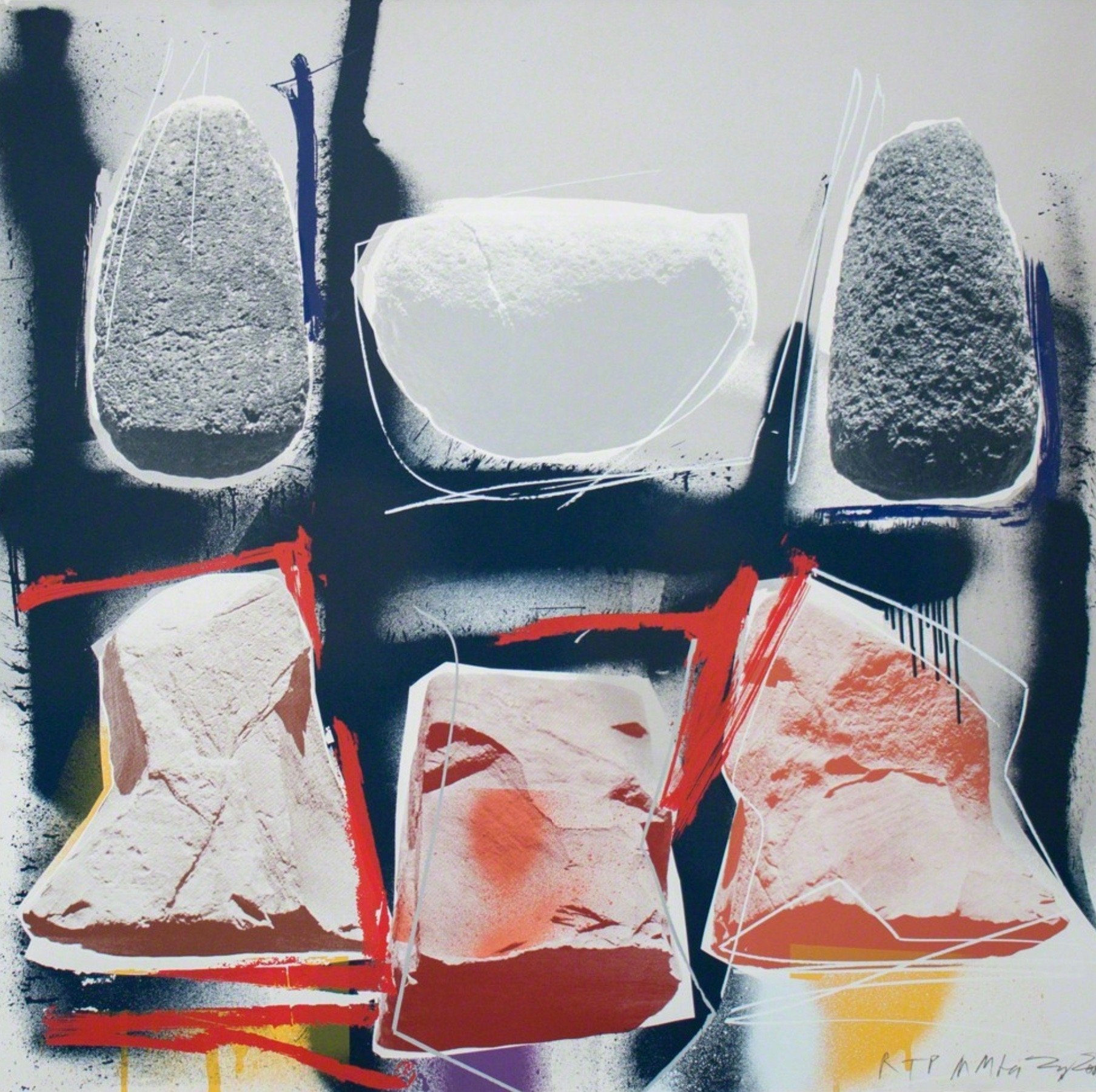
// Post Historic Screenprint #2 by Michael Heizer, created in 2014, is a limited edition screen-print that exemplifies Heizer's interest in monumental forms and abstract representations of geological structures. This artwork features six stylized rock-like forms, rendered in tones of gray, white, and red, with bold outlines and dynamic brushstrokes. The juxtaposition of smooth and rough textures, along with vibrant splashes of color and framing lines, gives each form a unique presence, evoking a sense of weight and permanence. Known for his land art, Heizer brings a similar sensibility to this print, creating a composition that reflects his fascination with natural formations and human interaction with the environment. With an edition size of only 40, Post Historic Screenprint #2 merges abstraction and the rawness of geological forms in a compelling and layered visual narrative.
Artwork Copyright © Michael HeizerMichael Heizer (United States, 1944) is an American artist renowned for his monumental land art and large-scale sculptures. A pioneer of the Earthworks movement, Heizer's works, such as 'Double Negative' and 'City,' involve massive earth excavations and constructions that challenge traditional notions of sculpture and space. His art explores the relationship between human intervention and the natural environment.
Artwork Copyright © Michael HeizerPost Historic Screenprint #2, 2014
Form
Medium
Size
- Inches
- Centimeters
Edition
Price
Available works →
- Authenticity Guaranteed
- Insured Shipping
- Online Since 2005
●
●Inventory 6878
●Signed
●Comes with gallery invoice and certificate
●Sell Us a Similar Artwork. Learn more.
// Post Historic Screenprint #2 by Michael Heizer, created in 2014, is a limited edition screen-print that exemplifies Heizer's interest in monumental forms and abstract representations of geological structures. This artwork features six stylized rock-like forms, rendered in tones of gray, white, and red, with bold outlines and dynamic brushstrokes. The juxtaposition of smooth and rough textures, along with vibrant splashes of color and framing lines, gives each form a unique presence, evoking a sense of weight and permanence. Known for his land art, Heizer brings a similar sensibility to this print, creating a composition that reflects his fascination with natural formations and human interaction with the environment. With an edition size of only 40, Post Historic Screenprint #2 merges abstraction and the rawness of geological forms in a compelling and layered visual narrative.
Artwork Copyright © Michael HeizerMichael Heizer (United States, 1944) is an American artist renowned for his monumental land art and large-scale sculptures. A pioneer of the Earthworks movement, Heizer's works, such as 'Double Negative' and 'City,' involve massive earth excavations and constructions that challenge traditional notions of sculpture and space. His art explores the relationship between human intervention and the natural environment.
Artwork Copyright © Michael Heizer- Recently Added
- Price (Low-High)
- Price (High-Low)
- Year (Low-High)
- Year (High-Low)

Michael Heizer
Post Historic Screenprint #2, 2014
Limited Edition Print
Screen-print
Currently Not Available
Related Artists


Image © Robert Lukeman / Unsplash
What is land art?
Also referred to as Earth Art, Earthworks, or Environmental Art, Land Art is a sculptural movement that involves creating artworks that integrate conceptual or physical elements of the earth or landscape into the finished piece. These works often interact directly with the environment, using natural materials and settings to explore themes related to nature, place, and time

Michael Heizer
Post Historic Screenprint #2, 2014
117 x 117 cm


