
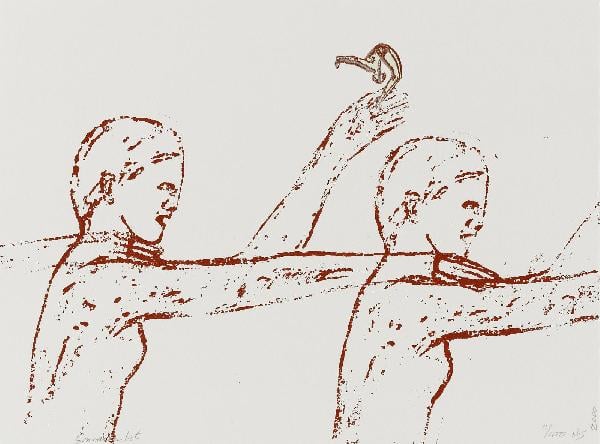
// The Somnambulist by Nancy Spero, a screen print created between 1987 and 1999, captures the artist's distinctive approach to portraying the female form and experience. The print features two overlapping female figures, rendered in earthy red tones that resemble ancient cave drawings or etchings. The women appear in a state of sleepwalking or trance, with elongated arms stretching forward, evoking a sense of motion and introspection. Spero, a prominent feminist artist, often explored themes of empowerment, struggle, and historical narratives of women. In this piece, the dual imagery may symbolize the continuity of female experiences or an exploration of identity and self-awareness. This limited edition print, part of an edition of 100 with additional artist proofs, reflects Spero’s commitment to both aesthetics and social commentary.
Artwork Copyright © Nancy SperoNancy Spero (United States, 1926–2009) was a pioneering feminist artist whose work spanned painting, printmaking, and collage. She is renowned for her politically charged pieces addressing themes of war, oppression, and the female experience. Spero's art is featured in major institutions, including the Museum of Modern Art and the Tate Modern.
Artwork Copyright © Nancy SperoThe somnambulist , 1987 - 1999
Form
Medium
Size
- Inches
- Centimeters
Edition
Price
Available works →
- Authenticity Guaranteed
- Insured Shipping
- Online Since 2005
●
●Inventory 3153
●Signed
●Comes with gallery invoice and certificate
●Sell Us a Similar Artwork. Learn more.
// The Somnambulist by Nancy Spero, a screen print created between 1987 and 1999, captures the artist's distinctive approach to portraying the female form and experience. The print features two overlapping female figures, rendered in earthy red tones that resemble ancient cave drawings or etchings. The women appear in a state of sleepwalking or trance, with elongated arms stretching forward, evoking a sense of motion and introspection. Spero, a prominent feminist artist, often explored themes of empowerment, struggle, and historical narratives of women. In this piece, the dual imagery may symbolize the continuity of female experiences or an exploration of identity and self-awareness. This limited edition print, part of an edition of 100 with additional artist proofs, reflects Spero’s commitment to both aesthetics and social commentary.
Artwork Copyright © Nancy SperoNancy Spero (United States, 1926–2009) was a pioneering feminist artist whose work spanned painting, printmaking, and collage. She is renowned for her politically charged pieces addressing themes of war, oppression, and the female experience. Spero's art is featured in major institutions, including the Museum of Modern Art and the Tate Modern.
Artwork Copyright © Nancy Spero- Recently Added
- Price (Low-High)
- Price (High-Low)
- Year (Low-High)
- Year (High-Low)
Nancy Spero
The somnambulist , 1987 - 1999
Limited Edition Print
Screen-print
Currently Not Available
Related Artists

Artwork by Willem de Kooning
What is Gestural?
Gestural art is a term that describes painting with freely sweeping brushstrokes. The primary goal of gestural art is to allow the artist to physically express emotional impulses. The varied, yet expressive paint marks are intended to convey the artist's inner thoughts and emotions, which viewers are believed to understand through the dynamic and spontaneous application of paint.


Nancy Spero
The somnambulist , 1987 - 1999
19 x 26.5 cm


