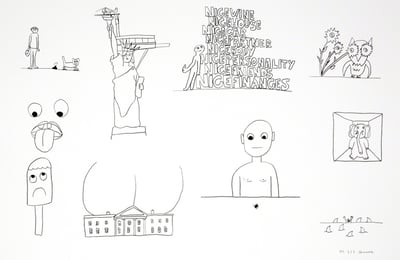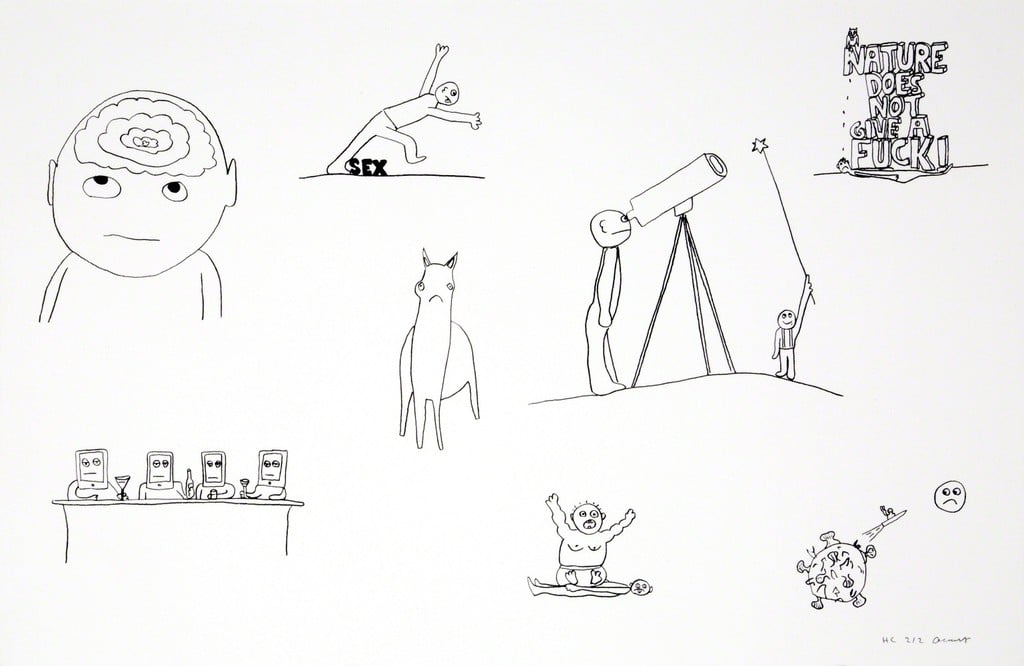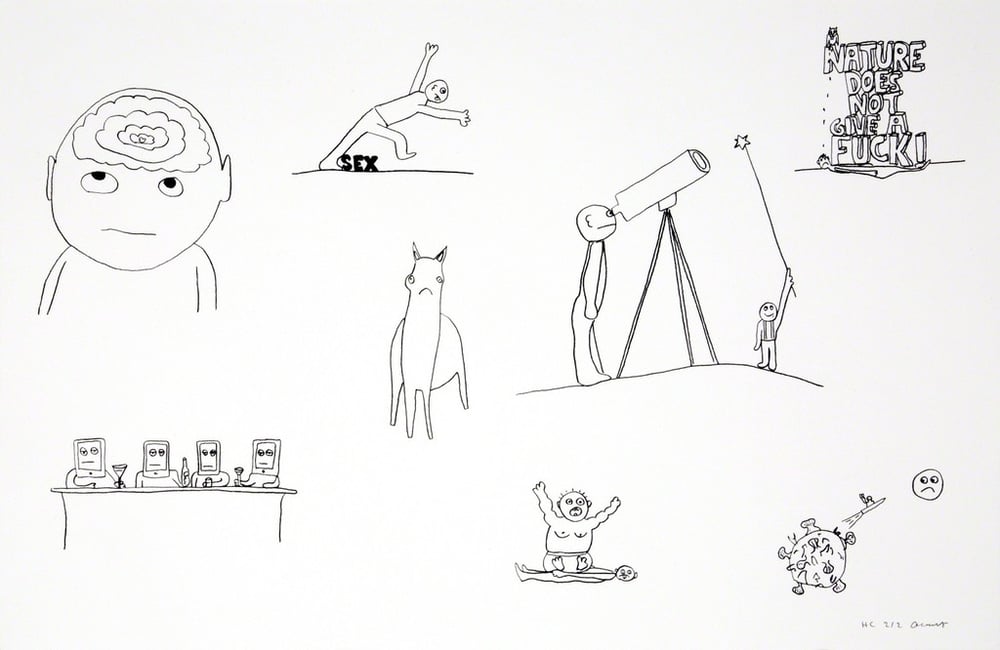
// Random Thoughts About Life 2 by Olaf Breuning, a 2018 lithograph, presents a series of quirky and surreal line drawings that explore themes of introspection, desire, and existential humor. The illustrations include a figure with an exposed brain in concentric circles, a person reaching toward a star with a telescope, a sign stating NATURE DOES NOT GIVE A FUCK! and a depiction of SEX with a stretching figure. Other scenes include rows of identical faces in boxes, a horse with an empty expression, and a figure triumphantly raising arms. Breuning’s simplistic, cartoon-like style adds a playful tone, encouraging viewers to reflect on the absurdities and curiosities of modern life with humor and lighthearted contemplation.
Olaf Breuning (Switzerland, 1970) is a contemporary artist celebrated for his playful and eclectic works in photography, sculpture, and video. His art explores themes of popular culture and human behavior, blending humor with social critique. Breuning’s visually striking pieces often mix high and low cultural elements to challenge perceptions.
Lithograph Lithography is a printing method based on the principle that water and oil do not mix. It can be used to print artwork or text onto paper or other suitable materials. Traditionally, an image was drawn with wax, fat, or oil onto a lithographic limestone surface or plate. Today, metal plates and other surfaces are also used in lithographic printing.
// Random Thoughts About Life 2 by Olaf Breuning, a 2018 lithograph, presents a series of quirky and surreal line drawings that explore themes of introspection, desire, and existential humor. The illustrations include a figure with an exposed brain in concentric circles, a person reaching toward a star with a telescope, a sign stating NATURE DOES NOT GIVE A FUCK! and a depiction of SEX with a stretching figure. Other scenes include rows of identical faces in boxes, a horse with an empty expression, and a figure triumphantly raising arms. Breuning’s simplistic, cartoon-like style adds a playful tone, encouraging viewers to reflect on the absurdities and curiosities of modern life with humor and lighthearted contemplation.
Olaf Breuning (Switzerland, 1970) is a contemporary artist celebrated for his playful and eclectic works in photography, sculpture, and video. His art explores themes of popular culture and human behavior, blending humor with social critique. Breuning’s visually striking pieces often mix high and low cultural elements to challenge perceptions.
For me, art is a sensitive place where really murky things can be discussed.
- Olaf Breuning
The contemporary artworks of Swiss artist Olaf Breuning throw audiences into a colorful world of surrealist sarcasm. He works through the mediums of performance, film, sculpture and drawing. His eclectic works often feature as a means to breathe life into the dull. His 2014 installation in Central Park, Clouds, does just this. The bright blue aluminium clouds, 35 feet above the ground added a splash of color to the park, brightening both days and lives. Breuning’s work derives inspiration from pop culture, taking the lightness and humor often found in culturally iconic films and TV to juxtapose more significant and deep rooted issues and questions. For example, in the 2011 series of color photographs, The Art Freaks, Browning paints the bodies of nude models in styles symbolic of influential 20th century artists such as Francis Bacon and On Kawara. This questioning of supposed masterpieces and our controlled experience of them is a theme Breuning frequently touches on, raising questions toward our relationship with art, pop culture and the internet.
Surrealism began in the 1920s as an art and literary movement with the goal of revealing the unconscious mind and unleashing the imagination by exploring unusual and dream-like imagery. Influenced by Sigmund Freud’s theories of psychoanalysis, Surrealist artists and writers sought to bring the unconscious into rational life, blurring the lines between reality and dreams. The movement aimed to challenge conventional perceptions and express the irrational aspects of the human experience.