

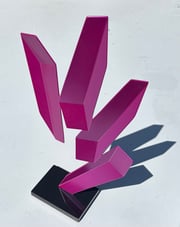

Metal sculpture. Hand-signed in pencil at the bottom and numbered.
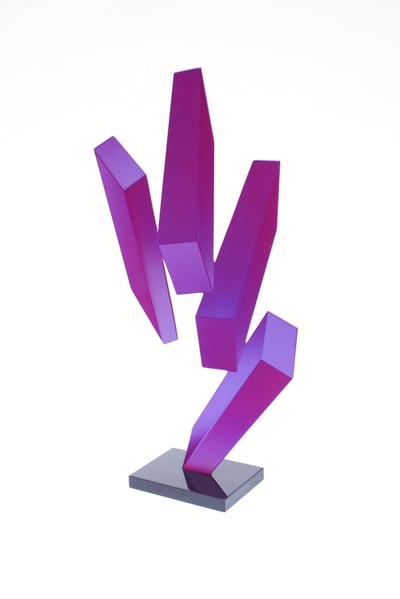
Levitation 2 by Rafael Barrios is a 2019 painted metal sculpture that exemplifies the Venezuelan artist’s exploration of perception, balance, and geometric illusion. Composed of four sharply angled magenta forms that appear to hover in space, the sculpture creates a compelling visual tension between stability and movement. Although firmly anchored to a square base, the precisely engineered elements seem to defy gravity, inviting viewers to question their sense of depth and equilibrium. Barrios is internationally recognized for transforming simple geometric volumes into dynamic optical experiences, drawing on the traditions of Kinetic and Constructivist art. Issued in an edition of 20, Levitation 2 demonstrates the artist’s mastery of form, color, and spatial interaction.
Artwork Copyright © Rafael BarriosRafael Barrios (Venezuela, 1947) is a renowned sculptor celebrated for his vibrant, geometric works that create striking optical illusions. His sculptures play with perception, making flat forms appear three-dimensional. Barrios’s innovative approach has earned him international acclaim, with his large-scale installations featured in prominent public spaces worldwide.
Artwork Copyright © Rafael BarriosLevitation 2, 2019
Form
Medium
Size
- Inches
- Centimeters
Edition
Price
- USD
- EUR
- GBP
- CHF
- Authenticity Guaranteed
- Insured Shipping
- Online Since 2005
●Inventory 17636
●Signed
●Comes with gallery invoice and certificate
●Sell Us a Similar Artwork. Learn more.
Metal sculpture. Hand-signed in pencil at the bottom and numbered.
Levitation 2 by Rafael Barrios is a 2019 painted metal sculpture that exemplifies the Venezuelan artist’s exploration of perception, balance, and geometric illusion. Composed of four sharply angled magenta forms that appear to hover in space, the sculpture creates a compelling visual tension between stability and movement. Although firmly anchored to a square base, the precisely engineered elements seem to defy gravity, inviting viewers to question their sense of depth and equilibrium. Barrios is internationally recognized for transforming simple geometric volumes into dynamic optical experiences, drawing on the traditions of Kinetic and Constructivist art. Issued in an edition of 20, Levitation 2 demonstrates the artist’s mastery of form, color, and spatial interaction.
Artwork Copyright © Rafael BarriosRafael Barrios (Venezuela, 1947) is a renowned sculptor celebrated for his vibrant, geometric works that create striking optical illusions. His sculptures play with perception, making flat forms appear three-dimensional. Barrios’s innovative approach has earned him international acclaim, with his large-scale installations featured in prominent public spaces worldwide.
Artwork Copyright © Rafael Barrios- Recently Added
- Price (Low-High)
- Price (High-Low)
- Year (Low-High)
- Year (High-Low)
Rafael Barrios
Levitation 2, 2019
Sculpture / Object
Metal
EUR 5,000

Rafael Barrios
Levitation III, 2019
Sculpture / Object
Metal
Currently Not Available
Related Artists



Artwork by Anthony Caro
What is New Generation Sculpture?
New Generation Sculpture was a movement started in the 1960s by a group of British artists. They experimented with unconventional forms, materials, and colors, creating sculptures that did not rely on traditional bases. Their work often featured plastic sheeting, fiberglass, and other industrial materials, which were fastened together and brightly painted.



