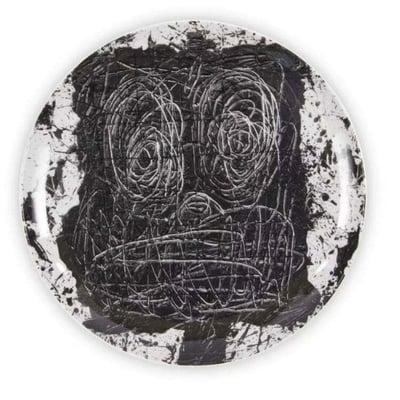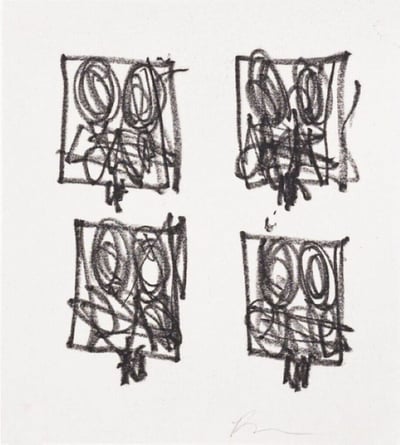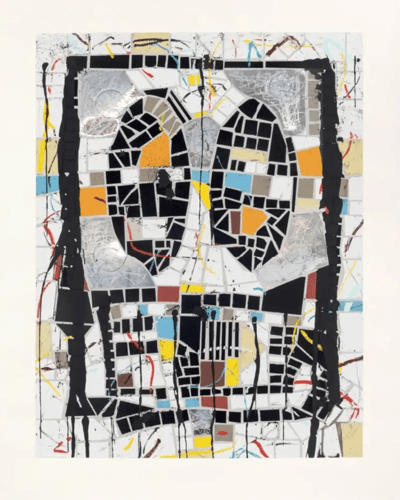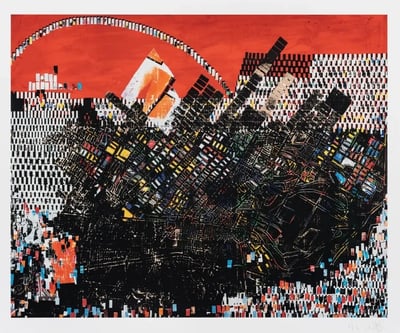
// Good Days by Rashid Johnson, a limited edition mixed media print from 2014, is a striking example of Johnson’s exploration of identity, culture, and history. The artwork is characterized by layered, abstract forms that include overlapping circles and bold black shapes dripping downward, set against a textured, earthy background. This complex layering and use of dark tones convey a raw, expressive energy, evoking themes of struggle, resilience, and introspection. Known for his use of unconventional materials and mark-making techniques, Johnson often draws on his own experiences and cultural heritage, creating pieces that feel both personal and universal. With an edition size of only 40, Good Days invites viewers to engage with its depth and contemplate its evocative, layered imagery.
Rashid Johnson (United States, 1977) is an American artist known for his conceptual post-black art. His diverse body of work includes photography, painting, sculpture, and installations that explore themes of African American identity, history, and culture. Johnson often incorporates materials like shea butter, black soap, and wax, infusing his pieces with symbolic meaning.
Mixed MediaMixed media refers to artwork that incorporates more than one medium within a single piece. Unlike multimedia art, which combines distinct forms of visual art and often includes elements like sound, video, or digital media, mixed media focuses on combining traditional art materials, such as paint, ink, and collage. Mixed media art allows artists to achieve a wide range of effects and textures by layering and blending different materials.
// Good Days by Rashid Johnson, a limited edition mixed media print from 2014, is a striking example of Johnson’s exploration of identity, culture, and history. The artwork is characterized by layered, abstract forms that include overlapping circles and bold black shapes dripping downward, set against a textured, earthy background. This complex layering and use of dark tones convey a raw, expressive energy, evoking themes of struggle, resilience, and introspection. Known for his use of unconventional materials and mark-making techniques, Johnson often draws on his own experiences and cultural heritage, creating pieces that feel both personal and universal. With an edition size of only 40, Good Days invites viewers to engage with its depth and contemplate its evocative, layered imagery.
Rashid Johnson (United States, 1977) is an American artist known for his conceptual post-black art. His diverse body of work includes photography, painting, sculpture, and installations that explore themes of African American identity, history, and culture. Johnson often incorporates materials like shea butter, black soap, and wax, infusing his pieces with symbolic meaning.
The way that light hits objects, I think, is one of the more important things that sculpture and photography share.
- Rashid Johnson
American conceptual post-black artist Rashid Johnson (1977) is a painter, photographer, filmmaker, and sculptor known for his photography and artistic productions that combine natural and spiritual sciences to augment black history. His early work was distinguished by a unique photo-printing process to achieve a painterly texture to prints, with The New York Times describing some of his black-and-white photography as “spectacularly rich.” As a photography major, Johnson earned a Bachelor of Fine Arts from Columbia College Chicago and a Master of Fine Arts from School of the Art Institute of Chicago, after which he taught in the Lower East Side of New York City at Pratt Institute. Sometimes referred to as an artist-magician, Johnson creates and disseminates societal and cultural norms and expectations as they relate to the black experience. Much of his mixed-media work plays with concepts of race through contradiction and symbolism of coded references. Having earned national acclaim, Johnson’s work is held in some of the world’s leading art museums.
Sometimes referred to as Conceptualism, this is an art form where the idea(s) or concept(s) behind the work take precedence over material concerns and traditional aesthetics. Many conceptual artworks can be created by anyone simply by following written instructions. The concept or idea is the most essential aspect of the artwork.