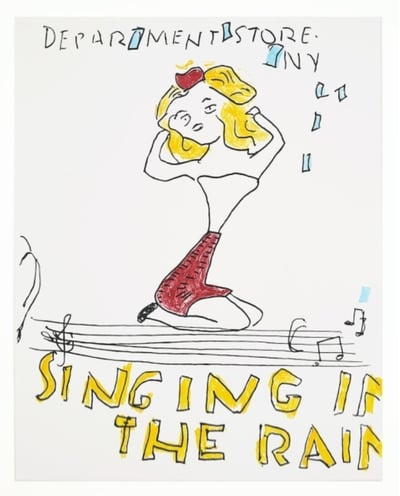
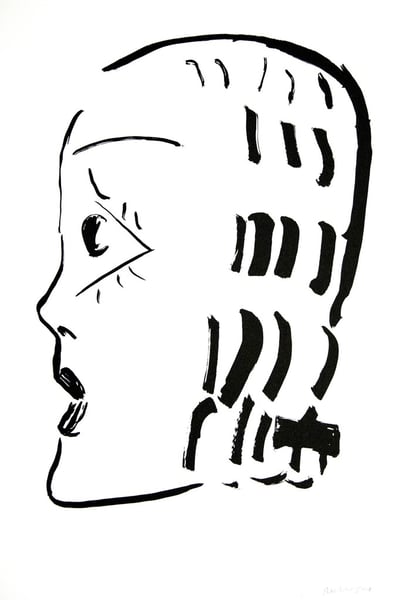
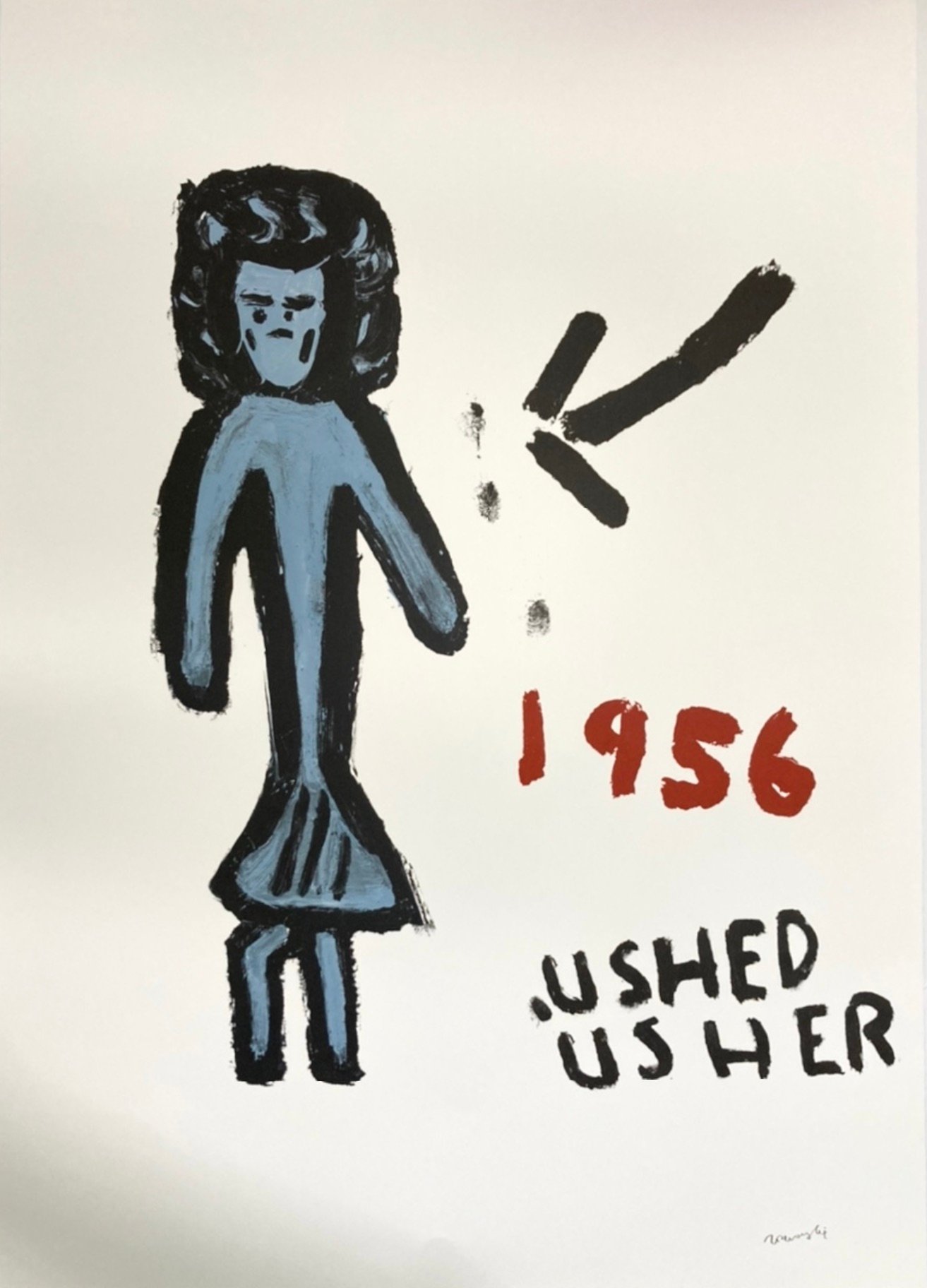
Rose Wylie’s Grumpy Girl (2020) is a lithograph that captures her signature raw, expressive style. The work features a loosely rendered female figure in blue with exaggerated features and an intense expression. The rough black outlines and uneven brushstrokes lend a childlike yet deeply evocative quality to the piece. Accompanying the figure are bold, handwritten elements: the year “1956” in red and the fragmented phrase “USHED USHER” in black, adding layers of ambiguity and intrigue.
Wylie is known for her unfiltered, intuitive approach to painting and drawing, often drawing inspiration from memory, pop culture, and personal history. This work exemplifies her ability to create dynamic and engaging compositions that blur the line between fine art and visual storytelling. The deliberately imperfect execution and stark contrast between text and imagery invite viewers to interpret the piece in multiple ways, reinforcing Wylie’s playful yet profound artistic language.
Rose Wylie (UK, 1934) is a celebrated British painter known for her bold, large-scale canvases that feature playful, cartoon-like imagery. Her work often draws inspiration from pop culture, daily life, and art history, with a distinctive, childlike aesthetic that challenges traditional notions of composition and technique. Wylie’s unique style has gained her acclaim in contemporary art circles worldwide.
Lithograph Lithography is a printing method based on the principle that water and oil do not mix. It can be used to print artwork or text onto paper or other suitable materials. Traditionally, an image was drawn with wax, fat, or oil onto a lithographic limestone surface or plate. Today, metal plates and other surfaces are also used in lithographic printing.
Rose Wylie’s Grumpy Girl (2020) is a lithograph that captures her signature raw, expressive style. The work features a loosely rendered female figure in blue with exaggerated features and an intense expression. The rough black outlines and uneven brushstrokes lend a childlike yet deeply evocative quality to the piece. Accompanying the figure are bold, handwritten elements: the year “1956” in red and the fragmented phrase “USHED USHER” in black, adding layers of ambiguity and intrigue.
Wylie is known for her unfiltered, intuitive approach to painting and drawing, often drawing inspiration from memory, pop culture, and personal history. This work exemplifies her ability to create dynamic and engaging compositions that blur the line between fine art and visual storytelling. The deliberately imperfect execution and stark contrast between text and imagery invite viewers to interpret the piece in multiple ways, reinforcing Wylie’s playful yet profound artistic language.
Rose Wylie (UK, 1934) is a celebrated British painter known for her bold, large-scale canvases that feature playful, cartoon-like imagery. Her work often draws inspiration from pop culture, daily life, and art history, with a distinctive, childlike aesthetic that challenges traditional notions of composition and technique. Wylie’s unique style has gained her acclaim in contemporary art circles worldwide.
Imperfections give energy to a painting—it shouldn’t be too tidy.
- Rose Wylie
Renowned for her vibrant, often child-like imagery, Rose Wylie is a painter whose works are often large-scale and created on unstretched, unprimed canvas; depicting various subjects ranging from cultural iconography to hybrid forms, Wylie has acknowledged that the primitive nature of her art can be difficult for some people to comprehend ‘but then they find that actually there’s stuff in it relating to Dürer and Cézanne’. Among the works that best capture her signature style are Queen of Sheba with Gold Lump and Black Stork, both of which also feature her trademark illegible scrawling, further emphasising the absurdity and wry humour of the final image presented.
Comic strip art refers to artwork that utilizes the subject matter and commercial printing techniques found in comic strips. In the 1960s, a group of artists began creating paintings that incorporated Ben-Day dots—commonly used in comics and advertising—to produce highly graphic designs in bright colors, using traditional art media.