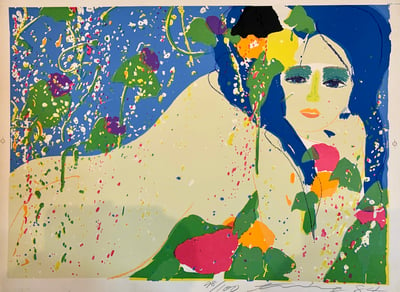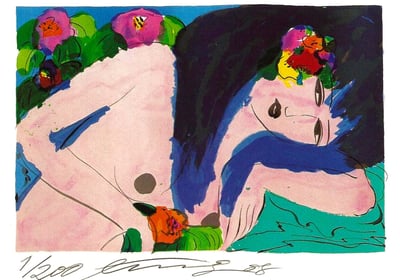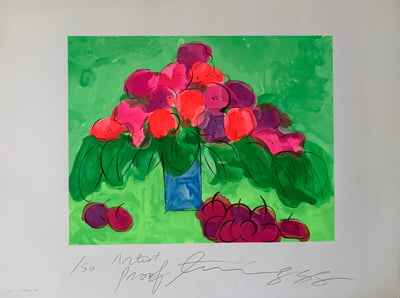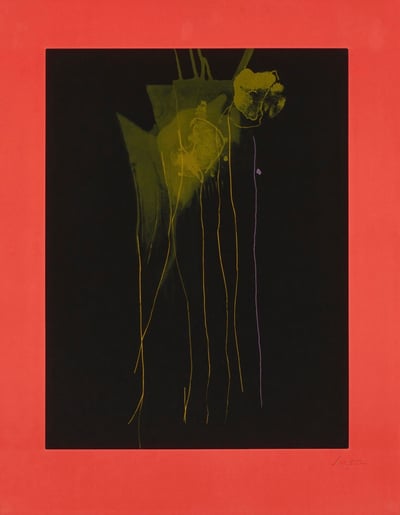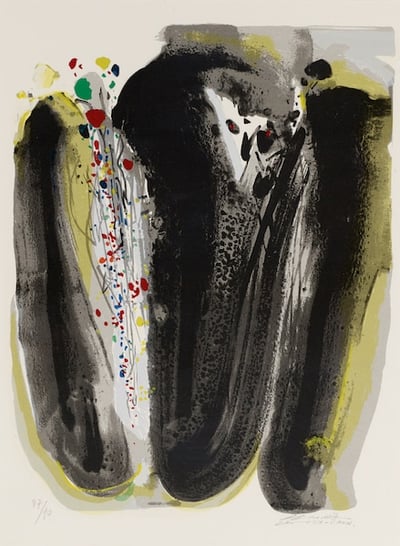
Nature Morte by Walasse Ting, created in 1990, is a vibrant lithograph that exudes life and color, contrasting with the traditional concept of a still life. Ting’s composition is filled with a lush array of flowers in full bloom, fruit, and birds in cages, rendered in his characteristic bold and expressive color palette. Dominated by rich reds, yellows, pinks, and greens, the artwork has an energetic and joyful atmosphere, capturing the essence of nature's beauty. The colorful birds in cages add a whimsical touch, while the abundant arrangement of fruits and flowers conveys vitality and abundance. Measuring 120 x 160 cm and part of a limited edition of 250, this lithograph showcases Ting's unique ability to blend elements of Eastern and Western art traditions with a contemporary, vibrant aesthetic.
Walasse Ting (China/United States, 1928–2010) was a Chinese-American visual artist and poet celebrated for his vibrant paintings that blend Eastern and Western styles. His works often feature vivid depictions of women, animals, and nature, characterized by bold colors and expressive brushstrokes. Ting was associated with the CoBrA movement and influenced by Abstract Expressionism and Pop Art.
LithographLithography is a printing method based on the principle that water and oil do not mix. It can be used to print artwork or text onto paper or other suitable materials. Traditionally, an image was drawn with wax, fat, or oil onto a lithographic limestone surface or plate. Today, metal plates and other surfaces are also used in lithographic printing.
Nature Morte by Walasse Ting, created in 1990, is a vibrant lithograph that exudes life and color, contrasting with the traditional concept of a still life. Ting’s composition is filled with a lush array of flowers in full bloom, fruit, and birds in cages, rendered in his characteristic bold and expressive color palette. Dominated by rich reds, yellows, pinks, and greens, the artwork has an energetic and joyful atmosphere, capturing the essence of nature's beauty. The colorful birds in cages add a whimsical touch, while the abundant arrangement of fruits and flowers conveys vitality and abundance. Measuring 120 x 160 cm and part of a limited edition of 250, this lithograph showcases Ting's unique ability to blend elements of Eastern and Western art traditions with a contemporary, vibrant aesthetic.
Walasse Ting (China/United States, 1928–2010) was a Chinese-American visual artist and poet celebrated for his vibrant paintings that blend Eastern and Western styles. His works often feature vivid depictions of women, animals, and nature, characterized by bold colors and expressive brushstrokes. Ting was associated with the CoBrA movement and influenced by Abstract Expressionism and Pop Art.
There is only one kind of birth, but there are a hundred kinds of death.
- Walasse Ting
The Belgian artist, Pierre Alechinsky discovered Walasse Ting sleeping on boards in a tiny attic room and became his best friend. Walasse Ting was inspired by the “Expressionist” movement, as well as the many works of Picasso. He began as an abstract artist, but the bulk of his work since the mid 1970's has been described as popular “figuratism.” In the early 1940's Walasse Ting exhibited a few water colors at a local Hong Kong bookstore. However, he made his way to Paris and then to the West, where he struggled for six years before becoming noticed by the COBRA artistic group: Karel Appel, Asger Jorn and his friend Alechinsky. In the mid 1950's, Walasse Ting became involved in the “abstract expressionist” era, where he was befriended by Sam Francis. Ting had been previously noted for his bold strokes which were mainly poetic abstracts, like the renowned artist Zao Wouki. In the 1970's Ting developed his own distinctive style, using vivid acrylic paint within his Chinese calligraphic brushstrokes. Walasse Ting’s artistic works are filled with vitality and freshness, in his depictions of sensuous women, flowers, birds, fishes, various types of animals, and a wide array of flora and fauna. His art work is simply named, such as "Lady With Vase," "Busy Bodies," and "Cat In The Garden." Ting’s canvas paintings expressed his passion for the beauty of the natural world, which awarded him the Guggenheim Fellowship Award for Drawing. Walasse Ting was self-taught, but his artistic works can be found in the permanent collections of international museums, such as the Museum of Modern Art, Art Institute of Chicago, London's Tate Modern, Centre Pompidou, and the Parisian and Hong Kong Museum of Art, as well as many others. After 20 years in New York, Walasse Ting moved to Amsterdam, which he said reminded him of Hangzhou's West Lake area. His exotic colorful abstracts are an inspiration of his experiences in Tahiti, like Gauguin. Ting suffered a brain hemorrhage in 2002 and passed away in 2010, in New York after he moved from the Netherlands.
Gestural art is a term that describes painting with freely sweeping brushstrokes. The primary goal of gestural art is to allow the artist to physically express emotional impulses. The varied, yet expressive paint marks are intended to convey the artist's inner thoughts and emotions, which viewers are believed to understand through the dynamic and spontaneous application of paint.