

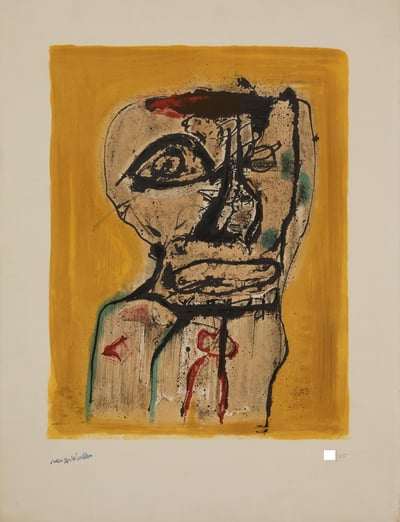
Willem van Hecke's untitled lithograph presents an abstract and emotionally charged portrait. The piece depicts a distorted human face with exaggerated features, rendered in thick black strokes and raw textures. Splashes of red and teal add a sense of urgency and vitality to the composition, while the golden ochre background creates a stark contrast, isolating the figure. The artwork carries an expressive, almost primal quality, emphasizing emotion over realism. Its rough lines and layered textures suggest themes of human struggle, inner turmoil, or existential reflection, reminiscent of post-war European expressionism.
Artwork Copyright © Willem Van HeckeWillem Van Hecke (Belgium, 1893–1976) was a self-taught artist known for his expressive seascapes, landscapes, and figurative paintings. His work evolved from early Impressionist influences to a distinctive style characterized by muted tones and abstract forms, reflecting themes of desolation and introspection. Van Hecke's art has been featured in numerous exhibitions and continues to be celebrated for its emotional depth and unique perspective.
Artwork Copyright © Willem Van HeckeUntitled
Form
Medium
Size
- Inches
- Centimeters
Edition
Price
Available works →
- Authenticity Guaranteed
- Insured Shipping
- Online Since 2005
●
●Inventory 15994
●Signed
●Comes with gallery invoice and certificate
●Sell Us a Similar Artwork. Learn more.
Willem van Hecke's untitled lithograph presents an abstract and emotionally charged portrait. The piece depicts a distorted human face with exaggerated features, rendered in thick black strokes and raw textures. Splashes of red and teal add a sense of urgency and vitality to the composition, while the golden ochre background creates a stark contrast, isolating the figure. The artwork carries an expressive, almost primal quality, emphasizing emotion over realism. Its rough lines and layered textures suggest themes of human struggle, inner turmoil, or existential reflection, reminiscent of post-war European expressionism.
Artwork Copyright © Willem Van HeckeWillem Van Hecke (Belgium, 1893–1976) was a self-taught artist known for his expressive seascapes, landscapes, and figurative paintings. His work evolved from early Impressionist influences to a distinctive style characterized by muted tones and abstract forms, reflecting themes of desolation and introspection. Van Hecke's art has been featured in numerous exhibitions and continues to be celebrated for its emotional depth and unique perspective.
Artwork Copyright © Willem Van Hecke- Recently Added
- Price (Low-High)
- Price (High-Low)
- Year (Low-High)
- Year (High-Low)
Willem Van Hecke
Untitled
Limited Edition Print
Lithograph
Currently Not Available
Related Artists


Artwork by Alex Katz
What is figurative art?
Sometimes known as Figurativism, figurative art refers to sculptures and paintings that are clearly or specifically derived from real objects, making them representational. The term figurative art is often used in contrast to abstract art. However, since the emergence of abstract art, figurative art has come to describe any form of modern art that has strong references to the real world or actual situations.

Willem Van Hecke
Untitled
55 x 42 cm


