
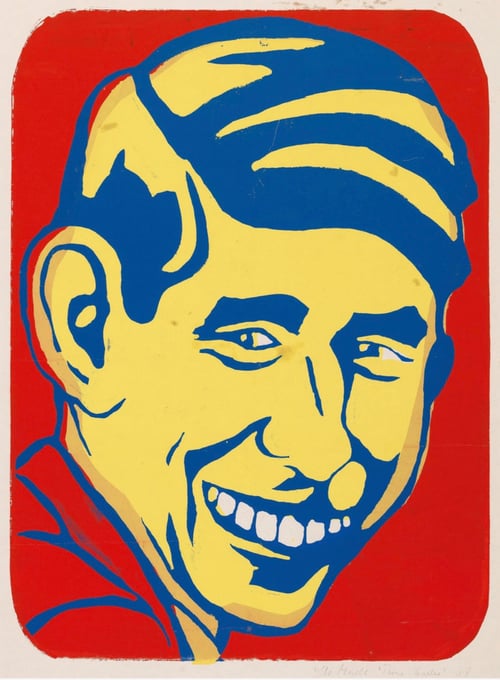
Otto Muehl
Otto Muehl (Austria, 1925–2013) was a controversial artist and a founding member of Viennese Actionism. Known for his provocative performances and multimedia works, he challenged societal norms with themes of liberation and chaos. Despite his innovative contributions to performance art, Muehl's legacy remains complex due to his later personal scandals.
© Otto Muehl. All rights reserved.
- Recently Added
- Price (Low-High)
- Price (High-Low)
- Year (Low-High)
- Year (High-Low)

Otto Muehl
Prinz Charles, 1967
Limited Edition Print
Silkscreen
Currently Not Available
No sold works to show.
I have been making art for 50 years and have never allowed myself to be corrupted.
- Otto Muehl
- Otto Muehl
Otto Muehl was an artist who went against the conformities of what he thought to be bourgeois society. In particular he was against sexual monogamy and this is reflected heavily in his art. Muehl is an expressionist artist who used a variety of mediums, but seemed to enjoy performance art the most. Almost all of his art either includes nudes, or is a reference to sexuality. A quote from Muehl about his art is “I enjoy confounding people,” he said. “That is my big idea. I have nothing more.” Muehl has some paintings on canvas which all express a lustful feeling such as Woman, and Woman In Red. His performance art heavily features nude models. Muehl's Mama and Papa series and Versumpfung Einer Venus series were photographed in black and white of nude models in literally sticky situations. Muehl would use not only paint, but mud, food, blood, and fecal matter to splatter and pour over the models in a style a la Jackson Pollock. Muehl is quoted as saying "The aesthetics of the dung heap are the moral means against conformism, materialism and stupidity." Otto Muehl also did some films of his performance art, which frequently included sexual intercourse while covered in the aforementioned mediums.
Related Artists


Related Articles

Popular, Art Movements - May 23, 2022
Viennese Actionism: An unique convergence of shock value and Transcendence
Explore the provocative legacy of Viennese Actionism, blending shock value and transcendence. Discover how its pioneers redefined art with raw, political perfor…Read More
News, Popular, Collecting, Artists - August 12, 2026
In Minor Keys: Finding Intimacy and Identity at the 61st Venice Biennale — and in Your Collection
Explore how Koyo Kouoh’s 61st Venice Biennale vision, In Minor Keys, is shifting contemporary collecting toward quiet introspection, memory, and personal identi…Read More
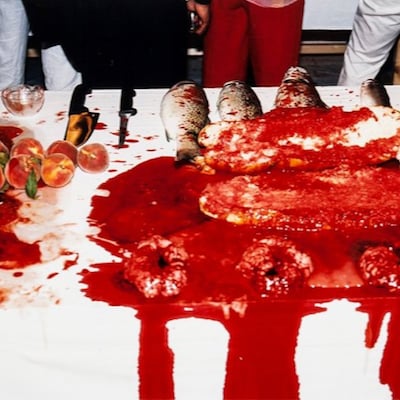 Artwork by Hermann Nitsch
What is actionism?
Viennese Actionism was a short-lived but intense art movement in the 20th century, emerging as part of the broader action art efforts of the 1960s. Known for its violent and provocative performances, the movement sought to break traditional art boundaries. Key figures in this movement included Arnulf Rainer and Hermann Nitsch.
Explore »

