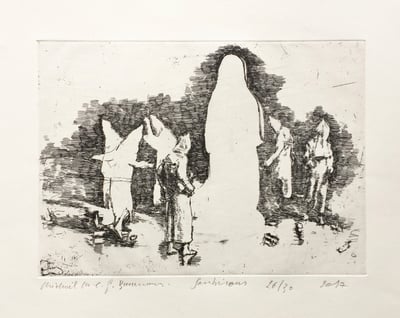
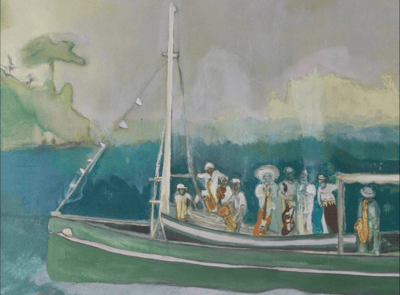
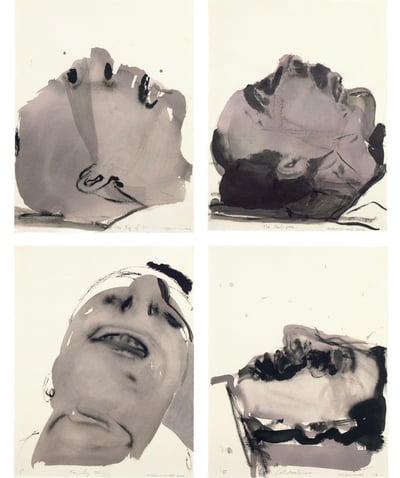
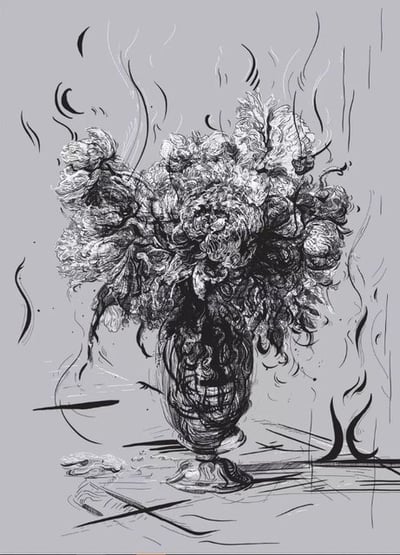
Portfolio of 7 artworks - Digital print on Conqueror Vergé Pencil paper -
Signed in pencil
Nevermore (Portfolio of 7) by Adrian Ghenie is a 2020 digital print series that delves into complex, layered portraits using collage techniques. Each of the seven pieces reinterprets classical portraiture, merging surreal and fragmented elements to evoke psychological depth and ambiguity. Ghenie’s signature blending of distorted faces and symbolic imagery offers a haunting exploration of identity, memory, and existential contemplation. Printed on Conqueror Vergé Pencil paper, the collection’s rough textures and muted tones enhance the sense of distortion and unease, inviting viewers to decode each piece’s underlying narrative. This series is signed in pencil, marking Ghenie's unique approach to digital printmaking.
Adrian Ghenie (Romania, 1977) is a contemporary painter whose work blends figurative and abstract elements to explore themes of history, memory, and identity. Utilizing a palette knife, he creates dynamic textures and complex compositions. Ghenie co-founded Galeria Plan B in Cluj-Napoca and has exhibited internationally, including representing Romania at the 56th Venice Biennale.
Digital Print on paperDigital print on paper refers to a digital image printed with archival-grade inks on high-quality, acid-free paper. This process ensures the print can last over twenty years if properly stored. The digital file allows for future prints to be made as needed.
Portfolio of 7 artworks - Digital print on Conqueror Vergé Pencil paper -
Signed in pencil
Nevermore (Portfolio of 7) by Adrian Ghenie is a 2020 digital print series that delves into complex, layered portraits using collage techniques. Each of the seven pieces reinterprets classical portraiture, merging surreal and fragmented elements to evoke psychological depth and ambiguity. Ghenie’s signature blending of distorted faces and symbolic imagery offers a haunting exploration of identity, memory, and existential contemplation. Printed on Conqueror Vergé Pencil paper, the collection’s rough textures and muted tones enhance the sense of distortion and unease, inviting viewers to decode each piece’s underlying narrative. This series is signed in pencil, marking Ghenie's unique approach to digital printmaking.
Adrian Ghenie (Romania, 1977) is a contemporary painter whose work blends figurative and abstract elements to explore themes of history, memory, and identity. Utilizing a palette knife, he creates dynamic textures and complex compositions. Ghenie co-founded Galeria Plan B in Cluj-Napoca and has exhibited internationally, including representing Romania at the 56th Venice Biennale.
Characterized by vivid reinterpretation of the past, Adrian Ghenie has emerged as a sought after young artist of our time. Born in Romania, Ghenie had brought up his native as well as other cultures' histories for reexamination. Vibrant styles married with his effort to rediscover past have made art connoisseurs to compare him with twentieth century Irish-born English artist Francis Bacon.
Ghenie has used oil on canvas as his preferred media, but he has also produced mixed media, collage, and sketch. His style is participatory in nature, where the viewer would experience the way the art was created. To this end, in his paintings bold strokes of palette knife is visible, revealing the textures.
In his own words, Adrian Ghenie is like a paparazzi for textures as he wants to explore and save the textures of a time period in the artwork. For instance, this process is clearly visible in the 2019 oil on canvas "The Raft," where the viewers get a tour of how the painting was painted. The viewers experience a sense of the artist's thought process when they find a closer look changes the meaning of the subject matter in a very elusive way. Another of his work "Charles Darwin as a Young Man" brings in an influential historic figure, hence Charles Darwin, and explores the implications of his scientific theory, notably the darker side of it. In essence, Ghenie's works are sure to make viewers think and reconsider, whatever the topic is.
Sometimes known as Figurativism, figurative art refers to sculptures and paintings that are clearly or specifically derived from real objects, making them representational. The term figurative art is often used in contrast to abstract art. However, since the emergence of abstract art, figurative art has come to describe any form of modern art that has strong references to the real world or actual situations.