
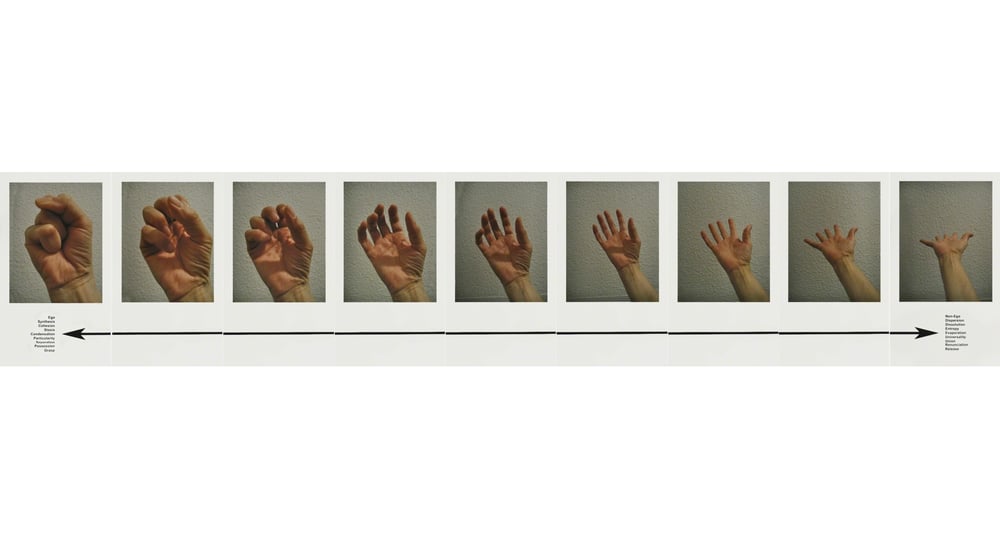
Set of 9 digital prints - size of EACH print is 40.5x23cm
Mokshamudra Progression by Adrian Piper is a limited edition set of 9 digital prints from 2012, with each print measuring 40.5 x 23 cm. This artwork presents a sequence of photographs capturing a hand progressively opening from a closed fist to an open palm. The images are arranged in a linear progression, suggesting a meditative or symbolic release. The title references moksha, a Sanskrit term signifying liberation, commonly associated with spiritual enlightenment. Piper’s piece explores themes of transformation, freedom, and the journey towards release or transcendence. The minimalist yet evocative sequence invites viewers to contemplate personal and spiritual growth, conveyed through the simple, universal gesture of the hand opening.
Artwork Copyright © Adrian PiperAdrian Piper (USA, 1948) is a conceptual artist and philosopher renowned for her provocative works addressing identity, race, and social justice. Using mediums like performance, text, and installation, Piper challenges audiences to confront biases and cultural norms. She was the first African-American woman to exhibit at the Venice Biennale in 1989.
Artwork Copyright © Adrian PiperMokshamudra Progression, 2012
Form
Medium
Size
- Inches
- Centimeters
Edition
Price
- USD
- EUR
- GBP
- CHF
- Authenticity Guaranteed
- Insured Shipping
- Online Since 2005
●Inventory 3046
●Signed
●Comes with gallery invoice and certificate
●Any questions?
Set of 9 digital prints - size of EACH print is 40.5x23cm
Mokshamudra Progression by Adrian Piper is a limited edition set of 9 digital prints from 2012, with each print measuring 40.5 x 23 cm. This artwork presents a sequence of photographs capturing a hand progressively opening from a closed fist to an open palm. The images are arranged in a linear progression, suggesting a meditative or symbolic release. The title references moksha, a Sanskrit term signifying liberation, commonly associated with spiritual enlightenment. Piper’s piece explores themes of transformation, freedom, and the journey towards release or transcendence. The minimalist yet evocative sequence invites viewers to contemplate personal and spiritual growth, conveyed through the simple, universal gesture of the hand opening.
Artwork Copyright © Adrian PiperAdrian Piper (USA, 1948) is a conceptual artist and philosopher renowned for her provocative works addressing identity, race, and social justice. Using mediums like performance, text, and installation, Piper challenges audiences to confront biases and cultural norms. She was the first African-American woman to exhibit at the Venice Biennale in 1989.
Artwork Copyright © Adrian Piper- Recently Added
- Price (Low-High)
- Price (High-Low)
- Year (Low-High)
- Year (High-Low)
Adrian Piper
Mokshamudra Progression, 2012
Limited Edition Print
Digital Print on paper
EUR 27,000
Related Artists


Artwork by On Kawara
What is mail art?
Mail Art is a populist art movement centered on the creation and exchange of small-scale artworks through the postal service. It developed out of the Fluxus movement in the 1950s and 1960s and has since evolved into a global art movement. Ray Johnson is recognized as the first mail artist, and his New York School is considered the first network of mail artists. Mail artists rely heavily on a network to exchange their works, often creating a community of artists connected through the postal system.



