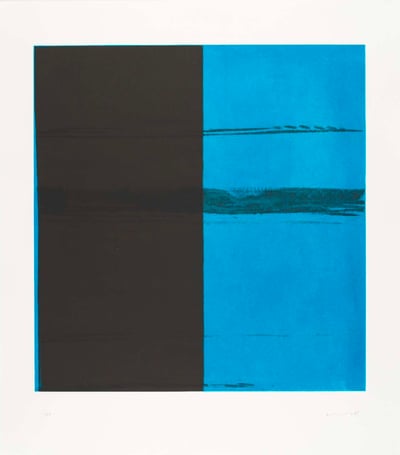
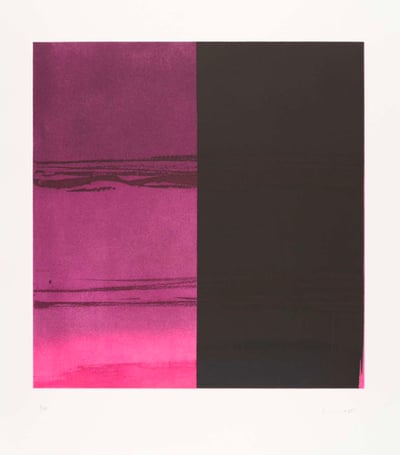
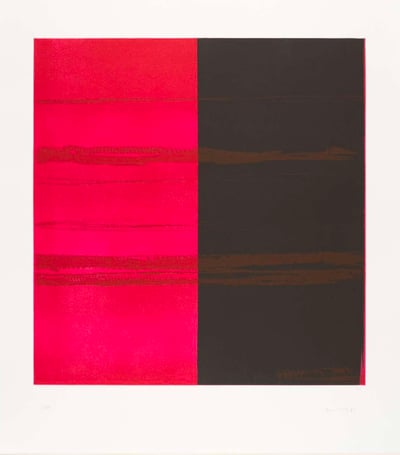
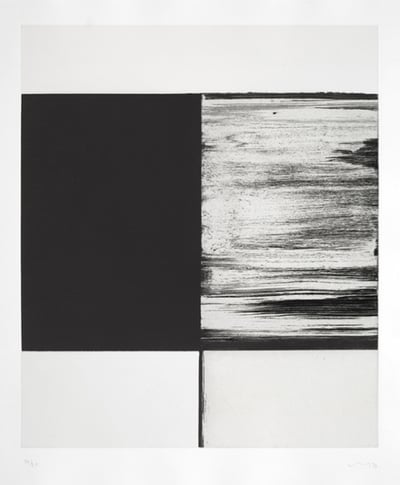
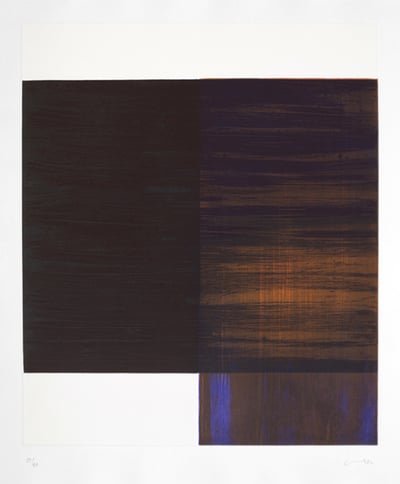
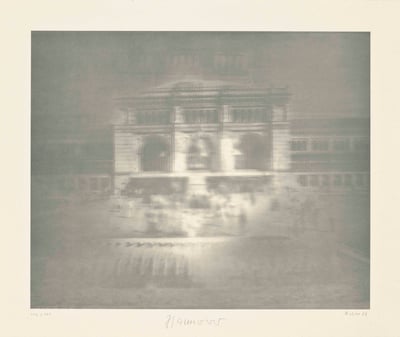
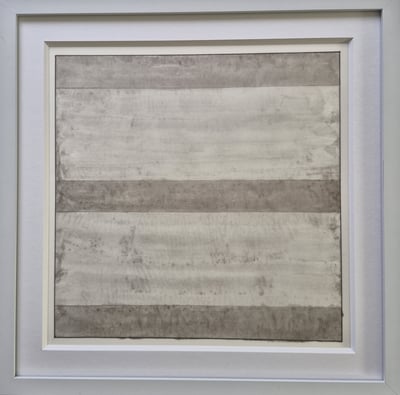
B1 by Callum Innes, created in 2022, is a set of four limited edition etchings that showcase Innes’s exploration of color and repetition through minimalistic abstraction. Each etching features a densely layered scribble-like pattern, rendered in a distinct color: yellow, black, red, and blue. The uniformity in form, yet variation in color, emphasizes the rhythm and movement within each piece, inviting viewers to engage with the subtle differences in texture and intensity. The simplicity and repetition present a meditative quality, characteristic of Innes’s practice, which often involves examining the effects of color and process. This set highlights the artist’s ability to convey depth and emotion through minimalistic gestures, making it both visually striking and contemplative.
Callum Innes (Scotland, 1962) is a Scottish abstract painter renowned for his distinctive technique of applying and removing paint to create luminous, minimalist compositions. His 'Exposed Paintings' series exemplifies this method, where he layers pigments and then uses turpentine to wash away sections, revealing subtle variations in color and texture. Innes's work explores themes of presence and absence, engaging viewers in a contemplative experience.
EtchingEtching is a technique where a design is created on a metal surface by using a strong acid or mordant to eat away the unprotected parts of the metal, leaving the desired pattern in relief (intaglio). In modern art and manufacturing, different chemicals may be used depending on the material being etched.
B1 by Callum Innes, created in 2022, is a set of four limited edition etchings that showcase Innes’s exploration of color and repetition through minimalistic abstraction. Each etching features a densely layered scribble-like pattern, rendered in a distinct color: yellow, black, red, and blue. The uniformity in form, yet variation in color, emphasizes the rhythm and movement within each piece, inviting viewers to engage with the subtle differences in texture and intensity. The simplicity and repetition present a meditative quality, characteristic of Innes’s practice, which often involves examining the effects of color and process. This set highlights the artist’s ability to convey depth and emotion through minimalistic gestures, making it both visually striking and contemplative.
Callum Innes (Scotland, 1962) is a Scottish abstract painter renowned for his distinctive technique of applying and removing paint to create luminous, minimalist compositions. His 'Exposed Paintings' series exemplifies this method, where he layers pigments and then uses turpentine to wash away sections, revealing subtle variations in color and texture. Innes's work explores themes of presence and absence, engaging viewers in a contemplative experience.
I am interested in the point where something comes into being and starts to disappear.
- Callum Innes
Callum Innes, a Scottish abstract painter, uses tone fields inside symmetrical grids or equal divisions of his paintings to create monochromic painting. Innes draws his inspiration from Barnett Newman’s work. He is distinguished by his brush technique, keenness to colour gradients and appearance.
Innes is associated with Minimalism, an art style developed after World War II. The trend is often seen as a response to abstract expressionism and modernism. He has given national and international presentations. Callum Innes' art is always meditative, the result of a laborious process of removing and applying paint. Innes' paintings are both technically and sensually appealing.
Innes attended Gray's School of Arts, where he studied drawing and painting before graduating in 1984. He enrolled in post-graduate studies at Edinburgh College in 1985. Innes received the Jerwood Painting Prize in 2002 after being shortlisted for the Turner Prize in 1995. The Edinburgh Arts Festival commissioned him in 2012 to transform the capital's Regent Bridge, which he irradiated with an alternating series of coloured light. Other notable Abstract Art figures include Wassily Kandinsky, Piet Mondrian, and Kazimir Malevich. Their countless paintings have remained iconic in history.
27M (Aritist Website)
Minimalism is a style in music and visual arts characterized by pared-down designs and simplicity. It began in Western art after World War II, gaining prominence particularly in American visual arts. Minimalism draws heavily on aspects of modernism and is often viewed as a reaction against Abstract Expressionism, as well as a precursor to post-minimal art practices. Prominent minimalist artists include Agnes Martin, Donald Judd, Robert Morris, Frank Stella, and Dan Flavin.