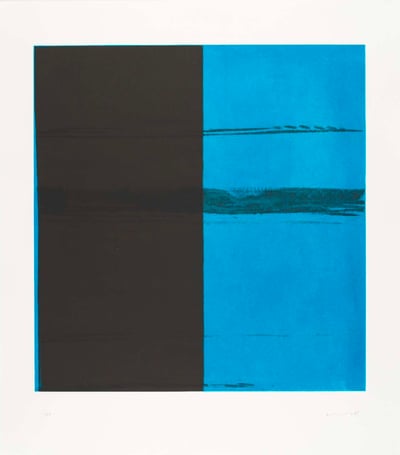
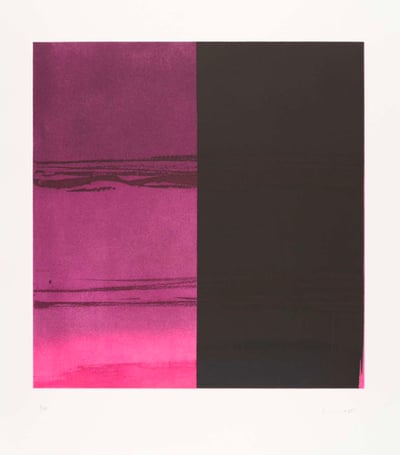
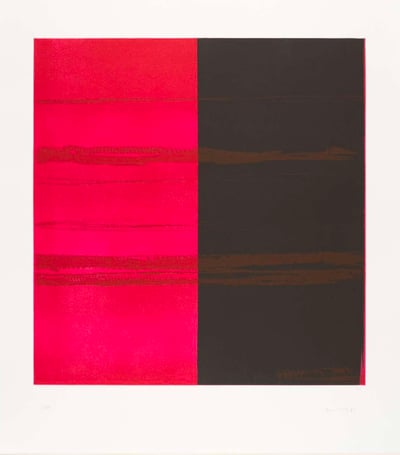
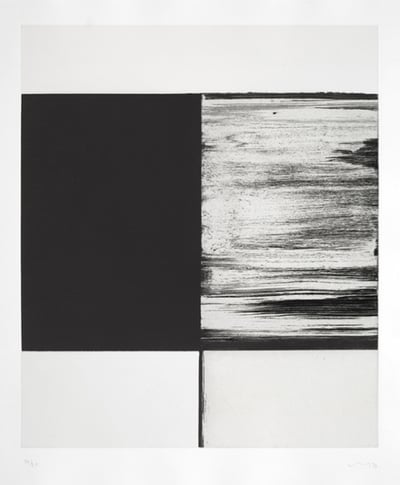
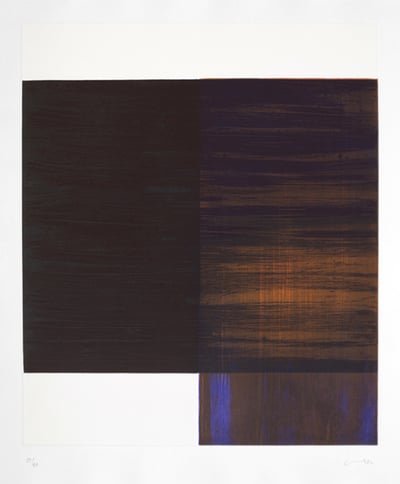
Lamp Black Cyan by Callum Innes is a limited edition print, created using etching and aquatint techniques. The composition is stark and abstract, divided into two bold sections. The left side features a solid, deep black field, evoking a sense of heaviness and depth. In contrast, the right side is a bright white space, disrupted only by a soft, horizontal blue brushstroke that appears almost translucent. The balance between these two contrasting spaces creates a visual tension, emphasizing the interaction between presence and absence, light and shadow. Innes’ minimalist approach allows for contemplation of form, color, and texture.
Callum Innes (Scotland, 1962) is a Scottish abstract painter renowned for his distinctive technique of applying and removing paint to create luminous, minimalist compositions. His 'Exposed Paintings' series exemplifies this method, where he layers pigments and then uses turpentine to wash away sections, revealing subtle variations in color and texture. Innes's work explores themes of presence and absence, engaging viewers in a contemplative experience.
Etching and AquatintEtching and aquatint are printmaking techniques. In aquatint, the printing plate is etched with a pattern of tiny pits and cracks to create a wide range of tonal gradations. This technique allows artists to replicate the broad, flat tones found in watercolor paintings and ink washes.
Lamp Black Cyan by Callum Innes is a limited edition print, created using etching and aquatint techniques. The composition is stark and abstract, divided into two bold sections. The left side features a solid, deep black field, evoking a sense of heaviness and depth. In contrast, the right side is a bright white space, disrupted only by a soft, horizontal blue brushstroke that appears almost translucent. The balance between these two contrasting spaces creates a visual tension, emphasizing the interaction between presence and absence, light and shadow. Innes’ minimalist approach allows for contemplation of form, color, and texture.
Callum Innes (Scotland, 1962) is a Scottish abstract painter renowned for his distinctive technique of applying and removing paint to create luminous, minimalist compositions. His 'Exposed Paintings' series exemplifies this method, where he layers pigments and then uses turpentine to wash away sections, revealing subtle variations in color and texture. Innes's work explores themes of presence and absence, engaging viewers in a contemplative experience.
I am interested in the point where something comes into being and starts to disappear.
- Callum Innes
Callum Innes, a Scottish abstract painter, uses tone fields inside symmetrical grids or equal divisions of his paintings to create monochromic painting. Innes draws his inspiration from Barnett Newman’s work. He is distinguished by his brush technique, keenness to colour gradients and appearance.
Innes is associated with Minimalism, an art style developed after World War II. The trend is often seen as a response to abstract expressionism and modernism. He has given national and international presentations. Callum Innes' art is always meditative, the result of a laborious process of removing and applying paint. Innes' paintings are both technically and sensually appealing.
Innes attended Gray's School of Arts, where he studied drawing and painting before graduating in 1984. He enrolled in post-graduate studies at Edinburgh College in 1985. Innes received the Jerwood Painting Prize in 2002 after being shortlisted for the Turner Prize in 1995. The Edinburgh Arts Festival commissioned him in 2012 to transform the capital's Regent Bridge, which he irradiated with an alternating series of coloured light. Other notable Abstract Art figures include Wassily Kandinsky, Piet Mondrian, and Kazimir Malevich. Their countless paintings have remained iconic in history.
27M (Aritist Website)
Contemporary art refers to avant-garde or innovative art created in the recent past or present day. The exact starting point of contemporary art varies depending on the institution, often tied to the founding year of museums or galleries that showcase the style. Contemporary art is characterized by its focus on current ideas, diverse media, and the exploration of new concepts and techniques.