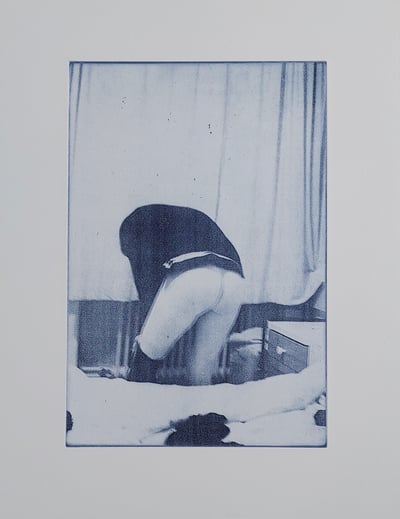
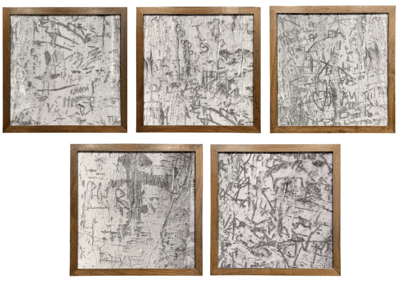
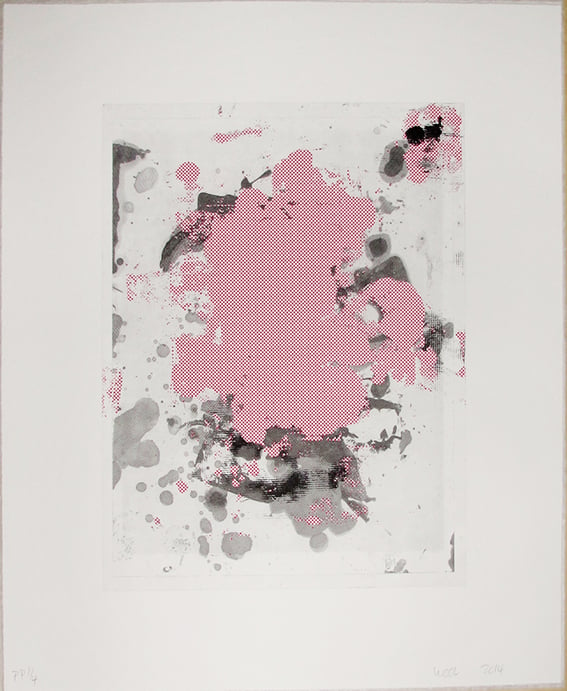
Christopher Wool's Portraits (Red) 4 (2014) is a lithograph on Rives BFK White paper, showcasing his signature abstract and expressive style. The artwork features a composition of irregular splashes and blotches, primarily rendered in shades of pink and black. The piece utilizes both organic forms and the repetition of halftone patterns, creating a layered, textured effect that challenges traditional portraiture. Wool's work often explores the intersection of abstraction and text, yet this piece emphasizes form and texture, highlighting the spontaneity and energy in his artistic process. This limited edition print is hand-numbered, with only 28 copies available, enhancing its rarity and value.
Christopher Wool (USA, 1955) is a prominent painter best known for his large-scale, text-based works and abstract compositions. His use of bold stenciled words, repetitive patterns, and graffiti-inspired gestures challenges traditional ideas of beauty and expression. Wool’s work combines elements of pop art, minimalism, and conceptual art, making a significant impact on contemporary painting.
Lithograph Lithography is a printing method based on the principle that water and oil do not mix. It can be used to print artwork or text onto paper or other suitable materials. Traditionally, an image was drawn with wax, fat, or oil onto a lithographic limestone surface or plate. Today, metal plates and other surfaces are also used in lithographic printing.
Christopher Wool's Portraits (Red) 4 (2014) is a lithograph on Rives BFK White paper, showcasing his signature abstract and expressive style. The artwork features a composition of irregular splashes and blotches, primarily rendered in shades of pink and black. The piece utilizes both organic forms and the repetition of halftone patterns, creating a layered, textured effect that challenges traditional portraiture. Wool's work often explores the intersection of abstraction and text, yet this piece emphasizes form and texture, highlighting the spontaneity and energy in his artistic process. This limited edition print is hand-numbered, with only 28 copies available, enhancing its rarity and value.
Christopher Wool (USA, 1955) is a prominent painter best known for his large-scale, text-based works and abstract compositions. His use of bold stenciled words, repetitive patterns, and graffiti-inspired gestures challenges traditional ideas of beauty and expression. Wool’s work combines elements of pop art, minimalism, and conceptual art, making a significant impact on contemporary painting.
The harder you look at something, the more it disappears.
- Christopher Wool
Christopher Wool is an American abstract painter who emerged from the 1980s New York art scene.Influenced by the Punk and No Wave movements of the early 1970s, he is also know for his bleak photographic explorations of urban landscapes. Christopher Wool began painting at a time when the form had been relegated as virtually dead by the artistic movement of the time, as defined by Douglas Crimp's influential 1981 essay The End of Painting which declared the form outmoded and all but redundant. Christopher Wool’s response to painting against this cultural backdrop was to reveal how to paint rather than what to paint through his art, with his distinctive works featuring patterned images painted over with paint rollers. This was a method of drawing and erasing, adding and subtracting, which concentrated on process rather than subject. In the late 1980s Christopher Wool began to experiment with word paintings which featured stencilled black text on white backgrounds, focussing on the topography of everyday signage. His seminal 1988 exhibition Apocalypse Now featured words from the Francis Ford Coppola film of the same name. His 2004 book East Broadway Breakdown is a black and white nocturnal photographic series that captures his downtown neighborhood of 25 years. Christopher Wool sees photography as an extension of his paintings, exploring monochrome patterns and flat, two dimensional imagery. Christopher Wool works mainly with mixed media such as paint and spray paint on silkscreen, allowing him to layer and obscure his pieces with the motifs of transformation. Using freehand strokes and spray guns his compositions evoke the act of graffiti or vandalism that exists on the city streets that he references. Wool's paintings featured prominently in the exhibition Abstractions Since 1980 at theGuggenheim Museum in 2014. (Artist website)
Gestural art is a term that describes painting with freely sweeping brushstrokes. The primary goal of gestural art is to allow the artist to physically express emotional impulses. The varied, yet expressive paint marks are intended to convey the artist's inner thoughts and emotions, which viewers are believed to understand through the dynamic and spontaneous application of paint.