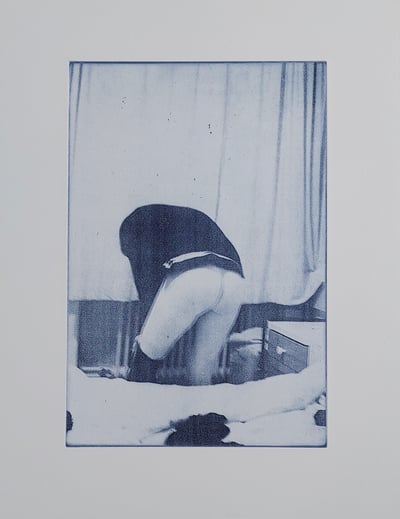
// Christopher Wool's Untitled (1994) is a provocative photogravure that explores themes of vulnerability, intimacy, and abstraction through an unconventional portrayal of the human form. Captured in stark monochrome, the composition presents a fragmented view of a figure bent forward in a seemingly private setting, with the subject’s face hidden and body partially obscured. The high-contrast image, marked by grainy textures and shadowy details, evokes a sense of voyeurism while simultaneously concealing the full narrative, inviting viewers to interpret the scene through their personal lens. Wool's work often challenges conventional boundaries of subject matter, using anonymity and ambiguity to explore the raw and unseen aspects of human experience.
Christopher Wool (USA, 1955) is a prominent painter best known for his large-scale, text-based works and abstract compositions. His use of bold stenciled words, repetitive patterns, and graffiti-inspired gestures challenges traditional ideas of beauty and expression. Wool’s work combines elements of pop art, minimalism, and conceptual art, making a significant impact on contemporary painting.
PhotogravurePhotogravure is a high-quality printing process that involves etching a photograph onto a copper plate. The plate is inked and pressed onto paper, producing fine art prints with detailed, soft tones and rich textures. Developed in the 19th century, photogravure is renowned for its ability to create art reproductions with exceptional depth and subtlety.
// Christopher Wool's Untitled (1994) is a provocative photogravure that explores themes of vulnerability, intimacy, and abstraction through an unconventional portrayal of the human form. Captured in stark monochrome, the composition presents a fragmented view of a figure bent forward in a seemingly private setting, with the subject’s face hidden and body partially obscured. The high-contrast image, marked by grainy textures and shadowy details, evokes a sense of voyeurism while simultaneously concealing the full narrative, inviting viewers to interpret the scene through their personal lens. Wool's work often challenges conventional boundaries of subject matter, using anonymity and ambiguity to explore the raw and unseen aspects of human experience.
Christopher Wool (USA, 1955) is a prominent painter best known for his large-scale, text-based works and abstract compositions. His use of bold stenciled words, repetitive patterns, and graffiti-inspired gestures challenges traditional ideas of beauty and expression. Wool’s work combines elements of pop art, minimalism, and conceptual art, making a significant impact on contemporary painting.
The harder you look at something, the more it disappears.
- Christopher Wool
Christopher Wool is an American abstract painter who emerged from the 1980s New York art scene.Influenced by the Punk and No Wave movements of the early 1970s, he is also know for his bleak photographic explorations of urban landscapes. Christopher Wool began painting at a time when the form had been relegated as virtually dead by the artistic movement of the time, as defined by Douglas Crimp's influential 1981 essay The End of Painting which declared the form outmoded and all but redundant. Christopher Wool’s response to painting against this cultural backdrop was to reveal how to paint rather than what to paint through his art, with his distinctive works featuring patterned images painted over with paint rollers. This was a method of drawing and erasing, adding and subtracting, which concentrated on process rather than subject. In the late 1980s Christopher Wool began to experiment with word paintings which featured stencilled black text on white backgrounds, focussing on the topography of everyday signage. His seminal 1988 exhibition Apocalypse Now featured words from the Francis Ford Coppola film of the same name. His 2004 book East Broadway Breakdown is a black and white nocturnal photographic series that captures his downtown neighborhood of 25 years. Christopher Wool sees photography as an extension of his paintings, exploring monochrome patterns and flat, two dimensional imagery. Christopher Wool works mainly with mixed media such as paint and spray paint on silkscreen, allowing him to layer and obscure his pieces with the motifs of transformation. Using freehand strokes and spray guns his compositions evoke the act of graffiti or vandalism that exists on the city streets that he references. Wool's paintings featured prominently in the exhibition Abstractions Since 1980 at theGuggenheim Museum in 2014. (Artist website)
Sometimes referred to as Conceptualism, this is an art form where the idea(s) or concept(s) behind the work take precedence over material concerns and traditional aesthetics. Many conceptual artworks can be created by anyone simply by following written instructions. The concept or idea is the most essential aspect of the artwork.