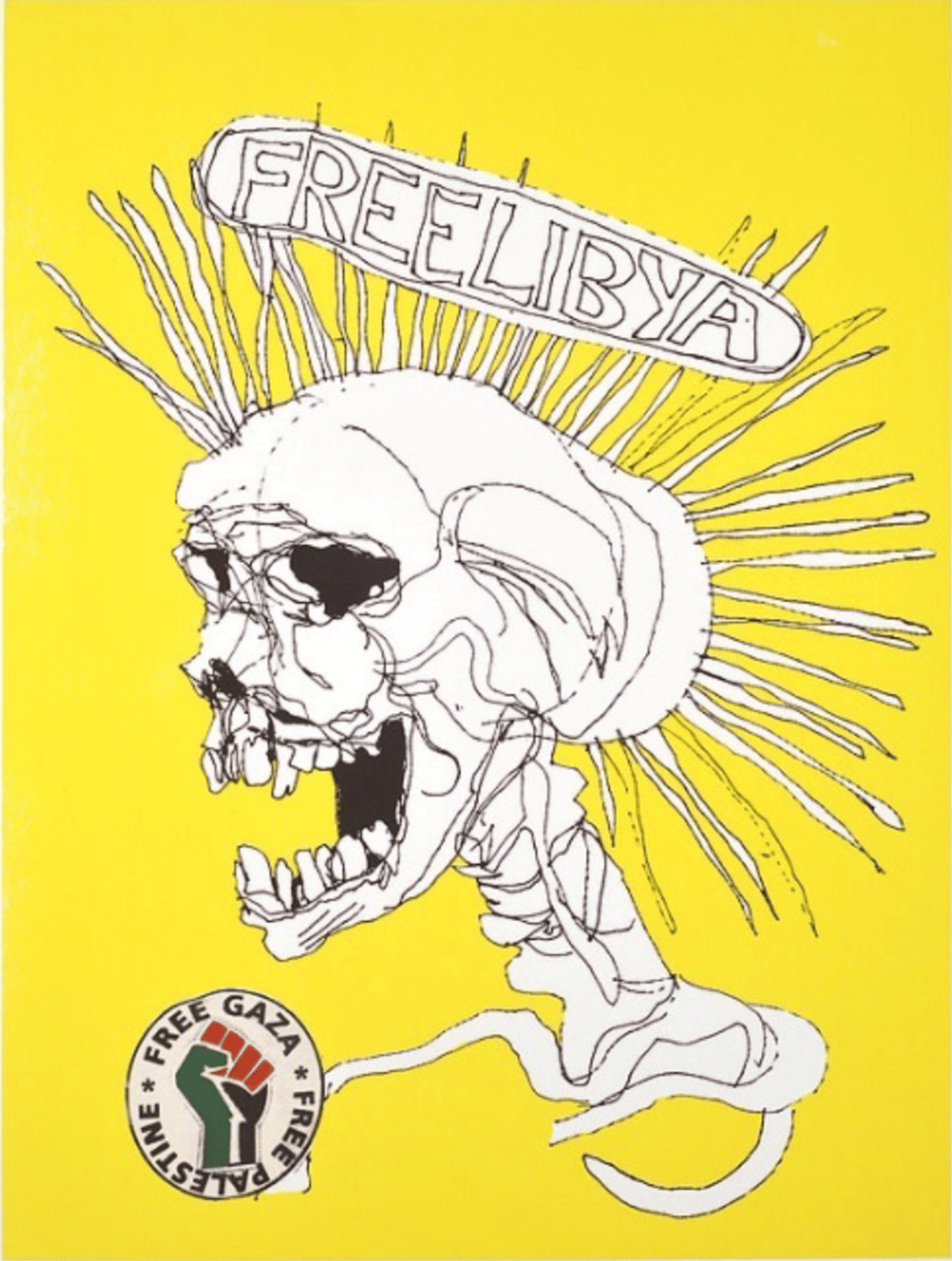
// Untitled E by Daniel Richter is a 2016-2017 silkscreen print that combines graphic, punk-inspired elements with powerful political messaging. Set against a bold yellow background, the central image is a skeletal skull with exaggerated, spiky projections resembling a headdress or crown, evoking a sense of rebellion and urgency. Above the skull, the words FREE LIBYA are prominently displayed, while a circular emblem at the bottom-left corner reads FREE GAZA, FREE PALESTINE, accompanied by a raised fist symbol. The print draws on the aesthetics of protest art and countercultural graphics, merging raw, visceral imagery with declarations of political solidarity. Richter’s work here challenges viewers to confront issues of freedom, resistance, and solidarity, using stark symbolism and contrasting colors to deliver a message that is as visually arresting as it is provocative.
Daniel Richter (Germany, 1962) is a contemporary artist recognized for his dynamic and colorful large-scale paintings. His work often blends abstract and figurative elements, addressing themes of history, politics, and pop culture. A leading figure in modern German art, his pieces are featured in major international museums and collections.
Silkscreen Silkscreen is a printmaking method that uses a screen made of silk or other mesh fabric. The screen is treated with a substance that blocks ink in certain areas, allowing ink to pass through only in the desired sections. Each color in the print requires a separate screen.
// Untitled E by Daniel Richter is a 2016-2017 silkscreen print that combines graphic, punk-inspired elements with powerful political messaging. Set against a bold yellow background, the central image is a skeletal skull with exaggerated, spiky projections resembling a headdress or crown, evoking a sense of rebellion and urgency. Above the skull, the words FREE LIBYA are prominently displayed, while a circular emblem at the bottom-left corner reads FREE GAZA, FREE PALESTINE, accompanied by a raised fist symbol. The print draws on the aesthetics of protest art and countercultural graphics, merging raw, visceral imagery with declarations of political solidarity. Richter’s work here challenges viewers to confront issues of freedom, resistance, and solidarity, using stark symbolism and contrasting colors to deliver a message that is as visually arresting as it is provocative.
Daniel Richter (Germany, 1962) is a contemporary artist recognized for his dynamic and colorful large-scale paintings. His work often blends abstract and figurative elements, addressing themes of history, politics, and pop culture. A leading figure in modern German art, his pieces are featured in major international museums and collections.
The more you know about the historical or ecological background of images, the more you can interpret, but it's not necessarily the truth about it.
- Daniel Richter
Daniel Richter attended Hochschule für bildende Künste Hamburg in the early nineties, and during the time he spent at University he studied with Werner Buttner and Martin Kippenberger. Richter was part of the resurgence of demonstrative painting during the 1980s. He was a professor of art (painting) at Universität der Künste, Germany in the middle of of the 2000's. Now he teaches at Akademie der bildenden Künste, Vienna. Daniel Richter initially focused on abstract painting, which were extremely colorful and was must like graffiti art. He has been creating large scale scenes which have been inspired by newspapers and books since 2002. Although Daniel Richter's work has appeared in countless exhibitions world wide, some of his best known work has been his set designs for 'Bluebeard's Castle' and for 'Lulu' at the Salzburg Festival. His collections can be found at the Museum of Modern Art in New York City, The Centre Pompidou in Paris, the Boros assemblage in Germany and the Falckenberg Display in Hamburg.
Gestural art is a term that describes painting with freely sweeping brushstrokes. The primary goal of gestural art is to allow the artist to physically express emotional impulses. The varied, yet expressive paint marks are intended to convey the artist's inner thoughts and emotions, which viewers are believed to understand through the dynamic and spontaneous application of paint.