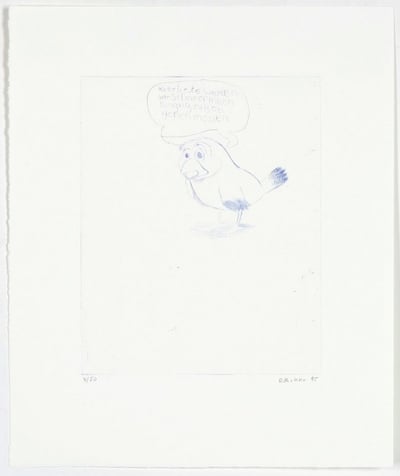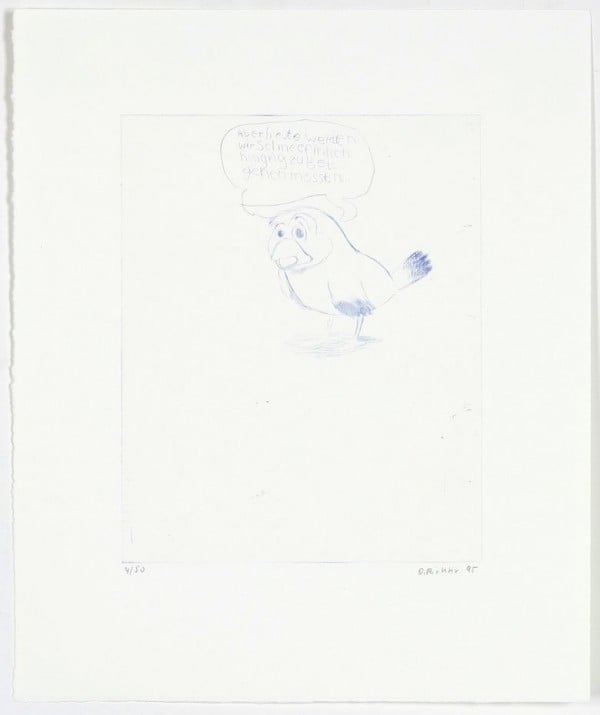
Little Doggy by Daniel Richter, created in 1995, is a drypoint etching that combines a whimsical illustration with subtle commentary. The etching depicts a simple, cartoon-like figure of a dog, drawn with light, delicate lines that give the piece a minimal and somewhat ephemeral quality. The dog appears to be speaking, with a speech bubble above its head, adding a narrative or humorous element to the composition. This minimalist style, combined with the humorous tone, reflects Richter’s exploration of both simplicity and irony. Measuring 38 cm by 32 cm, this limited-edition print invites viewers to engage with a gentle, almost childlike depiction that subtly layers meaning through text and imagery.
Daniel Richter (Germany, 1962) is a contemporary artist recognized for his dynamic and colorful large-scale paintings. His work often blends abstract and figurative elements, addressing themes of history, politics, and pop culture. A leading figure in modern German art, his pieces are featured in major international museums and collections.
DrypointDrypoint is an intaglio printmaking technique where an image is incised onto a plate using a sharp, pointed tool, typically a needle made of metal or diamond. Traditionally, copper plates were used, but today zinc, plexiglass, or acetate are also common. Drypoint is easier for drawing artists to master compared to engraving, as the needle technique resembles drawing with a pencil rather than the more complex burin used in engraving.
Little Doggy by Daniel Richter, created in 1995, is a drypoint etching that combines a whimsical illustration with subtle commentary. The etching depicts a simple, cartoon-like figure of a dog, drawn with light, delicate lines that give the piece a minimal and somewhat ephemeral quality. The dog appears to be speaking, with a speech bubble above its head, adding a narrative or humorous element to the composition. This minimalist style, combined with the humorous tone, reflects Richter’s exploration of both simplicity and irony. Measuring 38 cm by 32 cm, this limited-edition print invites viewers to engage with a gentle, almost childlike depiction that subtly layers meaning through text and imagery.
Daniel Richter (Germany, 1962) is a contemporary artist recognized for his dynamic and colorful large-scale paintings. His work often blends abstract and figurative elements, addressing themes of history, politics, and pop culture. A leading figure in modern German art, his pieces are featured in major international museums and collections.
The more you know about the historical or ecological background of images, the more you can interpret, but it's not necessarily the truth about it.
- Daniel Richter
Daniel Richter attended Hochschule für bildende Künste Hamburg in the early nineties, and during the time he spent at University he studied with Werner Buttner and Martin Kippenberger. Richter was part of the resurgence of demonstrative painting during the 1980s. He was a professor of art (painting) at Universität der Künste, Germany in the middle of of the 2000's. Now he teaches at Akademie der bildenden Künste, Vienna. Daniel Richter initially focused on abstract painting, which were extremely colorful and was must like graffiti art. He has been creating large scale scenes which have been inspired by newspapers and books since 2002. Although Daniel Richter's work has appeared in countless exhibitions world wide, some of his best known work has been his set designs for 'Bluebeard's Castle' and for 'Lulu' at the Salzburg Festival. His collections can be found at the Museum of Modern Art in New York City, The Centre Pompidou in Paris, the Boros assemblage in Germany and the Falckenberg Display in Hamburg.
Abstract art uses form, shape, line, and color to create a visual experience without attempting to represent external reality. The composition exists independently of the world's visual references, focusing on expressing ideas and emotions through non-representational means.