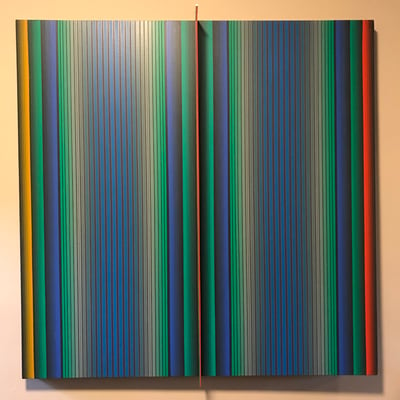
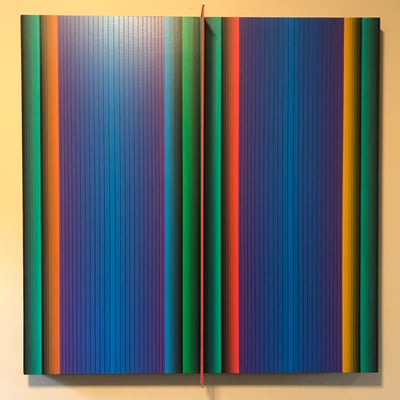
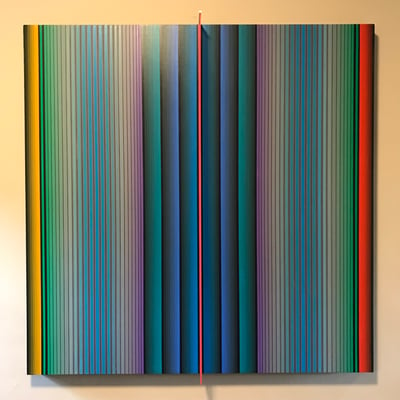
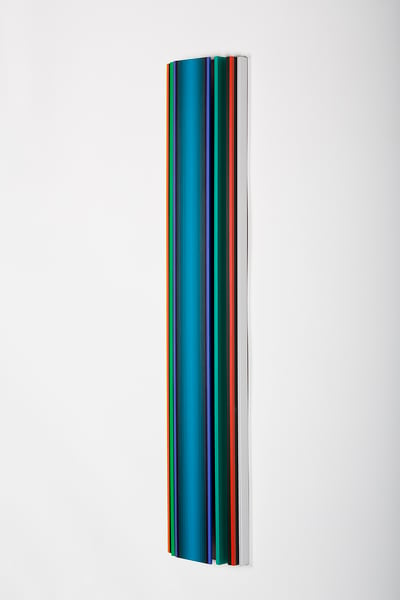
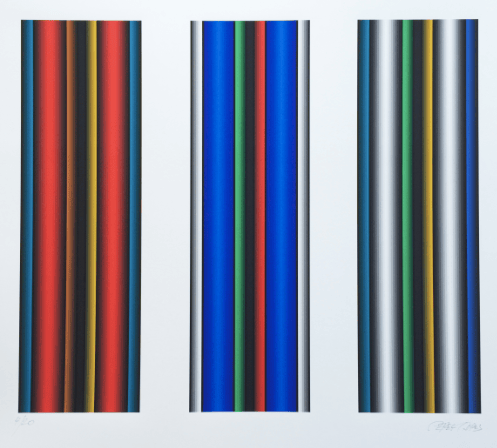
Prochromatique Tryptich by Dario Perez-Flores, created in 2015, is a vibrant lithograph that explores color dynamics through three vertical panels, each filled with narrow, parallel bands of color. The triptych presents a spectrum of hues—ranging from intense reds and yellows to deep blues and greens—organized in a gradient-like effect that evokes a sense of depth and movement. The careful arrangement of colors and transitions between warm and cool tones creates a rhythmic and kinetic visual experience. Perez-Flores’ work invites viewers to engage with the optical effects of color interaction, encouraging shifts in perception as the eye moves across the composition.
Dario Pérez-Flores (Venezuela, 1936–2022) was a prominent figure in the Op Art and Kinetic Art movements. His work focused on the interplay of color and movement, creating dynamic visual experiences. Pérez-Flores' innovative use of vertical elements and color gradients in his 'Prochromatiques' series exemplifies his exploration of optical vibrations and spatial perception.
Lithograph Lithography is a printing method based on the principle that water and oil do not mix. It can be used to print artwork or text onto paper or other suitable materials. Traditionally, an image was drawn with wax, fat, or oil onto a lithographic limestone surface or plate. Today, metal plates and other surfaces are also used in lithographic printing.
Prochromatique Tryptich by Dario Perez-Flores, created in 2015, is a vibrant lithograph that explores color dynamics through three vertical panels, each filled with narrow, parallel bands of color. The triptych presents a spectrum of hues—ranging from intense reds and yellows to deep blues and greens—organized in a gradient-like effect that evokes a sense of depth and movement. The careful arrangement of colors and transitions between warm and cool tones creates a rhythmic and kinetic visual experience. Perez-Flores’ work invites viewers to engage with the optical effects of color interaction, encouraging shifts in perception as the eye moves across the composition.
Dario Pérez-Flores (Venezuela, 1936–2022) was a prominent figure in the Op Art and Kinetic Art movements. His work focused on the interplay of color and movement, creating dynamic visual experiences. Pérez-Flores' innovative use of vertical elements and color gradients in his 'Prochromatiques' series exemplifies his exploration of optical vibrations and spatial perception.
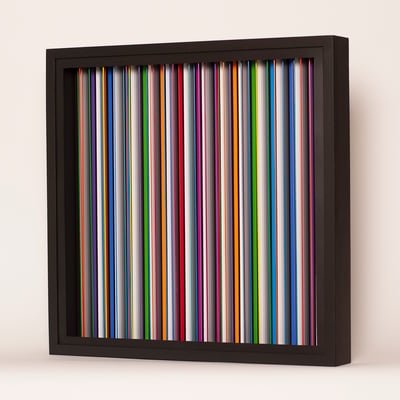
Dario Perez-Flores is a kinetic artistic who was born in Venezuela in 1936 and currently lives and works in Paris. He is considered to be part of both the Op Art and Kinetic Art movements. His work is exhibited in galleries in the United States and in public and private collections in Venezuela, France, Switzerland and Germany. Dario Perez-Flores is part of the interest in kinetic expressions created and developed by artists such as Carlos Cruz-Diaz and Jesus Rafael Soto. Driven by the desire to infuse designs with literal movement, artists such as these often include opportunities for viewers to touch their works to start movement within structures, or design ways to include electric motors in their compositions. When Dario Perez-Flores first began to create art, he used Plexiglass, metal and light as his sculpting media. His current pieces are created with painting and assemblage. Because he has spent his artistic life studying kinetic reverberation; the phenomenon of optical illusion that creates the impression of movement when viewers pass by, his key artistic elements focus on the ways that form and color affect perception. An important series of Dario Perez-Flores's current paintings is called Prochromatiques. Prochromatique 3, from 2010, is a box of 40 colored steel bars assembled with a colored back inside a black box. The work is signed in pencil on the back. Others in the series are painted on canvas. These paintings are highly structured, with vertical lines of color impeccably painted as if they had been computer-rendered. They are designed to serve as different kinds of optical illusions, as Dario Perez-Flores continues to seek the ultimate in visual representations of movement.
Contemporary art refers to avant-garde or innovative art created in the recent past or present day. The exact starting point of contemporary art varies depending on the institution, often tied to the founding year of museums or galleries that showcase the style. Contemporary art is characterized by its focus on current ideas, diverse media, and the exploration of new concepts and techniques.