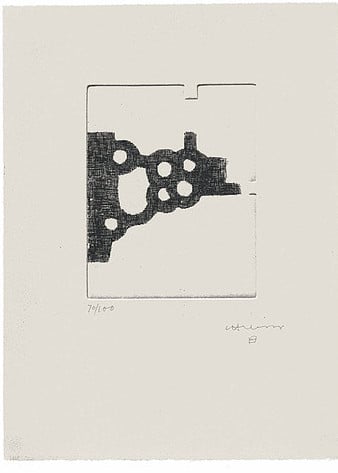
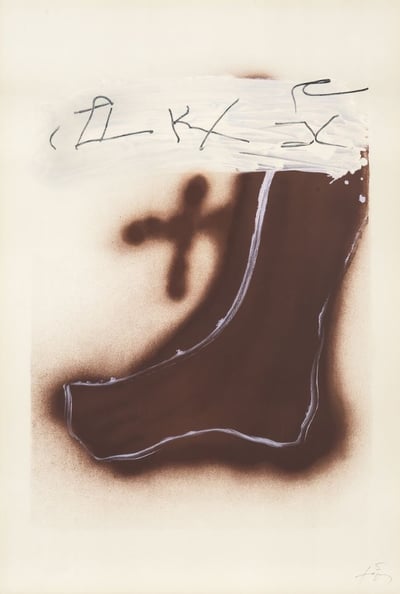
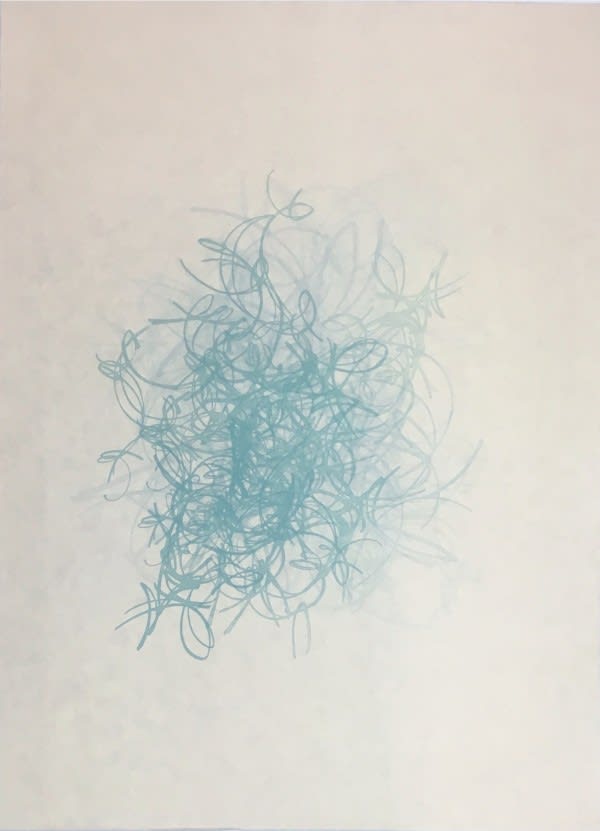
// 05.Octubre.2017 by David Rodríguez Caballero is an etching and aquatint print from 2017 that exemplifies the artist's delicate and contemplative approach to abstract form. This limited edition piece features a cluster of looping, intertwined lines in soft blue, which gently fades into the light background. The minimalistic composition evokes a sense of calm and fluidity, encouraging viewers to focus on the intricacies of each line and the subtle interplay of color and space. The ethereal quality of the piece suggests themes of impermanence and the quiet beauty of simple forms, characteristic of Rodríguez Caballero's exploration of light, texture, and organic abstraction.
David Rodríguez Caballero (Spain, 1970) is a contemporary sculptor known for his abstract works that explore the interplay of light and geometry. Utilizing materials such as aluminum, brass, and copper, he creates folded and curved forms that engage with their surroundings. His sculptures have been exhibited internationally, including at the Moscow Museum of Modern Art and the Museo Würth in Spain.
Etching and AquatintEtching and aquatint are printmaking techniques. In aquatint, the printing plate is etched with a pattern of tiny pits and cracks to create a wide range of tonal gradations. This technique allows artists to replicate the broad, flat tones found in watercolor paintings and ink washes.
Size
Inches
Centimeters
119 X 89 cm
Edition
Edition of 10
Price
USD
EUR
GBP
CHF
3,500EUR
?
+ VAT/import Duties (if applicable)
Authenticity Guaranteed
Insured Shipping
Online Since 2005
Share
●Inventory 8135
●Signed
●Comes with gallery invoice and certificate
●Any questions?
// 05.Octubre.2017 by David Rodríguez Caballero is an etching and aquatint print from 2017 that exemplifies the artist's delicate and contemplative approach to abstract form. This limited edition piece features a cluster of looping, intertwined lines in soft blue, which gently fades into the light background. The minimalistic composition evokes a sense of calm and fluidity, encouraging viewers to focus on the intricacies of each line and the subtle interplay of color and space. The ethereal quality of the piece suggests themes of impermanence and the quiet beauty of simple forms, characteristic of Rodríguez Caballero's exploration of light, texture, and organic abstraction.
David Rodríguez Caballero (Spain, 1970) is a contemporary sculptor known for his abstract works that explore the interplay of light and geometry. Utilizing materials such as aluminum, brass, and copper, he creates folded and curved forms that engage with their surroundings. His sculptures have been exhibited internationally, including at the Moscow Museum of Modern Art and the Museo Würth in Spain.
The structural merging of spatial forms with the consistent exploration of tactile surfaces, are the two major propositions at work in David Rodriguez Caballero's work. These ideas are communicated through an effective use of space, which gives a crucial significance to the substance of light in his paintings. Caballero aims to explore the ramifications which the sensory effect of colour and paint can convey to the viewer. Early works, mainly influenced from Paul Klee, gradually gave way to masterful, large scale sculptures. Narrow curves, along with immaculate steel plates and sheets, are soldered together, spliced and hung from high beams and cables in his installations. Caballero uses the smallest amount of tools and techniques to create the maximum effect that can be produced from them. He wants to coordinate that which transcends the mere purposefulness of ordinary objects with infectious inclination to see poetry in the mundane. Born in Spain in 1970, Caballero studied art at the University of the Basque Country, and has been living in the US for over a decade. He has successfully re-articulated several directions explored by the school of abstractconstructivism, without compromising his sense of elegance and configurational articulation. In the presence of Caballero's work, the viewer is subtly encouraged to see a multiplicity of layouts constructed out of light, carefully balanced by the symmetry of texture and movement, ever present in his compositions. (Artist website)
Constructivism is an architectural and artistic philosophy of Russian origin that emerged as a rejection of the idea of autonomous art. The movement advocated for art to serve practical social purposes. Since its inception in 1919, Constructivism has evolved and significantly impacted 20th-century art movements, influencing major trends such as De Stijl and Bauhaus.