

Lithograph on paper. Signed and numbered.
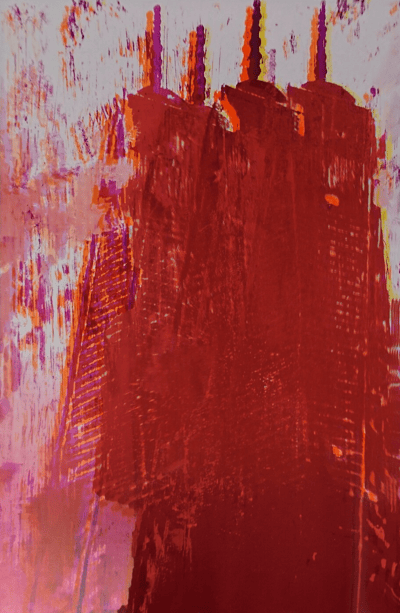
Enoc Perez's Freedom Tower 2 (2017) continues his exploration of iconic architecture through an abstract lens. This lithograph depicts the Freedom Tower with a distorted and layered effect, combining bold brushstrokes and blurred lines to create a sense of movement and impermanence. The dark hues are contrasted with subtle pink and blue tones, which blend into the background, enhancing the atmospheric quality of the piece. The image appears to shift and change, emphasizing the tower’s monumental yet fragile nature, inviting viewers to reflect on the historical and symbolic significance of such structures. This limited edition print, signed and numbered, showcases Perez’s ability to merge architectural imagery with expressive abstraction.
Artwork Copyright © Enoc PerezEnoc Perez (Puerto Rico, 1967) is a contemporary artist renowned for his vibrant paintings and oil stick drawings of Modernist architecture. His works often depict iconic buildings, exploring themes of utopia and cultural identity. Perez's distinctive style and technique have earned him international acclaim, with exhibitions in major galleries worldwide.
Artwork Copyright © Enoc PerezFreedom Tower 2, 2017
Form
Medium
Size
- Inches
- Centimeters
Edition
Price
Available works →
- Authenticity Guaranteed
- Insured Shipping
- Online Since 2005
●
●Inventory 13140
●Signed
●Comes with gallery invoice and certificate
●Sell Us a Similar Artwork. Learn more.
Lithograph on paper. Signed and numbered.
Enoc Perez's Freedom Tower 2 (2017) continues his exploration of iconic architecture through an abstract lens. This lithograph depicts the Freedom Tower with a distorted and layered effect, combining bold brushstrokes and blurred lines to create a sense of movement and impermanence. The dark hues are contrasted with subtle pink and blue tones, which blend into the background, enhancing the atmospheric quality of the piece. The image appears to shift and change, emphasizing the tower’s monumental yet fragile nature, inviting viewers to reflect on the historical and symbolic significance of such structures. This limited edition print, signed and numbered, showcases Perez’s ability to merge architectural imagery with expressive abstraction.
Artwork Copyright © Enoc PerezEnoc Perez (Puerto Rico, 1967) is a contemporary artist renowned for his vibrant paintings and oil stick drawings of Modernist architecture. His works often depict iconic buildings, exploring themes of utopia and cultural identity. Perez's distinctive style and technique have earned him international acclaim, with exhibitions in major galleries worldwide.
Artwork Copyright © Enoc Perez- Recently Added
- Price (Low-High)
- Price (High-Low)
- Year (Low-High)
- Year (High-Low)

Enoc Perez
Freedom Tower 1, 2017
Limited Edition Print
Lithograph
Currently Not Available
Enoc Perez
Freedom Tower 3, 2017
Limited Edition Print
Lithograph
Currently Not Available

Enoc Perez
Puerto Rico 3G 1/20, 2016
Limited Edition Print
Mixed Media
Currently Not Available
Related Artists


Artwork by Helen Frankenthaler
What is abstract expressionism?
Abstract Expressionism is an art movement that emerged in the United States during the 1940s and 1950s. Characterized by large, abstract canvases, the movement emphasized spontaneous, expressive brushwork and the use of color and form to convey emotion rather than represent reality. Artists like Jackson Pollock, Mark Rothko, and Willem de Kooning are key figures in this movement. Abstract Expressionism marked a shift in the art world, making New York City a center of the international art scene.


