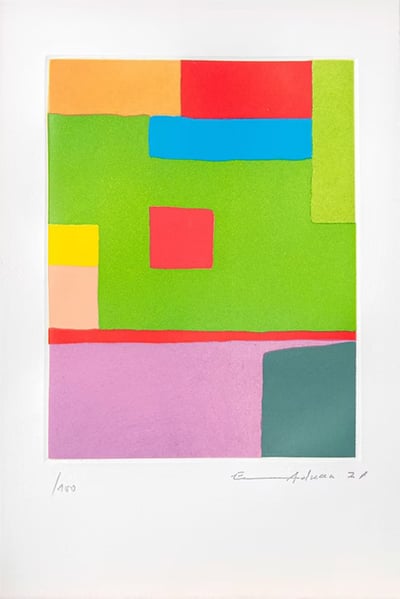
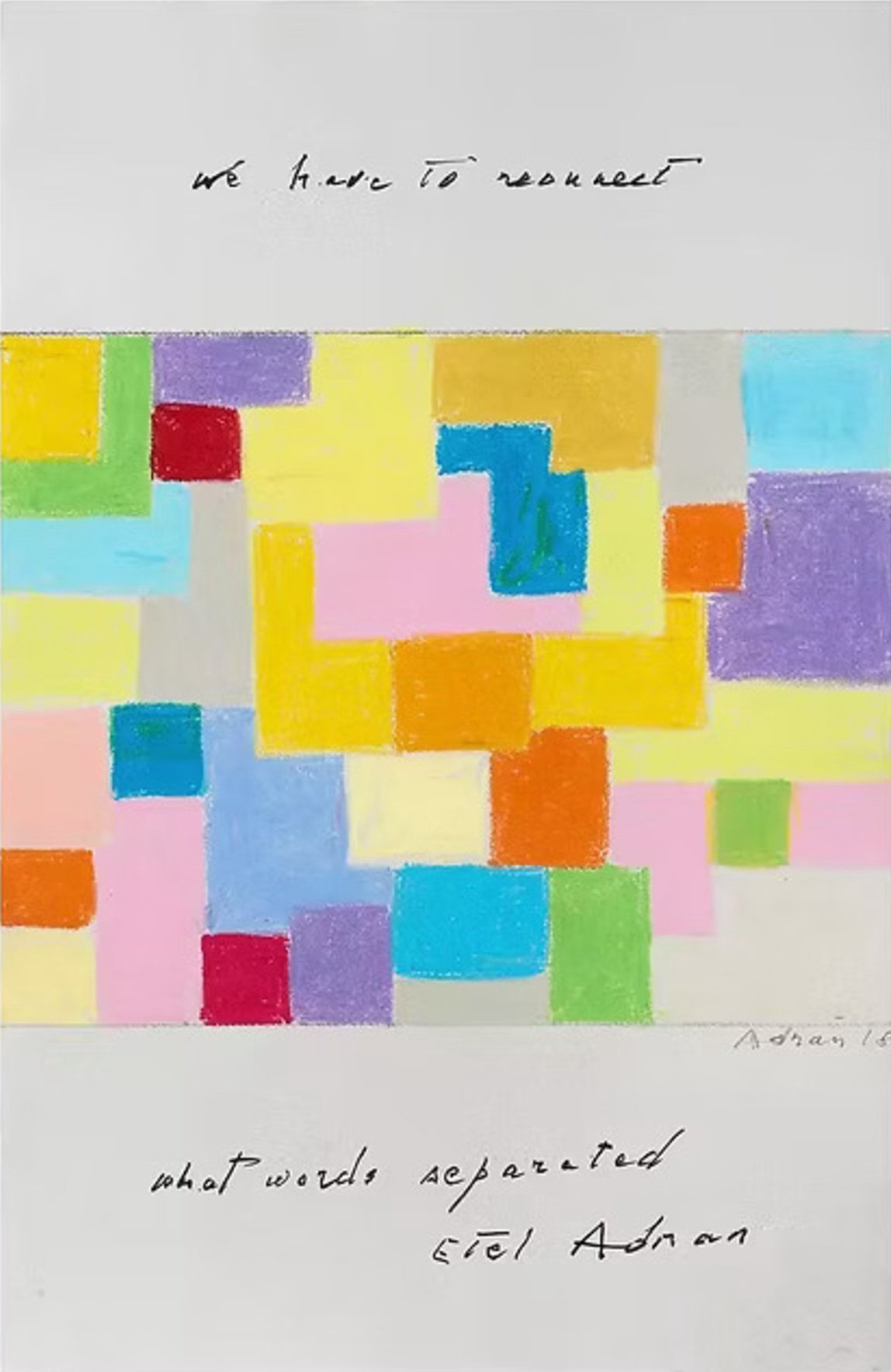
Giclee print on Hahnemuhle Bamboo 290 gsm paper.
Hologram stamp on the back.
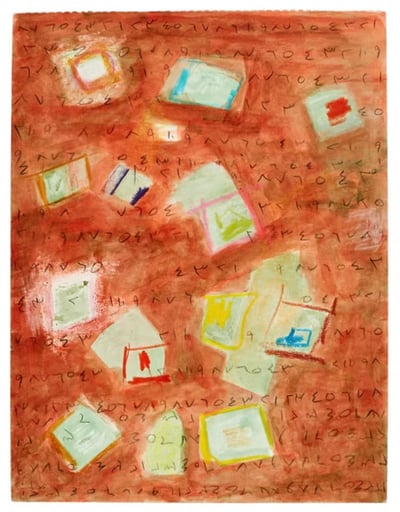
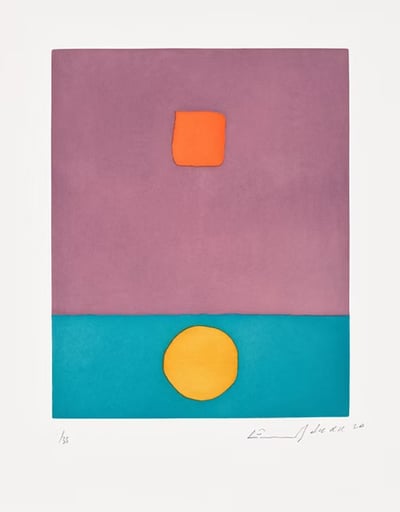
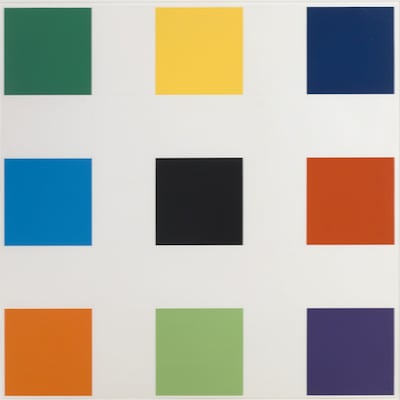
Adnan's poetic assertion manifests visually as a radiant chromatic grid where language dissolves into pure color sensation. The artist reconciles her dual practices of writing and visual art through an integration of word and abstract form, suggesting that meaning transcends linguistic boundaries.
Etel Adnan (Lebanon, 1925–2021) was a celebrated poet, painter, and essayist blending vivid abstraction with lyrical expression. Known for her colorful geometric landscapes, she often drew inspiration from nature and her multicultural identity. Adnan's works, including her acclaimed book The Arab Apocalypse, reflect themes of displacement, memory, and political resistance.
Giclée printingGiclée printing is a digital technique for reproducing artwork using a high-resolution digital file and an inkjet printer with archival-quality inks. This process produces prints with exceptional color accuracy and detail, closely matching the original artwork.
Giclee print on Hahnemuhle Bamboo 290 gsm paper.
Hologram stamp on the back.
Adnan's poetic assertion manifests visually as a radiant chromatic grid where language dissolves into pure color sensation. The artist reconciles her dual practices of writing and visual art through an integration of word and abstract form, suggesting that meaning transcends linguistic boundaries.
Etel Adnan (Lebanon, 1925–2021) was a celebrated poet, painter, and essayist blending vivid abstraction with lyrical expression. Known for her colorful geometric landscapes, she often drew inspiration from nature and her multicultural identity. Adnan's works, including her acclaimed book The Arab Apocalypse, reflect themes of displacement, memory, and political resistance.
Abstract art was the equivalent of poetic expression; I didn't need to use words, but colors and lines.
- Etel Adnan
Etel Adnan was a playwright, journalist, academic, and painter who was renowned not only for her intensely energetic and bold paintings, but her poetry, plays, and philosophical meditations on aesthetics. Born in Beirut, she became an important figure within the Arab-American community.
Adnan took a unique approach to her landscape oil paintings, characteristically limiting herself to only a few colors and laying thick swaths of paint on her canvasses using a palette knife, rather than a brush. Although she tended to work on a small scale, her highly abstract landscapes were nevertheless composed of bold, sometimes monolithic shapes. This approach was informed by her philosophical and spiritualized conception of colors, which she described as “entities in themselves,” having almost divine qualities. As an artist, she thus sought to give physical expression to these metaphysical beings.
In her 1986 book, Journey to Mount Tamalpais, Etel Adnan argued that nature constitutes an important dimension of thinking. Her broader oeuvre stand as a testament to the way in which she sought to attend to the “spirit” of the landscapes and places that were her subjects, as well as the colors through which such a spirit can be expressed.(Artist Website).
Hard Edge art is a style of abstract painting that became popular in the 1960s. It features areas of color separated by crisp, sharp edges that are painted with geometric precision. The term hard-edge painting was coined by art critic Jules Langsner to describe this approach, which contrasts with the softer, more fluid forms of other abstract styles.