

// Twenty-two Constructions from 1967 (Jahn 113-134) by Fred Sandback is a minimalist lithograph from 1967, illustrating Sandback’s signature focus on line and space. The artwork features a simple linear form—a thin, elongated parallelepiped—rendered in white against a muted blue background. Sandback’s restrained style emphasizes the conceptual exploration of spatial boundaries and perception, inviting viewers to engage with the volume and form implied by minimal gestures. This piece reflects Sandback’s dedication to the principles of Minimalism, where less is more, and form is conveyed with the utmost simplicity.
Artwork Copyright © Fred SandbackFred Sandback (USA, 1943–2003) was a minimalist sculptor celebrated for his delicate yarn installations that defined space with simple lines. Using only acrylic yarn, Sandback created an illusion of volume and architectural form, influencing perceptions of sculpture and spatial art. His works are housed in prestigious collections worldwide, including MoMA and Dia:Beacon.
Artwork Copyright © Fred SandbackTwenty-two Constructions from 1967 (Jahn 113-134), 1967
Form
Medium
Size
- Inches
- Centimeters
Edition
Price
Available works →
- Authenticity Guaranteed
- Insured Shipping
- Online Since 2005
●
●Inventory 10806
●Signed
●Comes with gallery invoice and certificate
●Sell Us a Similar Artwork. Learn more.
// Twenty-two Constructions from 1967 (Jahn 113-134) by Fred Sandback is a minimalist lithograph from 1967, illustrating Sandback’s signature focus on line and space. The artwork features a simple linear form—a thin, elongated parallelepiped—rendered in white against a muted blue background. Sandback’s restrained style emphasizes the conceptual exploration of spatial boundaries and perception, inviting viewers to engage with the volume and form implied by minimal gestures. This piece reflects Sandback’s dedication to the principles of Minimalism, where less is more, and form is conveyed with the utmost simplicity.
Artwork Copyright © Fred SandbackFred Sandback (USA, 1943–2003) was a minimalist sculptor celebrated for his delicate yarn installations that defined space with simple lines. Using only acrylic yarn, Sandback created an illusion of volume and architectural form, influencing perceptions of sculpture and spatial art. His works are housed in prestigious collections worldwide, including MoMA and Dia:Beacon.
Artwork Copyright © Fred Sandback- Recently Added
- Price (Low-High)
- Price (High-Low)
- Year (Low-High)
- Year (High-Low)

Fred Sandback
Twenty-two Constructions from 1967 (Jahn 113-134), 1967
Limited Edition Print
Lithograph
Currently Not Available
Related Artists

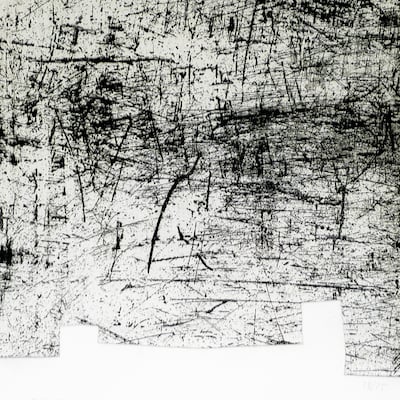
Artwork by Eduardo Chillida
What is abstract art?
Abstract art uses form, shape, line, and color to create a visual experience without attempting to represent external reality. The composition exists independently of the world's visual references, focusing on expressing ideas and emotions through non-representational means.

Fred Sandback
Twenty-two Constructions from 1967 (Jahn 113-134), 1967
27.8 x 21 cm


