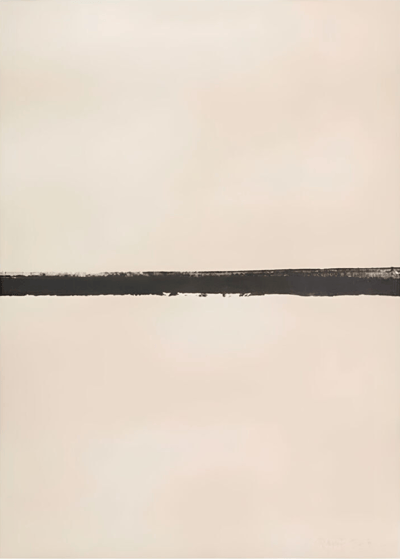
Black Gold (2015) by Gavin Turk presents a stark, minimalist composition using crude oil on canvas. The central form resembles an abstract droplet or spill, evoking both environmental concern and the economic symbolism of oil as a precious commodity. The thick black mass bleeds into a soft grey halo, creating a ghostly aura that contrasts with the purity of the surrounding white canvas. As part of an edition of 100, this work aligns with Turk’s interest in material transformation and conceptual identity, referencing pollution, power, and artistic value through a single potent medium.
Gavin Turk (United Kingdom, 1967) is a British artist known for his provocative works that challenge concepts of authorship and identity. A prominent figure among the Young British Artists, Turk gained early notoriety when the Royal College of Art refused to award him a degree for his 1991 installation 'Cave,' which featured a blue heritage plaque commemorating his own presence. His diverse oeuvre includes painted bronzes, waxworks, and installations that often reference art history and popular culture.
Oil on canvasOil paint is a slow-drying type of paint made from pigment particles suspended in a drying oil, typically linseed oil. The viscosity of the paint can be adjusted by adding a solvent like turpentine, and varnish can be added to increase the glossiness of the dried paint film. Oil painting has been used since the 12th century in Europe, initially for decoration, but it was not widely adopted as a primary painting medium until the 15th century.
Black Gold (2015) by Gavin Turk presents a stark, minimalist composition using crude oil on canvas. The central form resembles an abstract droplet or spill, evoking both environmental concern and the economic symbolism of oil as a precious commodity. The thick black mass bleeds into a soft grey halo, creating a ghostly aura that contrasts with the purity of the surrounding white canvas. As part of an edition of 100, this work aligns with Turk’s interest in material transformation and conceptual identity, referencing pollution, power, and artistic value through a single potent medium.
Gavin Turk (United Kingdom, 1967) is a British artist known for his provocative works that challenge concepts of authorship and identity. A prominent figure among the Young British Artists, Turk gained early notoriety when the Royal College of Art refused to award him a degree for his 1991 installation 'Cave,' which featured a blue heritage plaque commemorating his own presence. His diverse oeuvre includes painted bronzes, waxworks, and installations that often reference art history and popular culture.
I don't think I ever really decided I was an artist.
- Gavin Turk
Many configurations of present day sculptural art, which have become widely accepted, such as recycled art, plaster casts, or the use of litter in artistic expression, were initially developed by British artist Gavin Turk. His models and fixtures, essentially address his concerns with originality in creation, legitimacy and uniqueness in art.Turk vigorously challenges our preconceived notions of 'personality status' and ownership in a figurative work, a debate which origins can be traced all the way back to French conceptual artist Marcel Duchamp. Turk who was born in England in 1967, has always been fully engaged in the avant garde discourse about creative innovation, self-infatuation and how genuine expression can be achieved. With razor-sharp wit and self deprecation, he analyses, through his own installations and pictures, how particular artworks manage to claim global critical and economic success, and how the artists themselves, become entangled the machinery of celebrity and power. Turk has added a new perspective to the study of the process of inventiveness and inspiration in popular culture, by subverting the value content of many famous 20th century artworks. By openly borrowing famous productions by Andy Warhol or Jackson Pollock for example, Turk put himself in a position to question the utility of stylistic originality in art. The great bulk of his personal body of work, meticulously challenges the cohesiveness of honesty in the presentation of the self, within the context of artistic expression. (Artist website)
Chinese Contemporary Art is marked by a wide range of styles and experimental approaches. In the 1980s, avant-garde exhibitions were often shut down by government officials. The 1990s saw the rise of political pop and cynical realism, while China's One-Child Policy influenced artists to explore the individual as a subject matter.