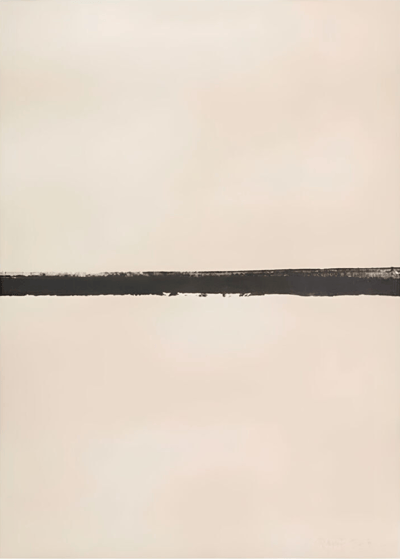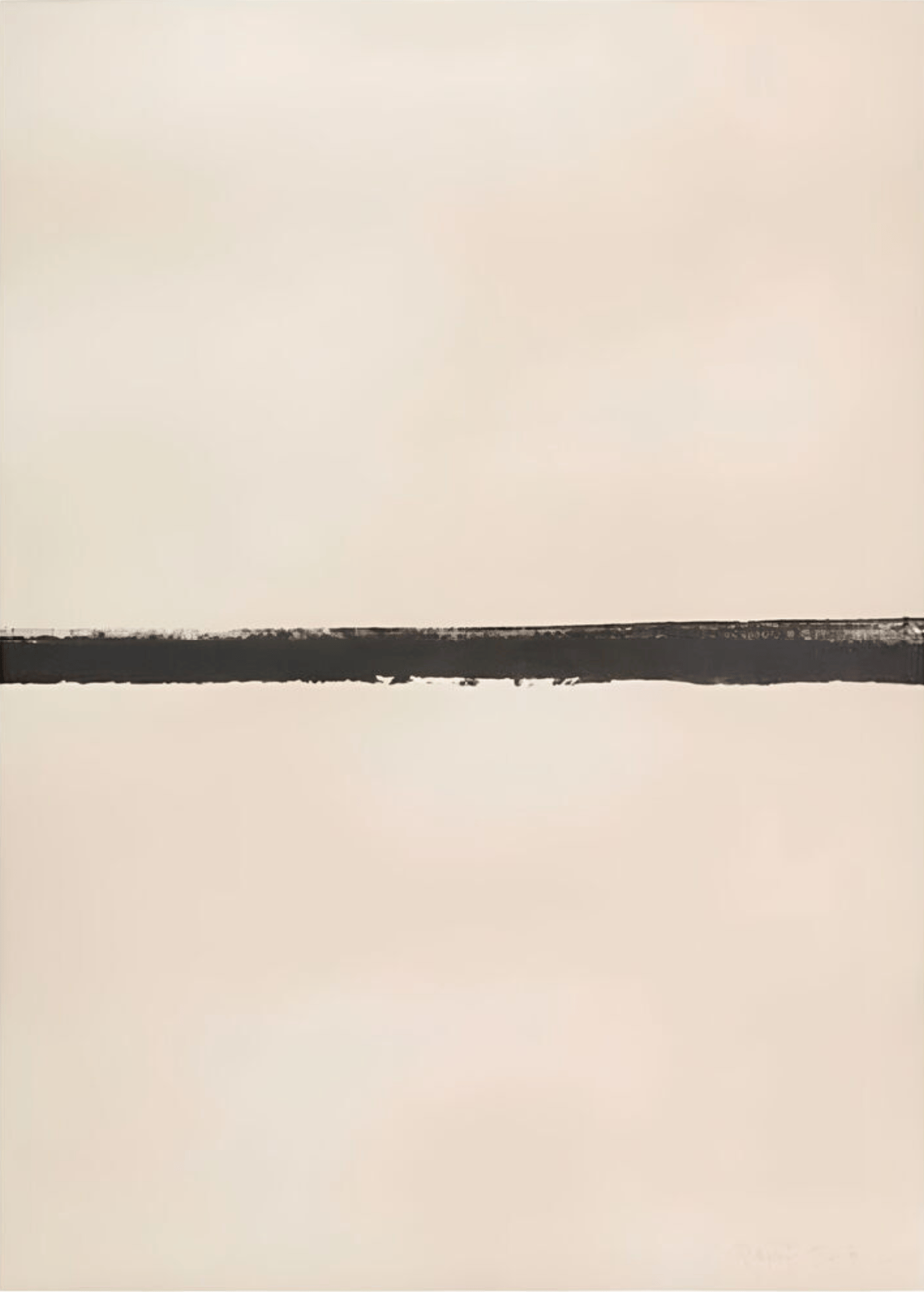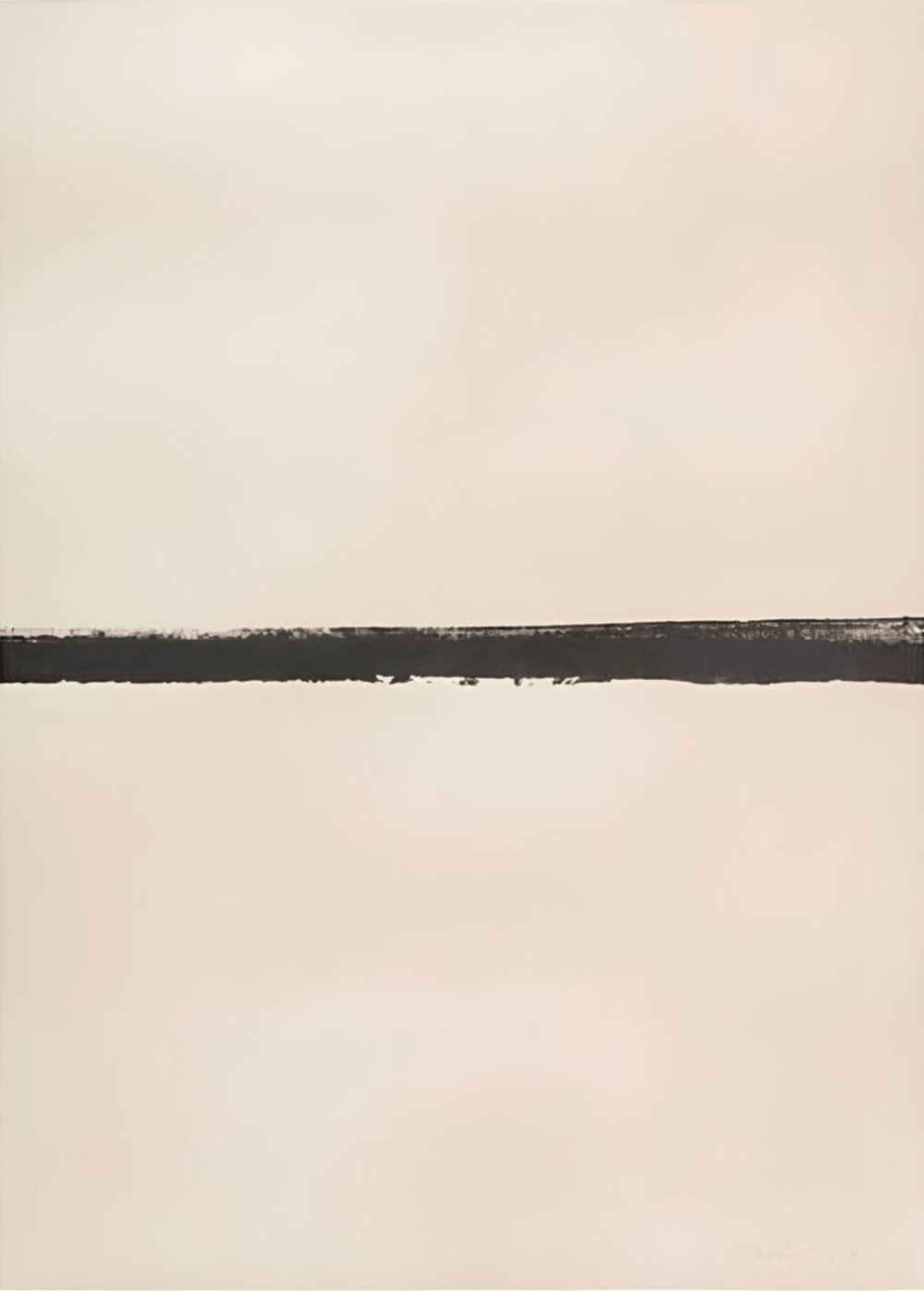
Cycle Line by Gavin Turk is a minimalist screenprint that features a single thick black line stretching horizontally across a pale background. The stark contrast and simplicity evoke themes of repetition, endurance, and boundary. The printed texture of the line suggests a worn or industrial surface—perhaps the residual trace of a tire or printing tool—emphasizing movement and the physical act of marking. Created in 2018 as part of a limited edition of 100, the work fits Turk’s conceptual exploration of authorship and artistic gesture, despite the absence of a signature.
Gavin Turk (United Kingdom, 1967) is a British artist known for his provocative works that challenge concepts of authorship and identity. A prominent figure among the Young British Artists, Turk gained early notoriety when the Royal College of Art refused to award him a degree for his 1991 installation 'Cave,' which featured a blue heritage plaque commemorating his own presence. His diverse oeuvre includes painted bronzes, waxworks, and installations that often reference art history and popular culture.
Mixed MediaMixed media refers to artwork that incorporates more than one medium within a single piece. Unlike multimedia art, which combines distinct forms of visual art and often includes elements like sound, video, or digital media, mixed media focuses on combining traditional art materials, such as paint, ink, and collage. Mixed media art allows artists to achieve a wide range of effects and textures by layering and blending different materials.
Cycle Line by Gavin Turk is a minimalist screenprint that features a single thick black line stretching horizontally across a pale background. The stark contrast and simplicity evoke themes of repetition, endurance, and boundary. The printed texture of the line suggests a worn or industrial surface—perhaps the residual trace of a tire or printing tool—emphasizing movement and the physical act of marking. Created in 2018 as part of a limited edition of 100, the work fits Turk’s conceptual exploration of authorship and artistic gesture, despite the absence of a signature.
Gavin Turk (United Kingdom, 1967) is a British artist known for his provocative works that challenge concepts of authorship and identity. A prominent figure among the Young British Artists, Turk gained early notoriety when the Royal College of Art refused to award him a degree for his 1991 installation 'Cave,' which featured a blue heritage plaque commemorating his own presence. His diverse oeuvre includes painted bronzes, waxworks, and installations that often reference art history and popular culture.
I don't think I ever really decided I was an artist.
- Gavin Turk
Many configurations of present day sculptural art, which have become widely accepted, such as recycled art, plaster casts, or the use of litter in artistic expression, were initially developed by British artist Gavin Turk. His models and fixtures, essentially address his concerns with originality in creation, legitimacy and uniqueness in art.Turk vigorously challenges our preconceived notions of 'personality status' and ownership in a figurative work, a debate which origins can be traced all the way back to French conceptual artist Marcel Duchamp. Turk who was born in England in 1967, has always been fully engaged in the avant garde discourse about creative innovation, self-infatuation and how genuine expression can be achieved. With razor-sharp wit and self deprecation, he analyses, through his own installations and pictures, how particular artworks manage to claim global critical and economic success, and how the artists themselves, become entangled the machinery of celebrity and power. Turk has added a new perspective to the study of the process of inventiveness and inspiration in popular culture, by subverting the value content of many famous 20th century artworks. By openly borrowing famous productions by Andy Warhol or Jackson Pollock for example, Turk put himself in a position to question the utility of stylistic originality in art. The great bulk of his personal body of work, meticulously challenges the cohesiveness of honesty in the presentation of the self, within the context of artistic expression. (Artist website)
Sometimes referred to as Conceptualism, this is an art form where the idea(s) or concept(s) behind the work take precedence over material concerns and traditional aesthetics. Many conceptual artworks can be created by anyone simply by following written instructions. The concept or idea is the most essential aspect of the artwork.