Photolithograph. Stamped by Newton estate verso, from edition of 500 published by Eyestorm.
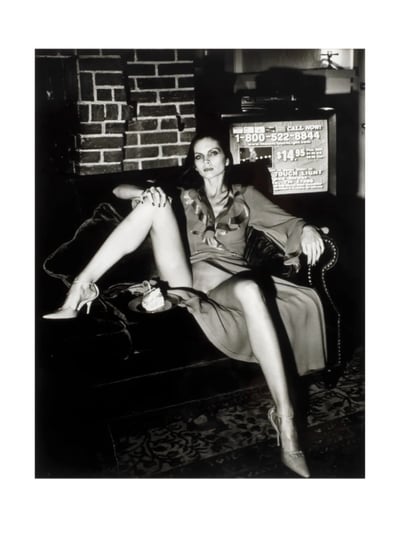
In stark monochrome theatre light, a woman sits cross-legged on a velvet sofa: stiletto heels, slim sheath dress, gold necklace, hand resting on her knee. Behind her glows a phone-sex advertisement — CALL NOW $14.95 — pinning the glamour to the seedy underbelly of late-century New York. Photolithograph from the celebrated 2000 series, stamped by the Newton estate verso, edition of 500 published by Eyestorm. Cyberwoman 3 is late Newton at full pitch — eros, money, danger, photographed cool. A confident acquisition from one of the great fashion photographers of the twentieth century.
Helmut Newton (Germany/Australia, 1920–2004) was a legendary fashion photographer known for his provocative, glamorous, and highly stylized images. His work, blending eroticism and elegance, redefined fashion photography and challenged conventions of beauty and power. Newton’s iconic black-and-white photographs appeared in major magazines like Vogue, shaping visual culture for decades.
PhotographA photograph is an image captured with a camera. Traditionally, photographs were made by exposing film and then developing the image on light-sensitive paper using chemicals. Today, photographs can also be captured digitally and printed or displayed electronically. The process requires a camera, whether film or digital, and a photographer.
Photolithograph. Stamped by Newton estate verso, from edition of 500 published by Eyestorm.
In stark monochrome theatre light, a woman sits cross-legged on a velvet sofa: stiletto heels, slim sheath dress, gold necklace, hand resting on her knee. Behind her glows a phone-sex advertisement — CALL NOW $14.95 — pinning the glamour to the seedy underbelly of late-century New York. Photolithograph from the celebrated 2000 series, stamped by the Newton estate verso, edition of 500 published by Eyestorm. Cyberwoman 3 is late Newton at full pitch — eros, money, danger, photographed cool. A confident acquisition from one of the great fashion photographers of the twentieth century.
Helmut Newton (Germany/Australia, 1920–2004) was a legendary fashion photographer known for his provocative, glamorous, and highly stylized images. His work, blending eroticism and elegance, redefined fashion photography and challenged conventions of beauty and power. Newton’s iconic black-and-white photographs appeared in major magazines like Vogue, shaping visual culture for decades.
My job as a portrait photographer is to seduce, amuse, and entertain.
- Helmut Newton
Known as "prolific and widely-imitated", German-Australian photographer Helmut Newton was a central figure of major publications. He began photography in 1936 as an apprentice to artist Elsie Simon. She would inspire him throughout his long career. After being hired by Australian Vogue in the 1950s, he went on to work for British Vogue and French Vogue. Helmut Newton also contributed to Playboy, Marie Claire, Queen, Elle, and countless other magazines. Newton began to photograph blatantly sexual images, after a heart attack in 1971. They included moments of voyeurism and lesbianism which made feminists outraged. Over the years, Helmut Newton's work focused on fashion, portraits, and nudes. His first solo exhibition was in Paris in 1975. The following year, he published his first book, "White Women." Helmut Newton continued to work and published a series of books, as well as solo exhibitions. Shortly before his death, Newton donated about one thousand of his works to his homeland of Germany. (Artist website)
Contemporary art refers to avant-garde or innovative art created in the recent past or present day. The exact starting point of contemporary art varies depending on the institution, often tied to the founding year of museums or galleries that showcase the style. Contemporary art is characterized by its focus on current ideas, diverse media, and the exploration of new concepts and techniques.