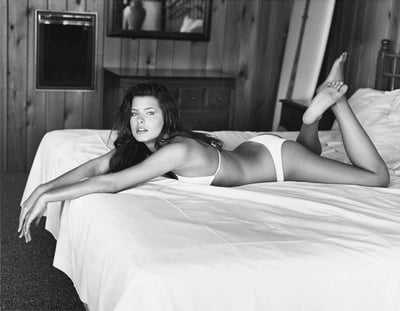
Signed, titled, and dated by the photographer in ink on the reverse, with his original copyright stamp. Literature: Helmut Newton, Portraits, Munich, 1987, p. 93; Helmut Newton, Pola Woman, Munich 1992, p.70 (variant).
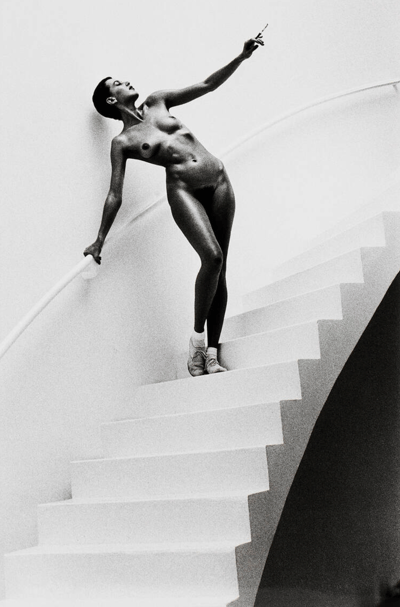
This gelatin silver print by Helmut Newton captures model Jenny Kapitän descending a white spiral staircase in his studio, her nude figure arching dramatically against the geometric sweep of the steps. The photograph exemplifies Newton's mastery of chiaroscuro, using high-contrast black-and-white to sculpt the human form within an architectural setting of stark modernist lines. Signed, titled, and dated by the photographer in ink on the reverse and bearing his original copyright stamp, this vintage print is referenced in multiple Newton monographs including Portraits and Pola Woman.
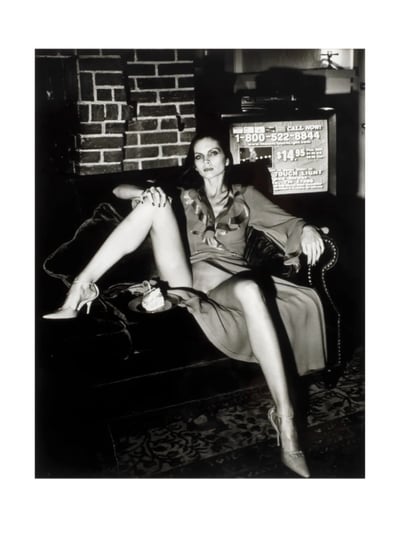
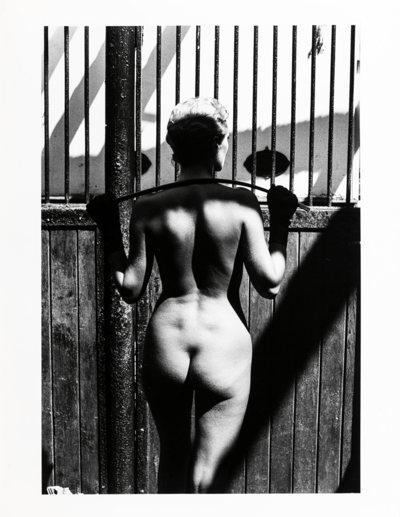
Helmut Newton (Germany/Australia, 1920–2004) was a legendary fashion photographer known for his provocative, glamorous, and highly stylized images. His work, blending eroticism and elegance, redefined fashion photography and challenged conventions of beauty and power. Newton’s iconic black-and-white photographs appeared in major magazines like Vogue, shaping visual culture for decades.
Gelatin Silver PrintA silver gelatin print is a type of photographic print made using the silver process. In this process, photographic materials such as black and white films and printing papers are coated with a light-sensitive emulsion of silver salts suspended in gelatin. This emulsion is applied to a support, which could be flexible plastic, glass, resin-coated paper, or baryta paper. The materials are light-sensitive and remain stable under normal storage conditions, making them ideal for long-term preservation.
Signed, titled, and dated by the photographer in ink on the reverse, with his original copyright stamp. Literature: Helmut Newton, Portraits, Munich, 1987, p. 93; Helmut Newton, Pola Woman, Munich 1992, p.70 (variant).
This gelatin silver print by Helmut Newton captures model Jenny Kapitän descending a white spiral staircase in his studio, her nude figure arching dramatically against the geometric sweep of the steps. The photograph exemplifies Newton's mastery of chiaroscuro, using high-contrast black-and-white to sculpt the human form within an architectural setting of stark modernist lines. Signed, titled, and dated by the photographer in ink on the reverse and bearing his original copyright stamp, this vintage print is referenced in multiple Newton monographs including Portraits and Pola Woman.
Helmut Newton (Germany/Australia, 1920–2004) was a legendary fashion photographer known for his provocative, glamorous, and highly stylized images. His work, blending eroticism and elegance, redefined fashion photography and challenged conventions of beauty and power. Newton’s iconic black-and-white photographs appeared in major magazines like Vogue, shaping visual culture for decades.
My job as a portrait photographer is to seduce, amuse, and entertain.
- Helmut Newton
Known as "prolific and widely-imitated", German-Australian photographer Helmut Newton was a central figure of major publications. He began photography in 1936 as an apprentice to artist Elsie Simon. She would inspire him throughout his long career. After being hired by Australian Vogue in the 1950s, he went on to work for British Vogue and French Vogue. Helmut Newton also contributed to Playboy, Marie Claire, Queen, Elle, and countless other magazines. Newton began to photograph blatantly sexual images, after a heart attack in 1971. They included moments of voyeurism and lesbianism which made feminists outraged. Over the years, Helmut Newton's work focused on fashion, portraits, and nudes. His first solo exhibition was in Paris in 1975. The following year, he published his first book, "White Women." Helmut Newton continued to work and published a series of books, as well as solo exhibitions. Shortly before his death, Newton donated about one thousand of his works to his homeland of Germany. (Artist website)
Contemporary art refers to avant-garde or innovative art created in the recent past or present day. The exact starting point of contemporary art varies depending on the institution, often tied to the founding year of museums or galleries that showcase the style. Contemporary art is characterized by its focus on current ideas, diverse media, and the exploration of new concepts and techniques.