

// Collage Bierdeckel auf Karton by Herbert Zangs is a minimalist composition created in 1953, showcasing the artist's fascination with everyday materials and repetition. This collage is constructed from beer coasters arranged in a grid-like pattern on cardboard, resulting in a structured, geometric aesthetic. Zangs' choice of a monochromatic palette emphasizes texture and form over color, inviting viewers to contemplate the tactile qualities and subtle imperfections within each coaster. This work is a testament to Zangs' experimental approach in the 1950s, where he explored unconventional materials and processes to question traditional boundaries in art. Measuring 60 cm in height and 81 cm in width, this piece embodies a unique interaction between ordinary objects and artistic expression.
Artwork Copyright © Herbert ZangsHerbert Zangs (Germany, 1924–2003) was a postwar avant-garde artist renowned for his monochromatic reliefs and experimental techniques. Known for his Whitenings, he explored texture and materiality by layering white paint over diverse surfaces. Zangs’ work often merged abstraction with poetic minimalism, positioning him as a distinctive voice in European modern art.
Artwork Copyright © Herbert ZangsCollage Bierdeckel auf Karton, 1953
Form
Medium
Size
- Inches
- Centimeters
Edition
Price
- USD
- EUR
- GBP
- CHF
- Authenticity Guaranteed
- Insured Shipping
- Online Since 2005
●Inventory 5537
●Signed
●Comes with gallery invoice and certificate
●Sell Us a Similar Artwork. Learn more.
// Collage Bierdeckel auf Karton by Herbert Zangs is a minimalist composition created in 1953, showcasing the artist's fascination with everyday materials and repetition. This collage is constructed from beer coasters arranged in a grid-like pattern on cardboard, resulting in a structured, geometric aesthetic. Zangs' choice of a monochromatic palette emphasizes texture and form over color, inviting viewers to contemplate the tactile qualities and subtle imperfections within each coaster. This work is a testament to Zangs' experimental approach in the 1950s, where he explored unconventional materials and processes to question traditional boundaries in art. Measuring 60 cm in height and 81 cm in width, this piece embodies a unique interaction between ordinary objects and artistic expression.
Artwork Copyright © Herbert ZangsHerbert Zangs (Germany, 1924–2003) was a postwar avant-garde artist renowned for his monochromatic reliefs and experimental techniques. Known for his Whitenings, he explored texture and materiality by layering white paint over diverse surfaces. Zangs’ work often merged abstraction with poetic minimalism, positioning him as a distinctive voice in European modern art.
Artwork Copyright © Herbert Zangs- Recently Added
- Price (Low-High)
- Price (High-Low)
- Year (Low-High)
- Year (High-Low)
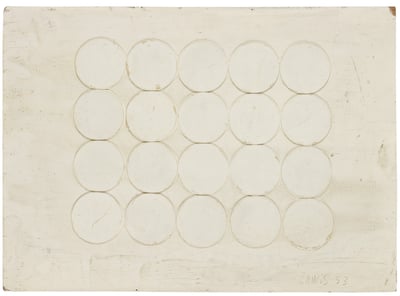
Herbert Zangs
Collage Bierdeckel auf Karton, 1953
Painting
Collage
EUR 22,500
Related Artists
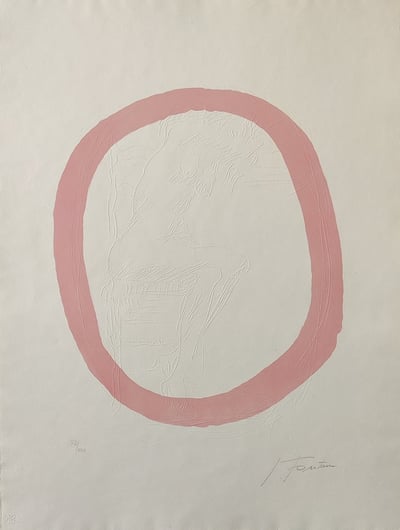

Artwork by Agnes Martin
What is minimalism?
Minimalism is a style in music and visual arts characterized by pared-down designs and simplicity. It began in Western art after World War II, gaining prominence particularly in American visual arts. Minimalism draws heavily on aspects of modernism and is often viewed as a reaction against Abstract Expressionism, as well as a precursor to post-minimal art practices. Prominent minimalist artists include Agnes Martin, Donald Judd, Robert Morris, Frank Stella, and Dan Flavin.


Herbert Zangs
Collage Bierdeckel auf Karton, 1953
60 x 81 cm


