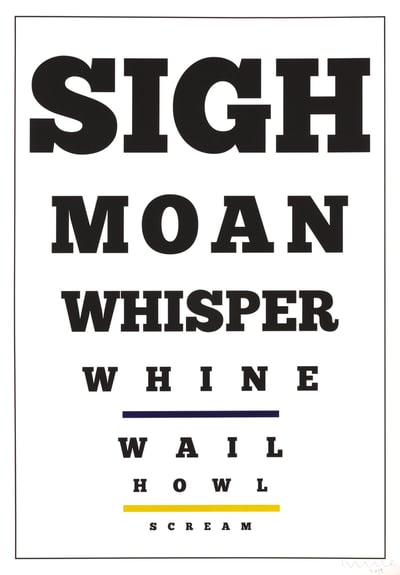
Carta Visual by Iván Navarro is a limited edition lithograph that plays with typography and psychological intensity, using bold, varied text to depict a progression of vocal expressions. Each word—ranging from “SIGH” to “SCREAM”—grows in emotional intensity as it descends, creating a visual representation of escalating tension. The layout resembles an eye chart, inviting viewers to consider how emotional states can be read, measured, and visually represented. Navarro, known for his exploration of language, light, and perception, encourages reflection on the universality of human expression and the gradations of emotion embedded in simple words.
Iván Navarro (Chile, 1972) is a contemporary artist renowned for his innovative use of light, mirrors, and neon to create thought-provoking sculptures and installations. His works often explore themes of power, control, and social issues, reflecting his experiences growing up under Chile's military dictatorship. Navarro's art challenges perceptions of space and reality, engaging viewers in a dialogue about political and social structures.
Lithograph Lithography is a printing method based on the principle that water and oil do not mix. It can be used to print artwork or text onto paper or other suitable materials. Traditionally, an image was drawn with wax, fat, or oil onto a lithographic limestone surface or plate. Today, metal plates and other surfaces are also used in lithographic printing.
Size
Inches
Centimeters
100 X 70 cm
Edition
Edition of 25
Price
USD
EUR
GBP
CHF
2,000EUR
?
+ VAT/import Duties (if applicable)
Authenticity Guaranteed
Insured Shipping
Online Since 2005
Share
●Inventory 9492
●Hand-signed by the artist
●Comes with gallery invoice and certificate
●Any questions?
Hand-signed and numbered by the artist
Carta Visual by Iván Navarro is a limited edition lithograph that plays with typography and psychological intensity, using bold, varied text to depict a progression of vocal expressions. Each word—ranging from “SIGH” to “SCREAM”—grows in emotional intensity as it descends, creating a visual representation of escalating tension. The layout resembles an eye chart, inviting viewers to consider how emotional states can be read, measured, and visually represented. Navarro, known for his exploration of language, light, and perception, encourages reflection on the universality of human expression and the gradations of emotion embedded in simple words.
Iván Navarro (Chile, 1972) is a contemporary artist renowned for his innovative use of light, mirrors, and neon to create thought-provoking sculptures and installations. His works often explore themes of power, control, and social issues, reflecting his experiences growing up under Chile's military dictatorship. Navarro's art challenges perceptions of space and reality, engaging viewers in a dialogue about political and social structures.
I do not believe there are strategies for Artistic Success.
- Ivan Navarro
Iván Navarro is a conceptual artist from Santiago, Chile, who works with light, electricity, and mirrors to create politically charged sculptures. He is best known for his use of fluorescent lights. Due to his use of light bulbs, Iván Navarro’s work invites comparison with the Minimalism movement, particularly the work of Dan Flavin. However, Navarro’s work is conceptually different from Minimalism and does not belong to a specific movement. Iván Navarro lived under the Chilean dictatorship and his work reflects the psychological anxiety of living under a corrupt and controlling regime. One of his early and best known works, You Sit, You Die, is a chair made of white fluorescent bulbs. This piece is Iván Navarro’s version of an electric chair, in reference to how the Chilean government used electricity as a means of torture, and also in response to executions in the United States. The chair included names of all prisoners executed in the state of Florida and was held together with shoelaces, which were items forbidden to prisoners due to fear that they would hang themselves. Although Iván Navarro’s explores suffering and oppression, his use of light in his sculptures is also an attempt to represent hope and truth. (Artist website)
Minimalism is a style in music and visual arts characterized by pared-down designs and simplicity. It began in Western art after World War II, gaining prominence particularly in American visual arts. Minimalism draws heavily on aspects of modernism and is often viewed as a reaction against Abstract Expressionism, as well as a precursor to post-minimal art practices. Prominent minimalist artists include Agnes Martin, Donald Judd, Robert Morris, Frank Stella, and Dan Flavin.