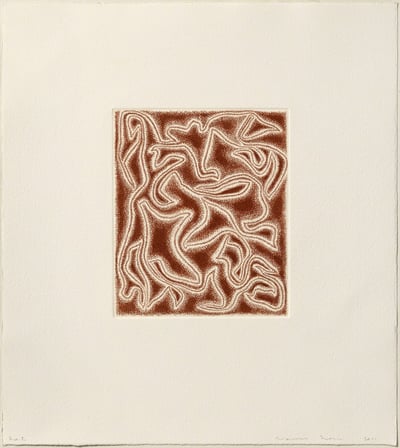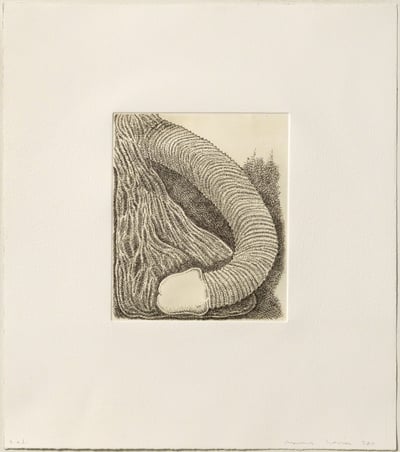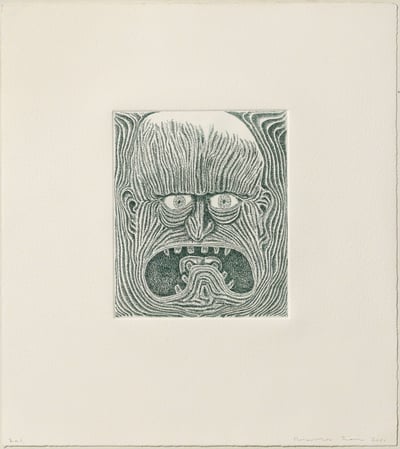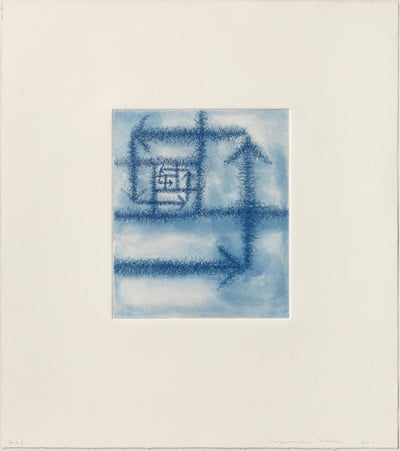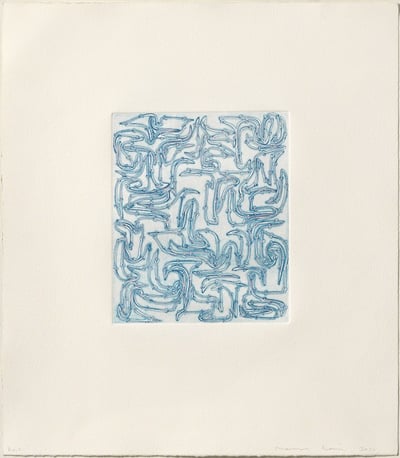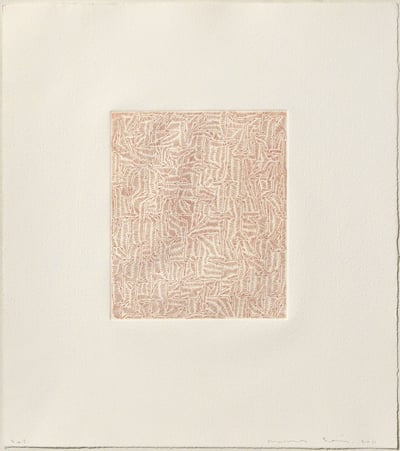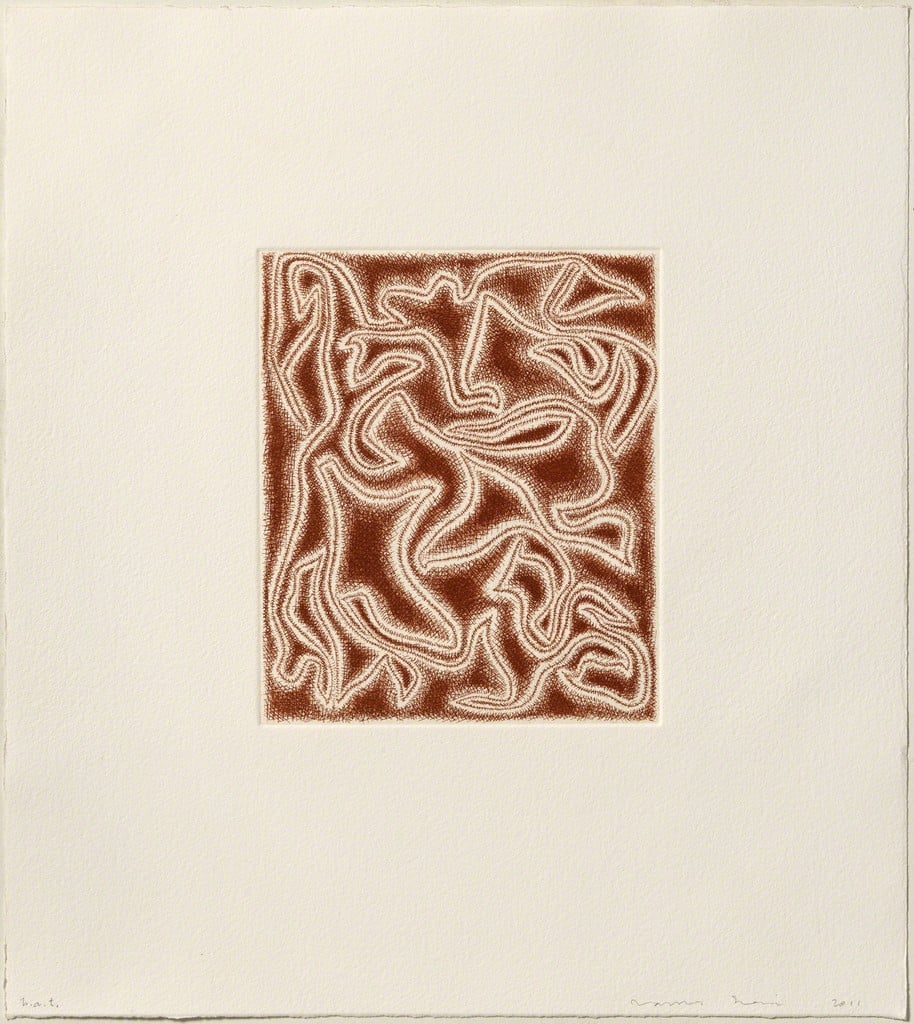
// Línies sortint de l'obscuritat by James Siena is a limited edition etching from 2011, with an edition size of 25. This artwork embodies Siena’s distinctive style of intricate line work, where organic shapes emerge from a richly textured, dark background. The densely packed white lines weave and curve within the rectangular frame, resembling a continuous, fluid pattern that appears to both recede and rise from the dark depths. This visual effect, created through the subtle tonal contrasts, conveys a sense of movement and mystery. Siena’s exploration of form and space within this confined, abstract composition invites viewers to engage with its dynamic energy.
James Siena (United States, 1957) is a contemporary artist celebrated for his intricate, rule-based abstractions. Employing self-imposed constraints, he creates complex patterns across mediums such as painting, printmaking, and sculpture. Siena's work is featured in prominent collections, including the Museum of Modern Art and the Whitney Museum of American Art.
Etching, aquatint and spitebieEtching is a technique where a design is created on a metal surface by using a strong acid or mordant to eat away the unprotected parts of the metal, leaving the desired pattern in relief (intaglio). In modern art and manufacturing, different chemicals may be used depending on the material being etched.
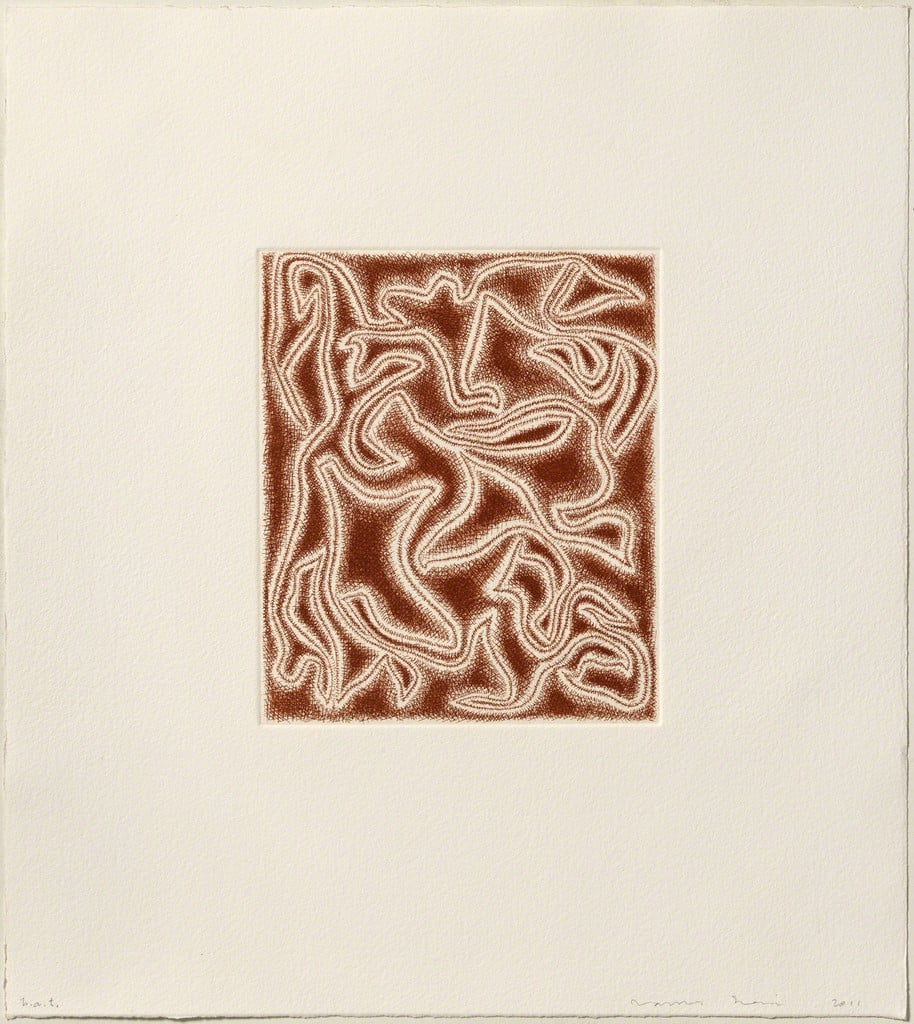
// Línies sortint de l'obscuritat by James Siena is a limited edition etching from 2011, with an edition size of 25. This artwork embodies Siena’s distinctive style of intricate line work, where organic shapes emerge from a richly textured, dark background. The densely packed white lines weave and curve within the rectangular frame, resembling a continuous, fluid pattern that appears to both recede and rise from the dark depths. This visual effect, created through the subtle tonal contrasts, conveys a sense of movement and mystery. Siena’s exploration of form and space within this confined, abstract composition invites viewers to engage with its dynamic energy.
James Siena (United States, 1957) is a contemporary artist celebrated for his intricate, rule-based abstractions. Employing self-imposed constraints, he creates complex patterns across mediums such as painting, printmaking, and sculpture. Siena's work is featured in prominent collections, including the Museum of Modern Art and the Whitney Museum of American Art.
The assumptions that viewers make when they first look at a picture are contradicted by direct examination.
- James Siena
James Siena is a contemporaryabstract artist whose works are geometrical and graphic in nature. The complex patterns of his works emerge from 'visual algorithms' that are presets to his designs. He work in a variety of media including painting, sculpture, lithography, etching, woodcut, bronze-work, engraving, enameling and drawing. Siena's initial inspiration emerged from Artificial Intelligence, over the years he has moved on to explore the visual tropes of labyrinths and puzzles, playing with the machine-like movement of moving through a work of art. James Siena's aesthetic is expressed through bold colors and repetitive patterns that connect with post-industrial abstractions and play with human perception. Dynamic in their style, James Siena seeks to make highly charged works that engage the viewer with their intricacy and complexity. James Siena cites Rube Goldberg as an early influence, admiring his cartoons of complex machines that performed basic tasks, seeing his own works as two-dimensional machines. Works such as Battery(1997) and Dr. Michelle Carlson (2011-201) are intense patterns that border on optical illusion. Other works such as theLogic Package Sequence series are linear works that resemble flow charts. His sculptures are 3D manifestations of his signature geometrical shapes, with James Siena's bronze-works recalling endless tube formation. Siena's works are visually stunning in both their organic and mathematically precise renderings of shape and form.
Sometimes referred to as Conceptualism, this is an art form where the idea(s) or concept(s) behind the work take precedence over material concerns and traditional aesthetics. Many conceptual artworks can be created by anyone simply by following written instructions. The concept or idea is the most essential aspect of the artwork.