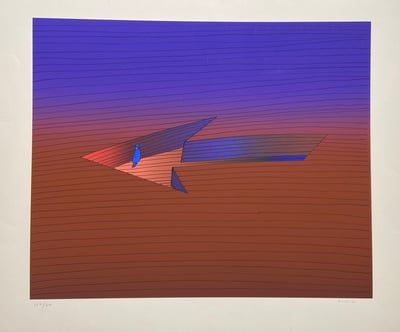
// Jean-Michel Folon’s Je vous écris de Coney Island (1986) is a silkscreen print that captures a surreal, dreamlike perspective on an iconic location. Set against a deep, twilight-blue sky, the composition depicts a series of intersecting lines and structures that recede into the distance, converging toward a focal point in the center. Beams of light in soft gradients of white, yellow, and green intersect with the lines, creating a sense of depth and movement. Folon’s work often explores themes of isolation and connection, and here, the abstract representation of a distant bridge or structure evokes a journey or a message from afar. The print's ethereal quality invites viewers to contemplate distance, memory, and the passage of time.
Jean-Michel Folon (Belgium, 1934–2005) was a celebrated illustrator, painter, and sculptor known for his dreamlike imagery. Using soft colors and surreal compositions, his works often depicted solitary figures, expansive landscapes, and themes of freedom, humanity, and nostalgia.
Silkscreen Silkscreen is a printmaking method that uses a screen made of silk or other mesh fabric. The screen is treated with a substance that blocks ink in certain areas, allowing ink to pass through only in the desired sections. Each color in the print requires a separate screen.
// Jean-Michel Folon’s Je vous écris de Coney Island (1986) is a silkscreen print that captures a surreal, dreamlike perspective on an iconic location. Set against a deep, twilight-blue sky, the composition depicts a series of intersecting lines and structures that recede into the distance, converging toward a focal point in the center. Beams of light in soft gradients of white, yellow, and green intersect with the lines, creating a sense of depth and movement. Folon’s work often explores themes of isolation and connection, and here, the abstract representation of a distant bridge or structure evokes a journey or a message from afar. The print's ethereal quality invites viewers to contemplate distance, memory, and the passage of time.
Jean-Michel Folon (Belgium, 1934–2005) was a celebrated illustrator, painter, and sculptor known for his dreamlike imagery. Using soft colors and surreal compositions, his works often depicted solitary figures, expansive landscapes, and themes of freedom, humanity, and nostalgia.
Contemporary artist Jean-Michel Folon attained notoriety in several different mediums, including painting, illustrating and sculpting. The Belgian-born Folon studied architecture at the Institut St. Luc in Brussels. He began his foray into the art world as a watercolor painter. Jean-Michel Folon’s first exhibition, which took place at the Lefebre Gallery in New York City in 1969 was in that style. However, as Folon's career took off, he moved into etching, silkscreen, illustrations, mosaics and stained glass. Jean-Michel Folon participated in the twenty-fifth Venice Biennele, a bi-annual celebration at which contemporary artists, dancers, architects and stage performers from around the world gather to share their work. Several internationally-renowned museums have dedicated exhibitions to Folon, including the Musee des Arts Decoratifs in Paris, France; the Museo Correr in Venice, Italy; and the Museum of Modern Art (MoMA) in New York City. One of his famous works is 'The Feast,' completed in 1983. Folon published drawings in a number of American newspapers. In addition,his illustrations have been featured in works by famous authors, such as Franz Kafka, Ray Bradbury, Jorge Luis Borges and AlbertCamus. Jean-Michel Folon was named a UNICEF Ambassador in 2004 and died the following year at age 71. (Artist website)
Naïve art describes a style of artwork that is simple and unsophisticated, often created by artists without formal training in an academy or art school. The style is characterized by a lack of advanced techniques, giving it a childlike appearance. Naïve art often features bright colors, simple shapes, and a straightforward approach to subject matter, reflecting the artist's untrained perspective.