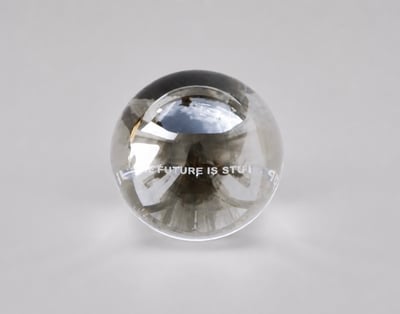
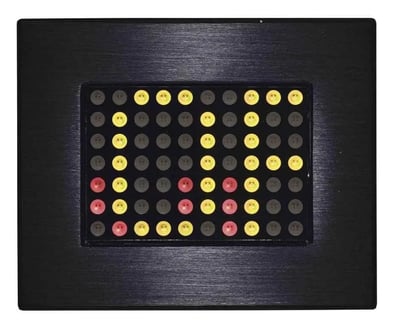
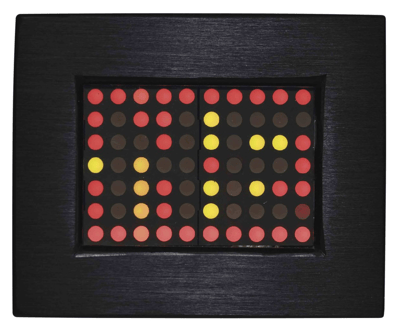
Truism 2 by Jenny Holzer, created between 1977 and 1979, is a mixed media sculpture featuring a mini electric LED sign with colored diodes. The grid of lights includes red, green, and yellow diodes arranged in a structured pattern, set against a black background within a minimalist black frame. Holzer’s use of LED technology reflects her focus on blending text, light, and modern communication methods to provoke thought on societal issues. The repetition and rhythm of the lights create a coded visual experience that challenges the viewer to engage with the deeper meaning behind the seemingly simple composition, emblematic of Holzer's conceptual approach.
Jenny Holzer (United States, 1950) is an American conceptual artist renowned for her text-based works that challenge societal norms and provoke thought. Utilizing mediums like LED displays, projections, and installations, she presents powerful messages in public spaces, addressing themes such as power, violence, and oppression. Holzer's art transforms language into a visual experience, engaging audiences worldwide.
Mixed MediaMixed media refers to artwork that incorporates more than one medium within a single piece. Unlike multimedia art, which combines distinct forms of visual art and often includes elements like sound, video, or digital media, mixed media focuses on combining traditional art materials, such as paint, ink, and collage. Mixed media art allows artists to achieve a wide range of effects and textures by layering and blending different materials.
Truism 2 by Jenny Holzer, created between 1977 and 1979, is a mixed media sculpture featuring a mini electric LED sign with colored diodes. The grid of lights includes red, green, and yellow diodes arranged in a structured pattern, set against a black background within a minimalist black frame. Holzer’s use of LED technology reflects her focus on blending text, light, and modern communication methods to provoke thought on societal issues. The repetition and rhythm of the lights create a coded visual experience that challenges the viewer to engage with the deeper meaning behind the seemingly simple composition, emblematic of Holzer's conceptual approach.
Jenny Holzer (United States, 1950) is an American conceptual artist renowned for her text-based works that challenge societal norms and provoke thought. Utilizing mediums like LED displays, projections, and installations, she presents powerful messages in public spaces, addressing themes such as power, violence, and oppression. Holzer's art transforms language into a visual experience, engaging audiences worldwide.
Jenny Holzer belongs to the neo-conceptual school of artists. Text is the basis for her work. With her first celebrated series, entitled “Truisms”, which began in 1977, she plastered Times Square and lower Manhattan with photostats of hand-typed one-liners intended to amuse, provoke and entertain. At a time when New York was going through a transitional time of rising crime, skyrocketing prices, and high unemployment, Holzer brought art out of the gallery and onto the street.
Holzer’s art was always directed to the common person, the individual strolling down the street or looking up at a billboard. The messages varied from quirky phrases to serious, thought-provoking statements concerning timely topics.
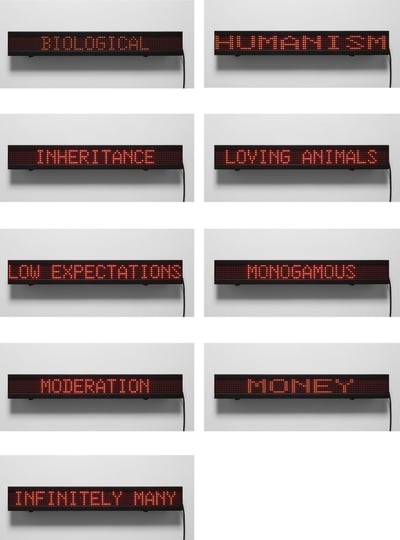
In addition to print art, Jenny Holzer employed LED lights, Neon Signs, and scrolling marquees during her most prolific period the late 1970s and early 1980s.
“Truisms” can still be found widely distributed with Holzer’s messages printed on ball caps, tee shirts, and posters.
Minimalism is a style in music and visual arts characterized by pared-down designs and simplicity. It began in Western art after World War II, gaining prominence particularly in American visual arts. Minimalism draws heavily on aspects of modernism and is often viewed as a reaction against Abstract Expressionism, as well as a precursor to post-minimal art practices. Prominent minimalist artists include Agnes Martin, Donald Judd, Robert Morris, Frank Stella, and Dan Flavin.