

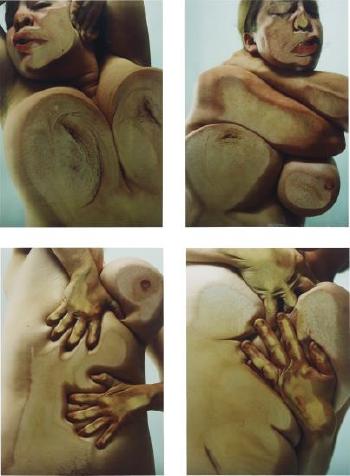
The complete set of four c-prints, on matt photo paper mounted to mount board (as issued). All prints signed, annotated 'A'-'D' respectively and numbered in black marker on the reverse
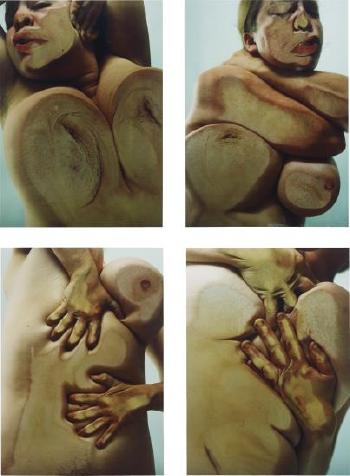
Close Contact by Jenny Saville, a set of four C-prints from 2002, delves into the raw and corporeal aspects of the human body, challenging conventional ideas of beauty and form. Each image presents close-up perspectives of the female form, with exaggerated and distorted flesh, as hands press and manipulate the skin in a tactile exploration of texture and weight. Saville’s focus on the body as a visceral, almost sculptural entity emphasizes both vulnerability and strength, with a focus on the physicality that is often hidden or minimized in mainstream representations. The work invites viewers to confront their perceptions of the body, as Saville's intense, almost confrontational approach to depicting flesh and form imbues each piece with an unsettling yet compelling intimacy. This set, part of a limited edition of 25, showcases Saville’s commitment to exploring the complexity of human form with unflinching realism.
Artwork Copyright © Jenny SavilleJenny Saville (United Kingdom, 1970) is a contemporary painter renowned for her large-scale depictions of the female form. A member of the Young British Artists, she challenges traditional representations of the body through her expressive brushwork and exploration of flesh. Her work is featured in major collections worldwide.
Artwork Copyright © Jenny SavilleClose Contact, 2002
Form
Medium
Size
- Inches
- Centimeters
Edition
Price
Available works →
- Authenticity Guaranteed
- Insured Shipping
- Online Since 2005
●
●Inventory 4056
●Signed
●Comes with gallery invoice and certificate
●Sell Us a Similar Artwork. Learn more.
The complete set of four c-prints, on matt photo paper mounted to mount board (as issued). All prints signed, annotated 'A'-'D' respectively and numbered in black marker on the reverse
Close Contact by Jenny Saville, a set of four C-prints from 2002, delves into the raw and corporeal aspects of the human body, challenging conventional ideas of beauty and form. Each image presents close-up perspectives of the female form, with exaggerated and distorted flesh, as hands press and manipulate the skin in a tactile exploration of texture and weight. Saville’s focus on the body as a visceral, almost sculptural entity emphasizes both vulnerability and strength, with a focus on the physicality that is often hidden or minimized in mainstream representations. The work invites viewers to confront their perceptions of the body, as Saville's intense, almost confrontational approach to depicting flesh and form imbues each piece with an unsettling yet compelling intimacy. This set, part of a limited edition of 25, showcases Saville’s commitment to exploring the complexity of human form with unflinching realism.
Artwork Copyright © Jenny SavilleJenny Saville (United Kingdom, 1970) is a contemporary painter renowned for her large-scale depictions of the female form. A member of the Young British Artists, she challenges traditional representations of the body through her expressive brushwork and exploration of flesh. Her work is featured in major collections worldwide.
Artwork Copyright © Jenny Saville- Recently Added
- Price (Low-High)
- Price (High-Low)
- Year (Low-High)
- Year (High-Low)
Jenny Saville
Close Contact, 2002
Photography
C-Print
Currently Not Available
Related Artists

Artwork by Alex Katz
What is figurative art?
Sometimes known as Figurativism, figurative art refers to sculptures and paintings that are clearly or specifically derived from real objects, making them representational. The term figurative art is often used in contrast to abstract art. However, since the emergence of abstract art, figurative art has come to describe any form of modern art that has strong references to the real world or actual situations.

Jenny Saville
Close Contact, 2002
39 x 29 cm


