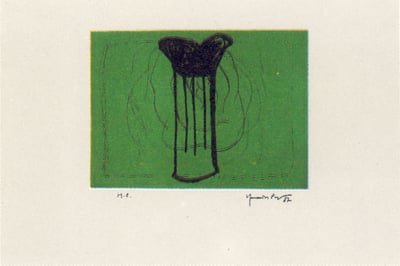
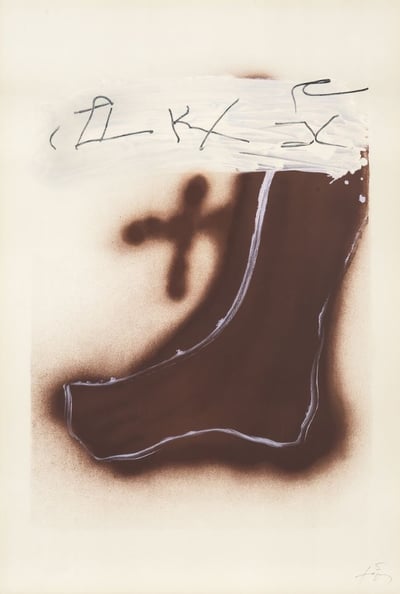
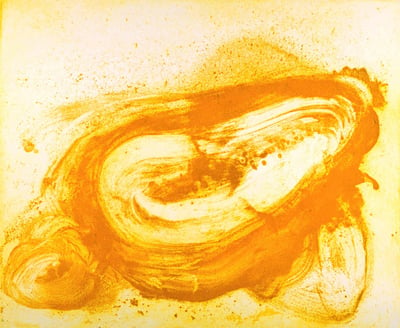
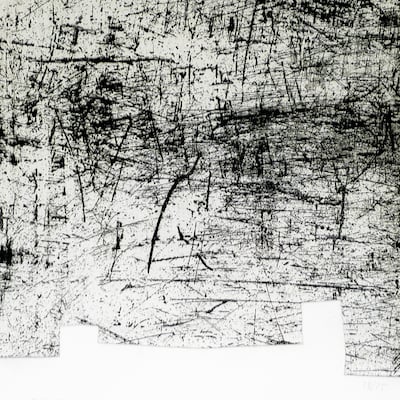
Catedral ocre by Joan Hernández Pijuan is a 1987 aquatint and drypoint print, rendered with minimalist precision. This artwork features a simple rectangular frame outlined in deep black against a warm ochre background. The top of the rectangle is marked by an irregular, jagged black form, resembling the pointed arches or spires of a cathedral, invoking architectural imagery with restrained abstraction. Hernández Pijuan often explored the intersection between form and emptiness, using minimal lines to evoke deep spatial contemplation. This piece, measuring 38 cm by 29 cm, emphasizes the balance between structure and void, inviting viewers to reflect on themes of space, architecture, and the sacred within simplicity.
Joan Hernández Pijuan (Spain, 1931–2005) was a Spanish painter and printmaker associated with the Art Informel movement. His work is characterized by minimalist compositions, often featuring solitary objects against monochromatic backgrounds, exploring themes of space and silence. Hernández Pijuan's art reflects a deep connection to the Catalan landscape, emphasizing simplicity and introspection.
AquatintIntaglio is a printmaking technique where the artist creates marks on a metal plate that hold ink or dye. The inked plate is then pressed onto paper, transferring the ink to the sheet. This process can be repeated multiple times depending on the technique. Intaglio methods, such as etching, often involve applying a mordant (acid) to the metal plate to create the design. Intaglio encompasses various techniques, including engraving, etching, and drypoint.
Catedral ocre by Joan Hernández Pijuan is a 1987 aquatint and drypoint print, rendered with minimalist precision. This artwork features a simple rectangular frame outlined in deep black against a warm ochre background. The top of the rectangle is marked by an irregular, jagged black form, resembling the pointed arches or spires of a cathedral, invoking architectural imagery with restrained abstraction. Hernández Pijuan often explored the intersection between form and emptiness, using minimal lines to evoke deep spatial contemplation. This piece, measuring 38 cm by 29 cm, emphasizes the balance between structure and void, inviting viewers to reflect on themes of space, architecture, and the sacred within simplicity.
Joan Hernández Pijuan (Spain, 1931–2005) was a Spanish painter and printmaker associated with the Art Informel movement. His work is characterized by minimalist compositions, often featuring solitary objects against monochromatic backgrounds, exploring themes of space and silence. Hernández Pijuan's art reflects a deep connection to the Catalan landscape, emphasizing simplicity and introspection.
Known for his simple and primitive compositions, Pijuan did not conform to art movements or trends. His art is based on passion, not political or societal critique, and employs abstraction, primitivism and expressionism. Having studied etching and lithography in Paris, his work adapted a geometric configuration that remained prominent until his return to informalism in the 1980s. With his traditionalist approach to artwork, he generally used oil on canvas, or pencil, ink, gouache or charcoal on paper. Landscapes and nature are common features throughout Joan Hernández Pijuan’s works. Although he refused to be called an abstract artist – or an artist for that matter – his landscapes are unmistakably abstract. His later works’ chromatism is reduced to black, white, green or ochre, and every detail is necessary. In the mid 1950s, Joan Hernández Pijuan co-founded the Silex Group, a group dedicated to exploring the connection between contemporary art and primitive convention. He became dean of the Department of Fine Arts University of Barcelona in 1992, and died in Barcelona at the age of seventy-four. Retrospectives have been held at the National Centre de Arte Reina Sofia in Madrid, Spain, and the Museum of Modern Art in Moscow, Russia. (Artist website)
Abstract art uses form, shape, line, and color to create a visual experience without attempting to represent external reality. The composition exists independently of the world's visual references, focusing on expressing ideas and emotions through non-representational means.