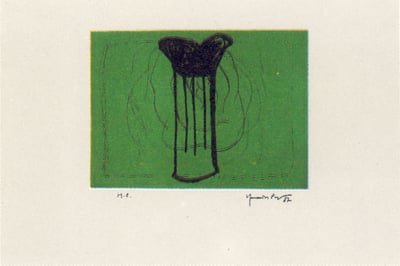
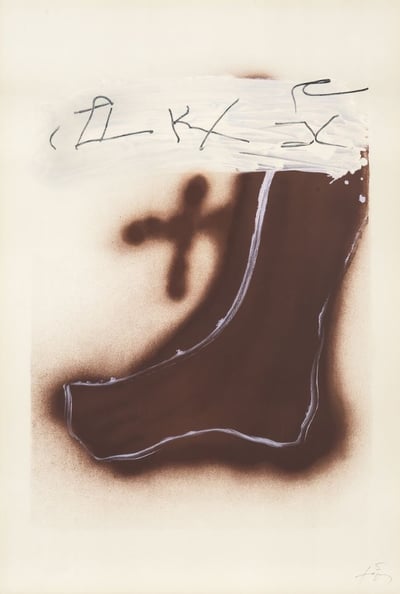
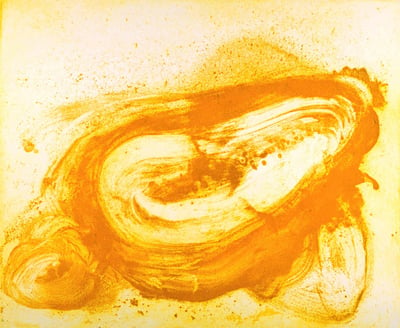
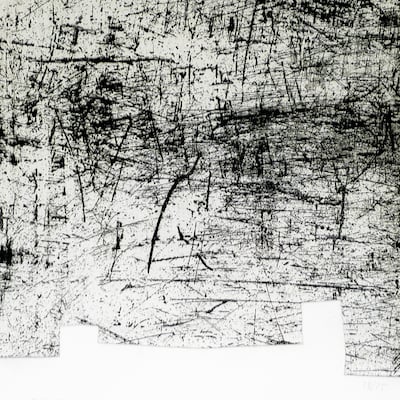
// Colors per un Paisatge by Joan Hernandez Pijuan is a lithograph created in 2004. This limited edition print presents an abstract composition that suggests a minimalist landscape. The central black form, reminiscent of plowed earth or undulating terrain, dominates the piece with its textured horizontal lines. Above it is a smooth ochre shape, possibly symbolizing the sun or sky, while below is a bold red form that could evoke the ground or foundation. Pijuan’s work is noted for exploring themes of space, memory, and nature through abstract forms, often evoking a sense of tranquility and contemplation.
Joan Hernández Pijuan (Spain, 1931–2005) was a Spanish painter and printmaker associated with the Art Informel movement. His work is characterized by minimalist compositions, often featuring solitary objects against monochromatic backgrounds, exploring themes of space and silence. Hernández Pijuan's art reflects a deep connection to the Catalan landscape, emphasizing simplicity and introspection.
Lithograph Lithography is a printing method based on the principle that water and oil do not mix. It can be used to print artwork or text onto paper or other suitable materials. Traditionally, an image was drawn with wax, fat, or oil onto a lithographic limestone surface or plate. Today, metal plates and other surfaces are also used in lithographic printing.
// Colors per un Paisatge by Joan Hernandez Pijuan is a lithograph created in 2004. This limited edition print presents an abstract composition that suggests a minimalist landscape. The central black form, reminiscent of plowed earth or undulating terrain, dominates the piece with its textured horizontal lines. Above it is a smooth ochre shape, possibly symbolizing the sun or sky, while below is a bold red form that could evoke the ground or foundation. Pijuan’s work is noted for exploring themes of space, memory, and nature through abstract forms, often evoking a sense of tranquility and contemplation.
Joan Hernández Pijuan (Spain, 1931–2005) was a Spanish painter and printmaker associated with the Art Informel movement. His work is characterized by minimalist compositions, often featuring solitary objects against monochromatic backgrounds, exploring themes of space and silence. Hernández Pijuan's art reflects a deep connection to the Catalan landscape, emphasizing simplicity and introspection.
Known for his simple and primitive compositions, Pijuan did not conform to art movements or trends. His art is based on passion, not political or societal critique, and employs abstraction, primitivism and expressionism. Having studied etching and lithography in Paris, his work adapted a geometric configuration that remained prominent until his return to informalism in the 1980s. With his traditionalist approach to artwork, he generally used oil on canvas, or pencil, ink, gouache or charcoal on paper. Landscapes and nature are common features throughout Joan Hernández Pijuan’s works. Although he refused to be called an abstract artist – or an artist for that matter – his landscapes are unmistakably abstract. His later works’ chromatism is reduced to black, white, green or ochre, and every detail is necessary. In the mid 1950s, Joan Hernández Pijuan co-founded the Silex Group, a group dedicated to exploring the connection between contemporary art and primitive convention. He became dean of the Department of Fine Arts University of Barcelona in 1992, and died in Barcelona at the age of seventy-four. Retrospectives have been held at the National Centre de Arte Reina Sofia in Madrid, Spain, and the Museum of Modern Art in Moscow, Russia. (Artist website)
Abstract art uses form, shape, line, and color to create a visual experience without attempting to represent external reality. The composition exists independently of the world's visual references, focusing on expressing ideas and emotions through non-representational means.