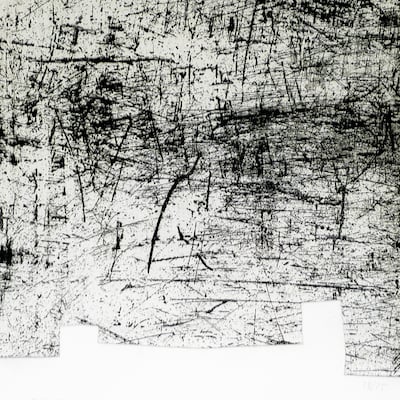
Relief print from letterpress plate on Italian mould-made Revere paper
- Signed and numbered on the front
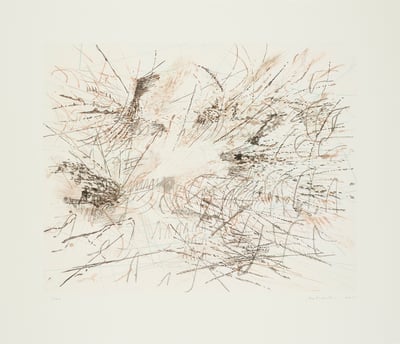
Julie Mehretu's 'Sapphic Strophe 1' is a relief print from her 2011 suite 'Sapphic Strophes', blending abstraction with the energy of gestural mark-making. The artwork features a dynamic arrangement of fine, linear marks on a stark white background, evoking a sense of rhythm and movement akin to poetry in visual form. The delicate, layered strokes seem to reference fragmented scripts or maps, inviting interpretations of language, geography, and identity. The minimalistic yet profound composition reflects Mehretu's interest in the intersection of personal and collective histories. Signed and numbered, the work showcases her meticulous craftsmanship and conceptual depth.
Julie Mehretu (Ethiopia/USA, 1970) is a renowned contemporary artist known for her dynamic, multilayered abstract paintings. Drawing on architecture, history, and geopolitics, her works fuse gestural marks with complex, map-like compositions. Mehretu’s art captures the chaos and energy of urban life, making her a significant voice in global contemporary art.
Relief printingRelief printing is a printmaking process where the design to be printed is etched or cut into a surface, leaving only the raised areas to transfer ink. The non-printing areas are removed, so only the design is inked and printed. Common relief printing techniques include woodcut, linocut, and wood engraving.
Relief print from letterpress plate on Italian mould-made Revere paper
- Signed and numbered on the front
Julie Mehretu's 'Sapphic Strophe 1' is a relief print from her 2011 suite 'Sapphic Strophes', blending abstraction with the energy of gestural mark-making. The artwork features a dynamic arrangement of fine, linear marks on a stark white background, evoking a sense of rhythm and movement akin to poetry in visual form. The delicate, layered strokes seem to reference fragmented scripts or maps, inviting interpretations of language, geography, and identity. The minimalistic yet profound composition reflects Mehretu's interest in the intersection of personal and collective histories. Signed and numbered, the work showcases her meticulous craftsmanship and conceptual depth.
Julie Mehretu (Ethiopia/USA, 1970) is a renowned contemporary artist known for her dynamic, multilayered abstract paintings. Drawing on architecture, history, and geopolitics, her works fuse gestural marks with complex, map-like compositions. Mehretu’s art captures the chaos and energy of urban life, making her a significant voice in global contemporary art.
I always wanted to be an artist, but I didn't really know how someone could make a life out of it.
- Julie Mehretu
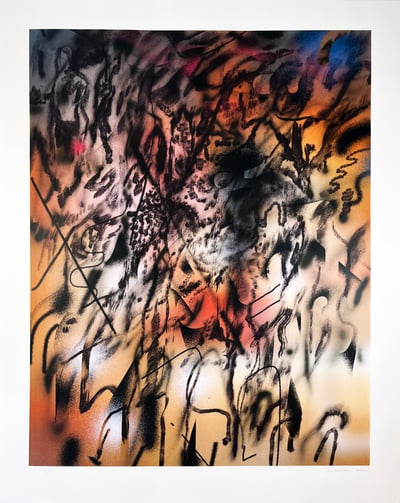
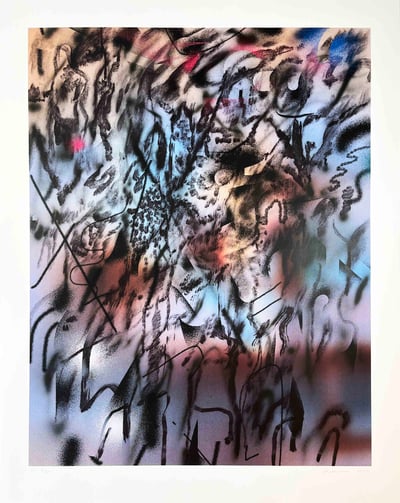
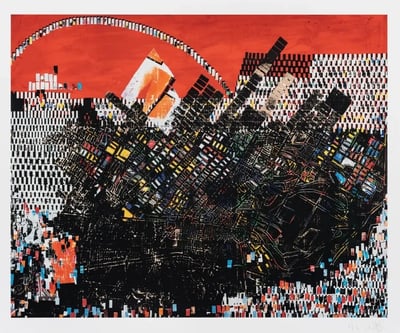
Born in Ethiopia, Michigan painter Julie Mehretu rose out of obscurity after 2000 with her abstract cityscapes that encompass history and geography into their wild yet intricate layers. Mehretu's paintings are generally large in scale and feature frenetic outlines and cross-sections of known or unknown cities in concrete gray tones. These "blueprints" are extensively overlapped by bold, often colorful lines and geometric shapes that appear to dash across, curve around, or burst through the canvas. The dynamic lines suggest the movement of objects and time, as Mehretu attempts to compress the complex history and numerous elements of "place" -- whether the place is historic or futuristic, real or imaginary -- into each two-dimensional image using traditional pencil, pen, and acrylic paint. Mehretu applies the layers of paint with tools equally varied: hands, brushes, towels, and so on.With the abstract expressionist artist as city planner, these multilayered plans or maps of cities come to resemble even more so the graffitiubiquitous to the urban landscape. Mehretu received an MFA from Rhode Island School of Design in Rhode Island.Two of her largest works, "Empiricial Construction, Istanbul" (which measures 10 feet by 15 feet) and "Mural" (23 feet by 80 feet) are housed at the Museum of Modern Art and at Goldman Sachs, respectively, in New York.
Abstract art uses form, shape, line, and color to create a visual experience without attempting to represent external reality. The composition exists independently of the world's visual references, focusing on expressing ideas and emotions through non-representational means.