

Drypoint, on Chine collé to Hahnemühle Copperplate paper.
Signed, numbered and dated on the front.
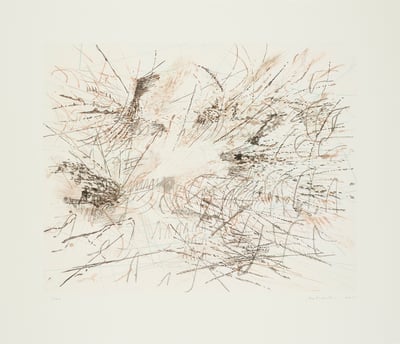
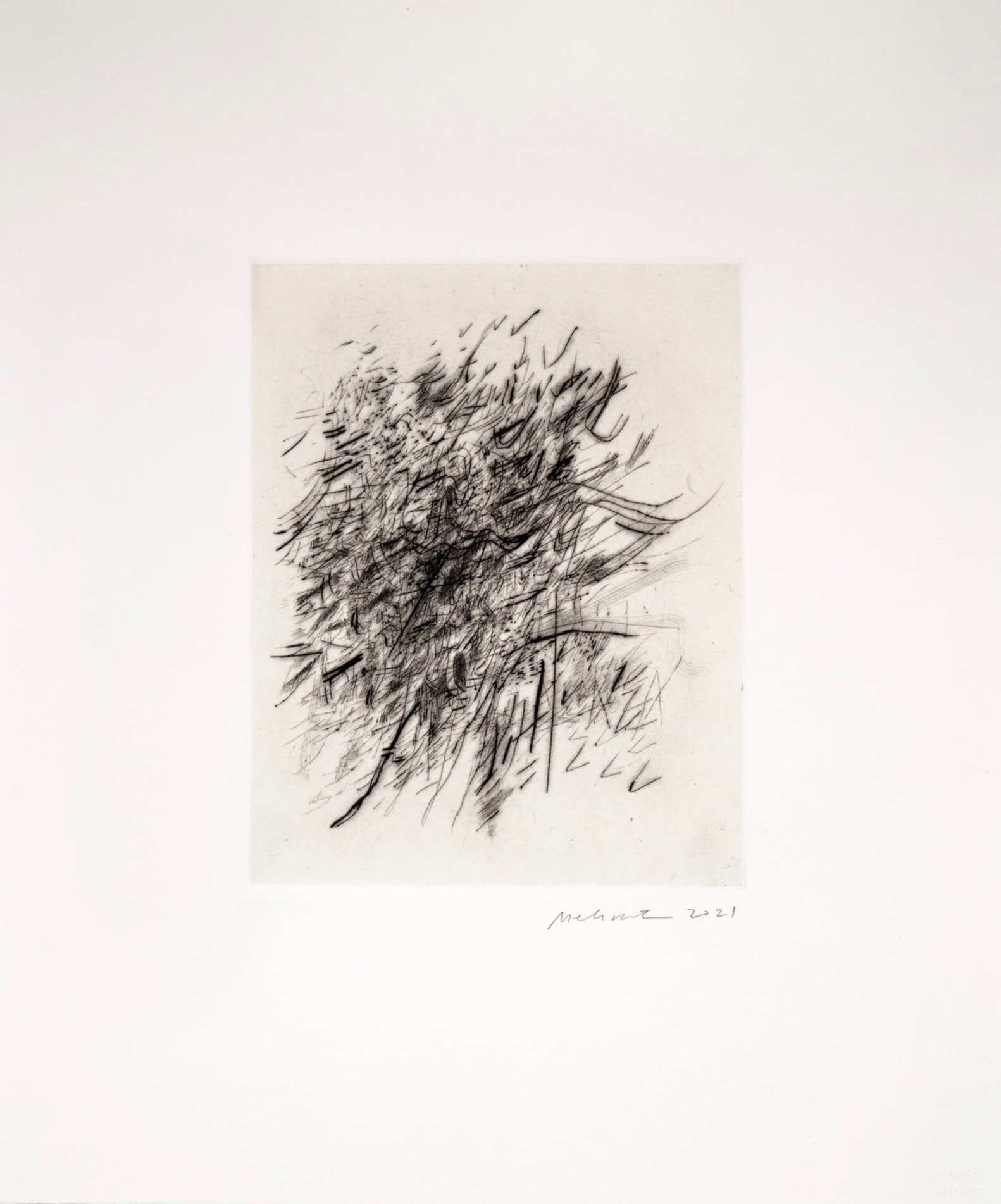
Amulet in Crowd (2021) by Julie Mehretu is a drypoint print on Chine collé mounted to Hahnemühle Copperplate paper, measuring 48.3 x 40.6 cm and produced in an edition of 35. The composition consists of a dense cluster of gestural marks and abstract forms, evoking a sense of movement, tension, and layered presence. Mehretu’s signature line work suggests both chaos and structure—an interplay of forces within a confined space. The piece appears as a visual "amulet," charged with energy, complexity, and potential meaning. Signed, numbered, and dated on the front, this print captures Mehretu's dynamic approach to drawing as a form of spatial thinking.
Artwork Copyright © Julie MehretuJulie Mehretu (Ethiopia/USA, 1970) is a renowned contemporary artist known for her dynamic, multilayered abstract paintings. Drawing on architecture, history, and geopolitics, her works fuse gestural marks with complex, map-like compositions. Mehretu’s art captures the chaos and energy of urban life, making her a significant voice in global contemporary art.
Artwork Copyright © Julie MehretuAmulet in Crowd, 2021
Form
Medium
Size
- Inches
- Centimeters
Edition
Price
- USD
- EUR
- GBP
- CHF
- Authenticity Guaranteed
- Insured Shipping
- Online Since 2005
●Inventory 16535
●Signed
●Comes with gallery invoice and certificate
●Sell Us a Similar Artwork. Learn more.
Drypoint, on Chine collé to Hahnemühle Copperplate paper.
Signed, numbered and dated on the front.
Amulet in Crowd (2021) by Julie Mehretu is a drypoint print on Chine collé mounted to Hahnemühle Copperplate paper, measuring 48.3 x 40.6 cm and produced in an edition of 35. The composition consists of a dense cluster of gestural marks and abstract forms, evoking a sense of movement, tension, and layered presence. Mehretu’s signature line work suggests both chaos and structure—an interplay of forces within a confined space. The piece appears as a visual "amulet," charged with energy, complexity, and potential meaning. Signed, numbered, and dated on the front, this print captures Mehretu's dynamic approach to drawing as a form of spatial thinking.
Artwork Copyright © Julie MehretuJulie Mehretu (Ethiopia/USA, 1970) is a renowned contemporary artist known for her dynamic, multilayered abstract paintings. Drawing on architecture, history, and geopolitics, her works fuse gestural marks with complex, map-like compositions. Mehretu’s art captures the chaos and energy of urban life, making her a significant voice in global contemporary art.
Artwork Copyright © Julie MehretuAvailability
Size
Medium
SORT BY
Julie Mehretu
Untitled (Pulse), 2013
Limited Edition Print
Lithograph
GBP 7,500 - 9,700

Julie Mehretu
Amulet in Crowd, 2021
Limited Edition Print
Drypoint
GBP 7,140
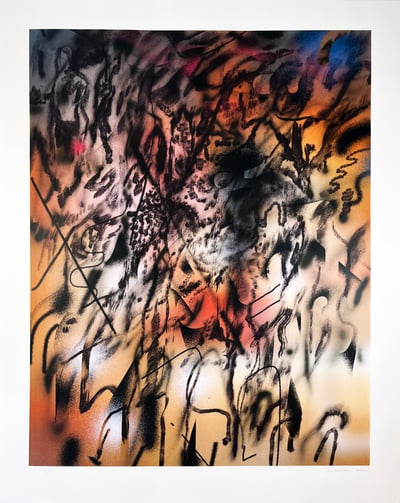
Julie Mehretu
Corner of Lake and Minnehaha, 2022
Limited Edition Print
Screen-print
USD 65,000 - 80,000
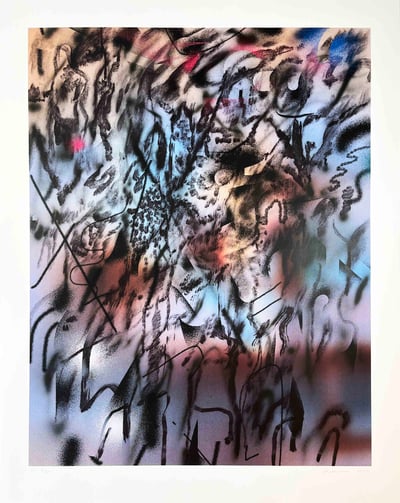
Julie Mehretu
Corner of Lake and Minnehaha (blue), 2022
Limited Edition Print
Screen-print
USD 70,000 - 80,000

Julie Mehretu
Sapphic Strophe 2 (from Sapphic Strophes: A Suite of Four Prints), 2011
Limited Edition Print
Relief printing
Currently Not Available

Julie Mehretu
Among the Multitude III, 2021
Limited Edition Print
Digital print on canvas
Currently Not Available
Related Artists
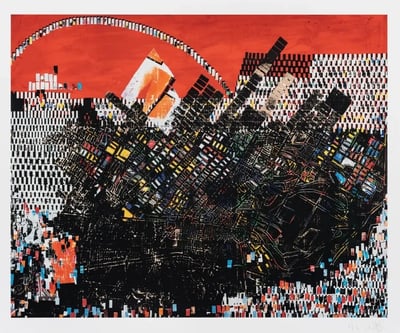


Artwork by Eduardo Chillida
What is abstract art?
Abstract art uses form, shape, line, and color to create a visual experience without attempting to represent external reality. The composition exists independently of the world's visual references, focusing on expressing ideas and emotions through non-representational means.

Julie Mehretu
Amulet in Crowd, 2021
48.3 x 40.6 cm


