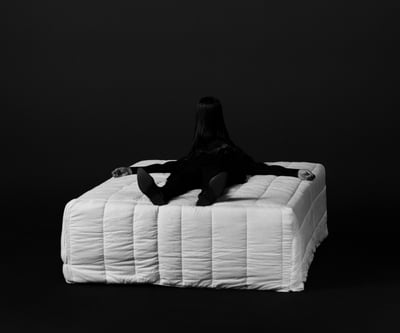
This artwork features a surreal and unsettling composition: a figure lies face-down on a stark white mattress, arms and legs extended in a cruciform position. The figure is clad entirely in black, contrasting sharply with the pristine, geometric form of the mattress. The obscured face and long hair evoke a sense of anonymity, mystery, and loss of identity, while the minimalistic black and white palette heightens the emotional tension. The title Attraktiver Attraktor (Attractive Attractor) hints at themes of duality, attraction, and contradiction, core concepts in Klauke’s exploration of the human condition and existential isolation. The photograph challenges conventional depictions of the body, space, and psychological states, consistent with the artist’s provocative, conceptual practice.
Jürgen Klauke (Germany, 1943) is a pioneering photographer and performance artist known for his exploration of identity, gender, and the human condition. His staged, conceptual photographs often challenge societal norms and blur the boundaries between art and life. A central figure in contemporary art, Klauke’s work is both provocative and introspective.
Lambda printA Lambda print is produced using a Lambda laser printer, a technology developed by the Durst company. The Durst Lambda was one of the first printers to use digital laser technology to create archival-quality prints. This process, also known as a Lambda c-type print, involves exposing photographic paper to laser light, resulting in high-quality, long-lasting images.
This artwork features a surreal and unsettling composition: a figure lies face-down on a stark white mattress, arms and legs extended in a cruciform position. The figure is clad entirely in black, contrasting sharply with the pristine, geometric form of the mattress. The obscured face and long hair evoke a sense of anonymity, mystery, and loss of identity, while the minimalistic black and white palette heightens the emotional tension. The title Attraktiver Attraktor (Attractive Attractor) hints at themes of duality, attraction, and contradiction, core concepts in Klauke’s exploration of the human condition and existential isolation. The photograph challenges conventional depictions of the body, space, and psychological states, consistent with the artist’s provocative, conceptual practice.
Jürgen Klauke (Germany, 1943) is a pioneering photographer and performance artist known for his exploration of identity, gender, and the human condition. His staged, conceptual photographs often challenge societal norms and blur the boundaries between art and life. A central figure in contemporary art, Klauke’s work is both provocative and introspective.
My body is a surface that many of the personalities and gender roles are being projected, and are transferred to the level of art.
- Jurgen Klauke
Jürgen Klauke is an influential photographer, widely attributed as being one of the first to be involved in Performance Art. He has contributed significantly to the development of photography as contemporary art. His avant-garde and actionist images focus on the human body in staged settings, which often appear surreal. Jürgen Klauke studied at the Werkschulen in Cologne and, from 1964 to 1970, he taught photography and art in Kassel. In the 1970s Jürgen Klauke’s photographic images were based around his own body and his performances. In a series of large-scale images he challenged what was at that time a traditional view of sexual identity and opposed social expectations of behavior. There was a darker mood revealed in many of his photography of the early 1980s and in the late 1980s he began a series of x-ray images of his own body. Some of his art deals with how physical identity and self awareness are constantly under threat from what is portrayed in the media and other outside influences. His series Aesthetic Paranoia is a pictorial analogy of the self obscured and bound by paranoia, sometimes becoming entangled with it. Jürgen Klauke has had a profound influence on the art of the late twentieth and early twenty-first-century. From 1993 to 2008, he was a professor at the Art Academy of Media in Cologne. (Artist website)
Minimalism is a style in music and visual arts characterized by pared-down designs and simplicity. It began in Western art after World War II, gaining prominence particularly in American visual arts. Minimalism draws heavily on aspects of modernism and is often viewed as a reaction against Abstract Expressionism, as well as a precursor to post-minimal art practices. Prominent minimalist artists include Agnes Martin, Donald Judd, Robert Morris, Frank Stella, and Dan Flavin.