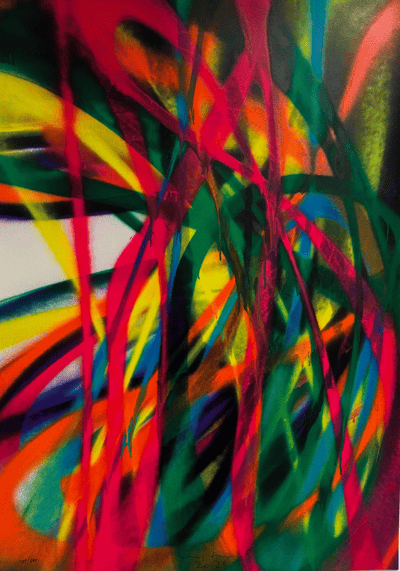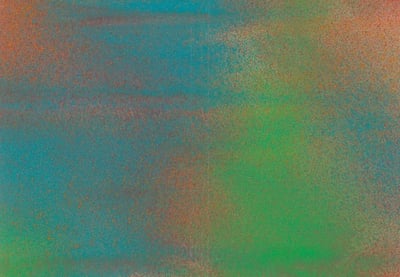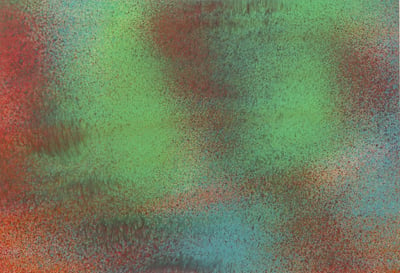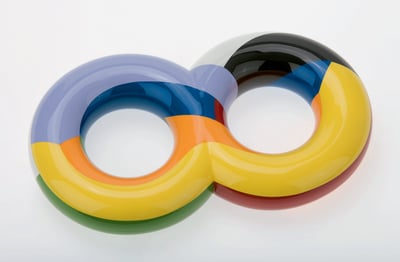
Katharina Grosse (Germany, 1961) is a German artist celebrated for her vibrant, large-scale installations and immersive paintings. Using spray guns, she transforms diverse surfaces like buildings, landscapes, and canvases into explosive fields of color. Grosse's work challenges the boundaries of painting, redefining it as an expansive, spatial experience.
Lithograph Lithography is a printing method based on the principle that water and oil do not mix. It can be used to print artwork or text onto paper or other suitable materials. Traditionally, an image was drawn with wax, fat, or oil onto a lithographic limestone surface or plate. Today, metal plates and other surfaces are also used in lithographic printing.
Katharina Grosse (Germany, 1961) is a German artist celebrated for her vibrant, large-scale installations and immersive paintings. Using spray guns, she transforms diverse surfaces like buildings, landscapes, and canvases into explosive fields of color. Grosse's work challenges the boundaries of painting, redefining it as an expansive, spatial experience.
About tricks that I play to myself or to others. I am the trickster, I guess.
- Katharina Grosse
Contemporary German artist Katharina Grosse, an abstract painter and sculptor, is best known for large, psychedelic installations that push the figurative and literal boundaries of painting. Using pigmented dirt and airbrushed acrylic paint, Grosse adheres to no canvas save the natural or man-made architecture above, below, and around her. The viewer, too, is meant to be absorbed into the piece rather than merely seeing it from a distance. Like the spirit behind their creation, Grosse's works convey a plethora of emotion, vibrancy, and movement. Before acquiring her current fame, Grosse studied for eight years at two German art academies, one of which now employs her as a professor. Influenced by fresco, en plein air painting, Abstract Expressionism, and graffiti art, she gained attention in the mid 1990's with her unconventional Color Field paintings, which were intentionally dirty and imperfect. She became known for her use of bold color rather than flawless brushwork to suggest form. As her ideas and talent grew in magnitude, so did her pieces. She upgraded from a brush on canvas to a broom on large sheets of paper and eventually to her signature industrial airbrush that suited her broad brushstrokes and imagination. In May 2014 in Philadelphia, Grosse completed a massive project entitled psychylustro, meant to be seen along the railway corridor by the thousands of passengers that ride the train. Bright swaths of color decorate passing features: massive orange-on-white streaks on an old warehouse, lime green smears on transportation infrastructures, and even a blanket of fuchsia over a young patch of trees and vegetation. Like most of her large installations, psychylustro is meant to erode and change over time. (Artist website)
Site-Specific Art is a form of artwork created to exist in a particular location, with the artist considering the site as an integral part of the creative process. Robert Irwin was a key figure in promoting this art form in California. Site-Specific Art emerged as a reaction against modernist objects, which were often portable, commodified, and confined to museum spaces. In contrast, Site-Specific Art is inherently tied to its location, challenging the traditional notions of art as a transportable and marketable commodity.