
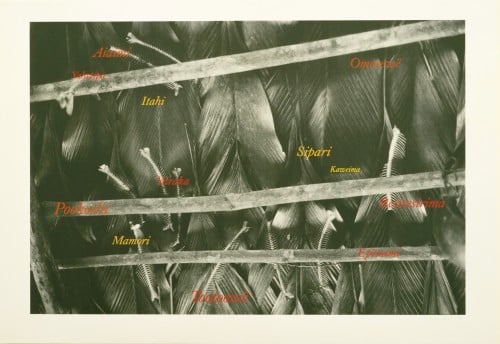
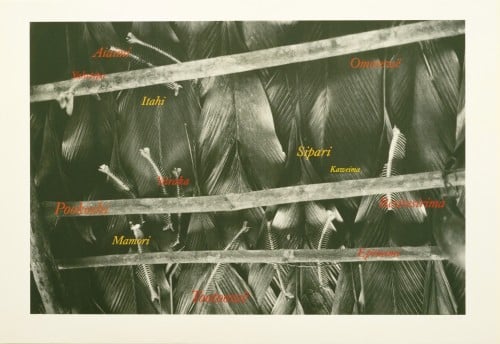
// Untitled (Fish) by Lothar Baumgarten, created in 1985, is a limited edition screen-print that combines natural imagery with textual elements, reflecting Baumgarten's interest in indigenous cultures and ecological themes. The print presents an abstracted image resembling fish or feather textures, layered with names of rivers or places in the Amazon Basin, written in a variety of colors across the composition. These words, including Sipari, Aitana, and Mamori, evoke a sense of geography and cultural context, grounding the natural imagery in a specific landscape. Baumgarten’s work often explores the intersection between nature and cultural identity, inviting viewers to reflect on the relationship between humanity and the environment. With an edition size of only 35, this piece encapsulates Baumgarten’s delicate balance of image and language, creating a contemplative, immersive experience.
Artwork Copyright © Lothar BaumgartenLothar Baumgarten (Germany, 1944–2018) was a German conceptual artist known for his installations and films that explored the intersections of culture and nature. His work often addressed themes of colonialism and indigenous cultures, notably through his time spent with the Yanomami people in the Amazon. Baumgarten's art challenged Western perceptions and highlighted the complexities of cultural representation.
Artwork Copyright © Lothar BaumgartenUntitled (Fish), 1985
Form
Medium
Size
- Inches
- Centimeters
Edition
Price
Available works →
- Authenticity Guaranteed
- Insured Shipping
- Online Since 2005
●
●Inventory 6863
●Signed
●Comes with gallery invoice and certificate
●Sell Us a Similar Artwork. Learn more.
// Untitled (Fish) by Lothar Baumgarten, created in 1985, is a limited edition screen-print that combines natural imagery with textual elements, reflecting Baumgarten's interest in indigenous cultures and ecological themes. The print presents an abstracted image resembling fish or feather textures, layered with names of rivers or places in the Amazon Basin, written in a variety of colors across the composition. These words, including Sipari, Aitana, and Mamori, evoke a sense of geography and cultural context, grounding the natural imagery in a specific landscape. Baumgarten’s work often explores the intersection between nature and cultural identity, inviting viewers to reflect on the relationship between humanity and the environment. With an edition size of only 35, this piece encapsulates Baumgarten’s delicate balance of image and language, creating a contemplative, immersive experience.
Artwork Copyright © Lothar BaumgartenLothar Baumgarten (Germany, 1944–2018) was a German conceptual artist known for his installations and films that explored the intersections of culture and nature. His work often addressed themes of colonialism and indigenous cultures, notably through his time spent with the Yanomami people in the Amazon. Baumgarten's art challenged Western perceptions and highlighted the complexities of cultural representation.
Artwork Copyright © Lothar Baumgarten- Recently Added
- Price (Low-High)
- Price (High-Low)
- Year (Low-High)
- Year (High-Low)

Lothar Baumgarten
Untitled (Fish), 1985
Limited Edition Print
Screen-print
Currently Not Available
Related Artists

Artwork by John Baldessari
What is conceptual art?
Sometimes referred to as Conceptualism, this is an art form where the idea(s) or concept(s) behind the work take precedence over material concerns and traditional aesthetics. Many conceptual artworks can be created by anyone simply by following written instructions. The concept or idea is the most essential aspect of the artwork.

Lothar Baumgarten
Untitled (Fish), 1985
80 x 115 cm


