

From the White Columns annual portfolio of prints. The portfolio consists of six individual silkscreen prints by LaKela Brown, Pam Glick, Marcus Jahmal, Louise Lawler, Sam Moyer, Rirkrit Tiravanija. All works are signed and numbered by the artists.
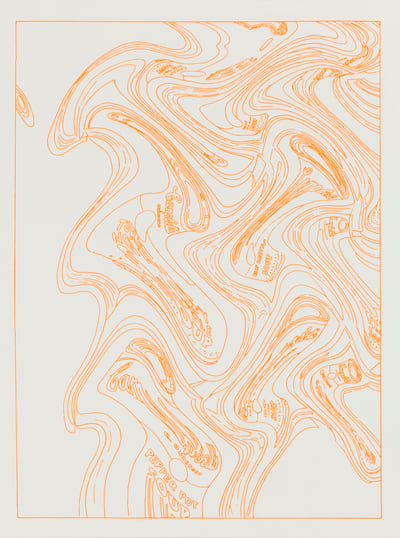
Untitled, created by Louise Lawler for the White Columns Print Portfolio in 2024, is a silkscreen that reflects the artist’s longstanding interest in questioning how artworks are presented, reproduced, and perceived. Composed of flowing orange contour lines on a white background, the image appears to dissolve and distort familiar visual references into an abstract, topographic pattern. Rather than presenting a fixed subject, Lawler encourages viewers to consider how meaning shifts through transformation, reproduction, and context. Since the late 1970s, her practice has explored the institutional life of art, examining the relationships between artworks, collectors, museums, and the art market. Published in an edition of 100, this print demonstrates her subtle yet conceptually rich approach to contemporary printmaking.
Artwork Copyright © Louise LawlerLouise Lawler (USA, 1947) is a conceptual artist and photographer associated with the Pictures Generation. She is renowned for her photographs of artworks in various settings—museums, auction houses, private homes—highlighting the influence of context on art's interpretation. Lawler's work critically examines the art world's presentation and consumption practices.
Artwork Copyright © Louise LawlerUntitled, from the White Columns Print Portfolio, 2024
Form
Medium
Size
- Inches
- Centimeters
Edition
Price
- USD
- EUR
- GBP
- CHF
- Authenticity Guaranteed
- Insured Shipping
- Online Since 2005
●Inventory 17676
●Signed
●Comes with gallery invoice and certificate
●Sell Us a Similar Artwork. Learn more.
From the White Columns annual portfolio of prints. The portfolio consists of six individual silkscreen prints by LaKela Brown, Pam Glick, Marcus Jahmal, Louise Lawler, Sam Moyer, Rirkrit Tiravanija. All works are signed and numbered by the artists.
Untitled, created by Louise Lawler for the White Columns Print Portfolio in 2024, is a silkscreen that reflects the artist’s longstanding interest in questioning how artworks are presented, reproduced, and perceived. Composed of flowing orange contour lines on a white background, the image appears to dissolve and distort familiar visual references into an abstract, topographic pattern. Rather than presenting a fixed subject, Lawler encourages viewers to consider how meaning shifts through transformation, reproduction, and context. Since the late 1970s, her practice has explored the institutional life of art, examining the relationships between artworks, collectors, museums, and the art market. Published in an edition of 100, this print demonstrates her subtle yet conceptually rich approach to contemporary printmaking.
Artwork Copyright © Louise LawlerLouise Lawler (USA, 1947) is a conceptual artist and photographer associated with the Pictures Generation. She is renowned for her photographs of artworks in various settings—museums, auction houses, private homes—highlighting the influence of context on art's interpretation. Lawler's work critically examines the art world's presentation and consumption practices.
Artwork Copyright © Louise Lawler- Recently Added
- Price (Low-High)
- Price (High-Low)
- Year (Low-High)
- Year (High-Low)
Louise Lawler
Untitled, from the White Columns Print Portfolio, 2024
Limited Edition Print
Silkscreen
USD 1,200

Louise Lawler
Twice Untitled (Traced and Painted), 2019
Drawing / Watercolor
Mixed Media
GBP 6,020

Louise Lawler
Pollyanna (adjusted to fit, distorted for the times, more), 2018
Photography
Digital Print on paper
GBP 1,225

Louise Lawler
Discernible Difference, 2010
Limited Edition Print
Inkjet print
Currently Not Available
Related Artists


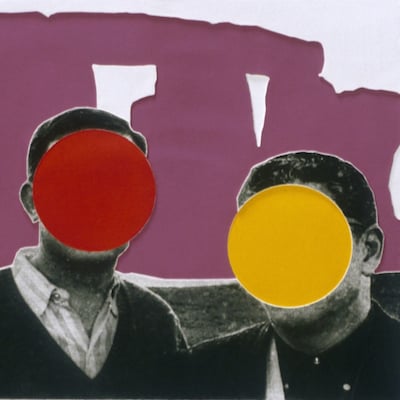
Artwork by John Baldessari
What is conceptual art?
Sometimes referred to as Conceptualism, this is an art form where the idea(s) or concept(s) behind the work take precedence over material concerns and traditional aesthetics. Many conceptual artworks can be created by anyone simply by following written instructions. The concept or idea is the most essential aspect of the artwork.

Louise Lawler
Untitled, from the White Columns Print Portfolio, 2024
37.1 x 27.9 cm


