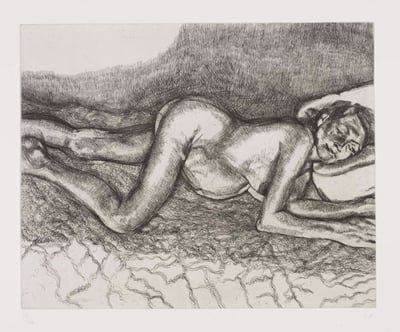
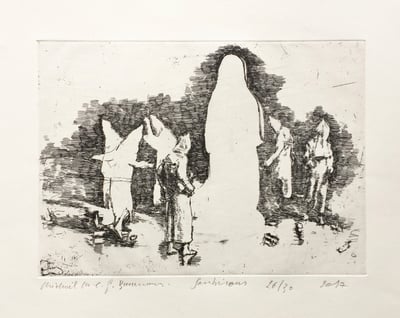
Archival pigment print on etching paper. Stamped by artist’s estate.
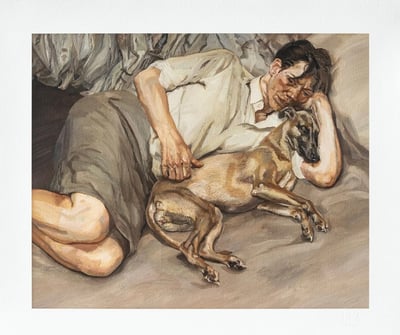
Double Portrait belongs to the mature phase of Lucian Freud's practice, when thick impasto and an unflinching scrutiny of flesh became the hallmarks of his portraiture. A woman in a white shirt sleeps curled on a daybed alongside a slender whippet, the two bodies intertwined in a state of mutual vulnerability. Muted earthy tones and rumpled cloth surround the pair, while the heavily worked paint surface conveys both physical weight and profound tenderness. The composition distils Freud's belief that paint must honour the living presence of its subjects.
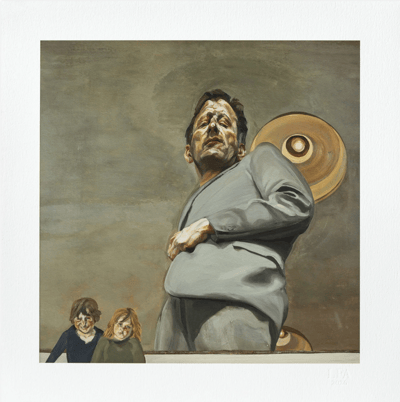
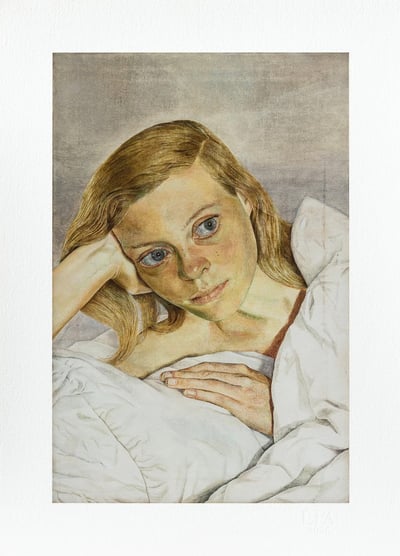
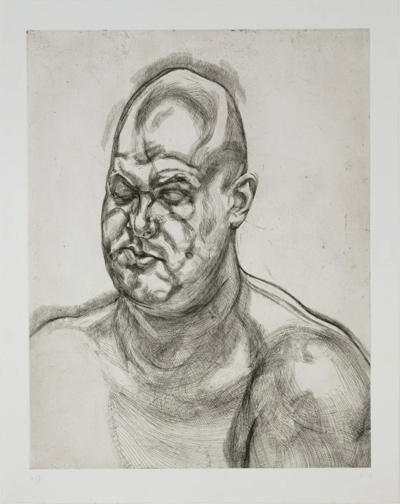
Lucian Freud (Germany/UK, 1922–2011) was a master of figurative painting known for his unflinching, intimate portraits. Using thick impasto and meticulous detail, he captured the physical and psychological essence of his subjects, redefining contemporary portraiture.
Archival PrintAn archival print refers to a fine art reproduction of museum quality, created using the highest quality materials and methods. These prints are produced on the finest papers and with inks specifically designed to resist color fading over time. Drawings and paintings are reproduced using a fine art printer with exceptionally high resolution, ensuring longevity and preservation of the artwork.
Archival pigment print on etching paper. Stamped by artist’s estate.
Double Portrait belongs to the mature phase of Lucian Freud's practice, when thick impasto and an unflinching scrutiny of flesh became the hallmarks of his portraiture. A woman in a white shirt sleeps curled on a daybed alongside a slender whippet, the two bodies intertwined in a state of mutual vulnerability. Muted earthy tones and rumpled cloth surround the pair, while the heavily worked paint surface conveys both physical weight and profound tenderness. The composition distils Freud's belief that paint must honour the living presence of its subjects.
Lucian Freud (Germany/UK, 1922–2011) was a master of figurative painting known for his unflinching, intimate portraits. Using thick impasto and meticulous detail, he captured the physical and psychological essence of his subjects, redefining contemporary portraiture.
I paint people not because of what they are like, not exactly in spite of what they are like, but how they happen to be.
- Lucian Freud
Lucien Freud was a German born painter, who grew up in England. He is highly regarded as one of the most important painters of portraits in the 20th century. His paintings reflect his reputation for being a very private man, as his subject matter primarily includes his family and friends. Freud is known to have painted using live models, and requiring very long and difficult sitting times with them. What resulted from the modeling sessions are paintings which have been described as somber, psychological interpretations of his relationships with his models. Lucien Freud was Sigmund Freud’s grandson. It is thought that Lucien’s paintings display an intensity derived from the comprehension Lucien gained of his subject’s physical and mental conditions during hours of modeling sessions. He required hundreds of hours to complete a nude painting, beginning with a charcoal drawing, adding paint to a small area, painting an initial version of the model’s head, and then returning to it after a lengthy time of interaction with the model. Lucien’s early works are influenced by German Expressionism and Surrealism. His portraits often depict his subjects in unusual settings, though retain the realism of figurative style even though abstract painting was extremely popular during the years he was working as an artist. Freuds work is admired for the wide range of flesh tones he created, using accumulated layers of thick impasto paint to focus on the textures of flesh and its colors. He focused on painted partial or full nudes for his mature works; such as Girl with a White Dog (1951-52). He referred to his work as autobiographical; painted purely about the places, people and things he cared about most. (Artist website)
Contemporary art refers to avant-garde or innovative art created in the recent past or present day. The exact starting point of contemporary art varies depending on the institution, often tied to the founding year of museums or galleries that showcase the style. Contemporary art is characterized by its focus on current ideas, diverse media, and the exploration of new concepts and techniques.